Wednesday, July 31, 2013

Tallinn, the start of a Baltic journey

In July 2013 I spent two weeks on the road, driving through the three Baltic countries, Estonia, Latvia and Lithuania, to explore the local food and beer culture as well as the long and interesting history of a region that has been under foreign rule for 700 years. This is the first post from the trip, and the focus is on Tallinn, the capital of Estonia, where my journey started.

Defensive towers in Tallinn's city wall

Getting there
Many visitors to Tallinn arrive by plane, especially those coming from afar. Tallinn's Lennart Meri International Airport is located just 5 km from the city centre, depending on traffic a taxi ride from the airport to a downtown hotel can take as little as 10 minutes and cost less than 10 euro.

Another popular way of travel, if you depart from Sweden or Finland, is by sea. From Stockholm a Tallink ferry departs every afternoon, taking 17 hours to cross the Baltic Sea to Tallinn. I took the M/S Victoria I, a modern ferry with numerous restaurants, bars and a large sun deck in the rear from where I got the chance to see the beautiful Stockholm archipelago as we sailed out to sea. Traveling by ferry is such a slow and relaxing mode of travel, a great way to wind down at the start of a vacation. The ferry docked just a couple of kilometers from old town Tallinn, a nice walk or a short taxi ride from most of the hotels. From Helsinki, there are express ferries departing every few hours that take just two hours in crossing the Gulf of Finland to Tallinn.

Before getting to the gist of things, a little history can be useful.

View from the ferry sailing through Roslagen

700 years of history in 5 minutes
It should be common knowledge that chieftains and kings from Scandinavia frequently raided the British isles and continental Europe (as well as each other) from the 8th to 11th century. What is probably less known is that Estonian pirates raided the coasts of Scandinavia and the trade routes across the Baltic sea, between Novgorod and the kingdoms in Scandinavia. Danish King Valdemar II decided he had had enough of the Estonian raiders and attacked the town that until then had been known as Qlwn (or Lyndanisse in Danish). It was finally conquered in 1219 and renamed Reval, a name it would keep until 1917.

The Danish conquest was the start of a 700 year long foreign rule of the city, a rule that would transform ancient Reval into what Tallinn has become today. The name Tallinn, by the way, probably comes from "Taani-linn(a)" which is Estonian for "Danish castle/town", referring to the stone castle the Danes built on Toompea hill.

In the 13th century there was no other major ports along the Gulf of Finland, Helsinki wasn't founded until 1550 and St Petersburg as late as 1703, so Reval became the undisputed trading port. In 1285, the city joined the Hanseatic League, becoming the league's northernmost member city. As part of this German league of trading cities, Reval received an influx of merchants from the other cities. These merchants settled in old town and gave Reval a more German look and feel.

The Teutonic Knights, a German religious and military order, expanded north into the Baltic region during the 13th and 14th century, forcing Christianity on the native population. The order had had its eyes on Reval for some time, looking for a strong base in the north from which to launch attacks on Novgorod and Lithuania. In 1346 the Danes accepted an offer, selling their Baltic conquest to the Teutonic Knights. At this time, Reval had a population of 8,000 and was very well fortified with a city wall and 66 defensive towers.

For the next few centuries Reval remained under the control of the Teutonic Knights but with freedom to pursue commerce as part of the Hanseatic League. The German influence became even stronger when the Teutonic Knights disbanded in 1525, during the Protestant Reformation, the leaders of the order adopting the Lutheran faith and becoming secular rulers. The last Grandmaster became the Duke of Prussia. However, German rule was about to end. By the mid 16th century Sweden had taken over from Denmark as the major power in northern Europe. Swedish troops conquered much land along the Baltic sea, from Finland in the north to Pomerania in the south. Reval fell under Swedish control in 1561.

Reval thrived and grew under the very liberal and easy rule of the Protestant kings of Sweden, which lasted until the Great Northern War of 1700-21 shifted the power balance in the Baltic region. The young and dynamic Tsar Peter of Russia was tired of being locked out of the Baltic sea and the trade with Europe, he built up a large army and eventually managed to destroy the main Swedish army at the Battle of Poltava in 1707. After this victory, Russian forces had no problems evicting the last Swedish troops from both Reval and Riga in 1710. Tsar Peter, after his successful battles with Sweden, went on to be known as Peter the Great, an almost mythical ruler in Russian history.

The Stenbock House built during Imperial Russian rule

Despite being incorporated into Imperial Russia, the city of Reval and the area around it retained cultural and economical autonomy as the Duchy of Estonia. This period would see some of the old German influence replaced by Russian, in particular through the building of orthodox churches and government buildings on Toompea hill. But with both Helsinki and St Petersburg growing stronger and the Hanseatic League just a shade of its former self, Reval lost much of its importance as a trading port.

When the Bolshevik Revolution in November 1917 led to civil war in Russia, the Duchy of Estonia was quick to declare its independence (like the two other Baltic states) though it took two years of struggle, including a defensive war against the Red Army of the Soviet Union, to obtain it. But in February 1920, Soviet leader Vladimir Lenin agreed to a treaty in which Estonia became an independent republic, with the former Reval - now renamed Tallinn - as its capital.

This hard-won independence only lasted twenty years, until 1939 when Nazi Germany and the Soviet Union signed the shocking Molotov-Ribbentrop pact. This treaty contained a secret protocol in which the two countries agreed to divide the territories of Poland, Romania and the Baltic countries. While Germany got east Prussia, Soviet got the eastern parts of Poland and the northern half of the Baltic, including all of Estonia. Despite a strong resistance in the population, the leaders of Estonia gave in to the pressure from the Soviet leaders and allowed the country to be occupied by the Red Army without firing a single shot.

Over the next couple of years Estonia's political and intellectual leaders were arrested, many executed, and thousands of ordinary Estonians were sent to work camps in Russia, never to return to Estonia. The Soviet assimilation program stopped in 1941 when Nazi Germany attacked them, and soon Estonia was under German control again. But this time far from liberal, hunting Jews and forcing young Estonians to work and fight for the Nazi regime. In 1944 the Soviet Red Army returned, pushing out all Germans - military and civilian alike - and this time it came to stay for a long time.

People in the Baltic countries were not happy to come under Soviet rule, partisan movements grew up in all three countries after the war. Known as Forest Brothers, because they hid in the large forests, up to 50,000 men and women fought the Soviet authorities until the KGB, via infiltration, had managed to kill most of the partisan officers by the mid 1950s.

One thing that worried the natives was the russification program started by the Soviet authorities, resulting in the mass-importation of Russian industrial labor and that Russian became the official language. The Nazis had also planned mass-import of German labor, so in this respect they shared ideas with the Soviet leaders on how to subjugate and control the native population. In a fairly short time hundreds of thousand Russians settled in the Baltic region, which is why 25% of the Estonian population today are Russian.

The disintegration of the Soviet Union in August 1991 gave the Baltic countries the chance to reclaim their independence. Estonia declared its independence on August 20th, and though events turned dramatic when Soviet troops attacked the TV tower outside Tallinn, in order to shut down the radio broadcasting, Estonia eventually won back its freedom.

In the last couple of decades Estonia has witnessed a remarkable economic growth, by far the strongest in the Baltic region. In 2004, the country joined the European Union and in 2011 it adapted the euro as its currency. Today, Estonia is the only country in the EU with a budget surplus. This has allowed the government to spend a good deal of money renovating the historical old town of Tallinn, which was entered on UNESCO's list of World Heritage Sites in 1997 as an "exceptionally complete and well preserved example of a medieval northern European trading city".

In 2013, greater Tallinn has a population of 525,000 or 40% of Estonia's total population of 1.3 million.

The remains of the 14th century Viru Gate 

What to see
Because of its well conserved and fairly compact old town, Tallinn has became a very popular tourist attraction, so don't expect to be able to explore old town alone. There are many places worth visiting, both for their historical value and for beauty, here are some of my favorite historical spots in Tallinn.

  • Toompea hill: This hill is at the heart of old town Tallinn, it was here that the Danes built their fortress and you'll find many old buildings and some great views here. The Estonian government has renovated and moved into the classic Stenbock House from 1792, while the parliament resides in Toompea Palace from 1773. The old Toompea Fortress and its Pikk Hermann tower can be found here, but the most impressive building is the Aleksander Nevski Cathedral, a Russian orthodox church from 1900 that has been beautifully restored, with gilded icon mosaics and a colorful facade.

  • Tallinn Town Hall: Located on Town Hall Square, or Raekoja Plats, in the heart of old town, this white brick building from 1404 was home to the local government or town council until 1970. It is the only remaining Gothic-style town hall in Northern Europe and it's still used for ceremonial and cultural purposes. It provides great photo opportunities with its classic gargoyles, arcades facing the square and the tall tower. But beware that the square is also where all tourist groups gather so it can get really crowded around the town hall.

  • Tallinn city walls: Today about 1.9 km remains of the old city wall as well as 20 defensive towers, some of them open for visitors. I visited the Hellemann tower on the east side of old town, where you can walk along a 200 meter long section of the wall, looking down at the narrow Müürivahe street. Along the top of the wall you can also admire an outdoor art exhibition (but I doubt the paintings will be there in the winter).

  • St. Olaf's Church: Located along Lai street, the origins of this church dates back to before the Danish conquest, when it was a centre for the Scandinavian community. The church is dedicated to King Olaf II of Norway (995-1030), who was canonized Saint Olaf in 1164. The church was extensively rebuilt during the 14th century, and from 1549 to 1625, with its 159-meter tall spire, it was the tallest building in the world! However, a lightning strike in 1625 caused the wooden spire to burn down. The current metal spire is only 123.7 meter tall, which is still pretty high so it was used by the KGB, during Soviet times, as a radio transmission tower.

  • Culture Boiler: Known as Kultuurikatel in Estonian, this culture centre is located on the grounds of an old thermal power plant just outside the city wall on the north side of old town. Visitors come for musical concerts, performances or to watch art exhibitions. If you're a film buff, you may be interested to learn that Andrei Tarkovsky filmed parts of his scifi masterpiece "Stalker" (1979) at this location.

  • Tallinn TV Tower: Unlike the sites listed above, this one does not lie in or near old town. Located some 10 km east of Tallinn, the best way of getting there is to buy a ticket for the hop-on tour buses that stops at the TV tower. Known as Tallinna Teletorn, this 314 meter tall tower was built from 1975-1980 to provide better telecommunication services for the 1980 Moscow Summer Olympics regatta event, held in Tallinn. But it also came with an observation deck on the 21st floor, 170 meter above ground, which quickly became very popular with the locals and more recently with the tourists. The tower was renovated 2007-2012 and now provides guests with breathtaking views of Tallinn and the Gulf of Finland.

In addition to these, Tallinn offers several nice parks both inside the city walls and outside, and there are many old alleys, such as St. Catherine's Passage, where you can spend hours walking along half a millennium old buildings. When you've had your fill of history, and the flocks of tourists, it's time to find a good pub to explore some Estonian beers.

Tallinn seen from the observation deck of the Teletorn

Estonian beer
Because of the long German influence, which didn't end until the Soviet occupation in 1944, most Estonian breweries make predominantly lager beers. Not necessarily pilsner only, but lagers in various forms - such as amber lager (Vienna-style), dunkel (München-style) and schwarzbier. However, the trade with Britain has also left traces in the form of pale ales and porters.

In 2013, a new class of beer was added to RateBeer - Sahti/Gotlandsdricke/Koduõlu. Despite being new on RateBeer, these are old and almost forgotten beer styles, the Sahti from Finland, Gotlandsdricke from the island of Gotland and koduõlu from Estonia. Kodu is Estonian for home while õlu means ale, so koduõlu basically means "home(brewed) ale", i.e. the traditional farm ales of Estonia. I had received lots of background information and tips from another beer traveler (thank you, Lars Marius) before going, so I was alert to any koduõlu whenever I visited a bar or a shop with Estonian beer.

The three major, industrial breweries of Estonia have all been swallowed up by international brewery groups after the independence, they are in no particular order:

  • Saku Õlletehas is located in the small borough of Saku, 16 km south of Tallinn. Owned by Carlsberg, Saku brews a number of fairly standard lager and pilsner beers, though I did try a few decent ones too; Saku Tume is a tasty dark beer while Saku Koduõlu is their take on a traditional Estonian beer. Because of its location, Saku is the most common brand in Tallinn.

  • A. Le Coq is located in the University city of Tartu, about 180 km south east of Tallinn. Owned by Finnish brewery group Olvi, A. Le Coq traces its roots London, England, where it was founded in 1807. The brewery relocated to Estonia in the early 20th century to be closer to the Imperial court in St Petersburg, Russia, for which A Le Coq became the main supplier of beer from 1912. I tried their regular Porter, which reminded me of a German dunkel, and the Imperial Ale, a decent English pale ale.

  • Viru Õlu is located in the borough of Haljala, about 90 km east of Tallinn along the main road to Narva. Like Saku, it is owned by a Danish company, in this case by Harboe. I encountered Viru in disguise as house beers at the Hell Hunt pub in Tallinn and know that they have brewed beers on contract for several others, so Viru Õlu must have a fairly large brewing capacity.

A bottle of Saku Koduõlu at Beerwood Pub 

As for smaller breweries, it's possible to find beer from Sillamãe Õlletehas, a microbrewery in the town of Sillamãe, not far from Narva, in the northeast of Estonia. This small brewery only has three beers listed by RateBeer, a light beer, a dark beer and a fairly decent Vienna lager called München Vaskne, the latter is available on draft at Hell Hunt.

Probably of more interest to beer tourists, there is actually a brewpub in Tallinn, but only one as far as I know (see warning below). It may look like a tourist trap, and it certainly is one, but the Bavarian beer hall inspired Beer House is also home to a very decent microbrewery. During my visit, the place had seven of their own beers on draft, some of them really well made, so I would certainly recommend a visit there. I'll return to this brewpub in the next section.

At this point I think it's important to post a warning, though it will be mentioned in the next section too. A place called Brewery Õlleklubi, in the heart of Tallinn, both sounds like a brewpub and seemingly acts like one. But even though they write about "Our brewery" in their beer menu, it has no such thing, their draft beers are brewed in Latvia!

Finally, before going on to the beer scene in Tallinn, I have to mention a beer that hails from an island off the west coast of Estonia: Saaremaa Taluõlu Pihtla. This 7.6% abv beer is a true koduõlu, made by the small Oü Taako brewery, owned and operated by Arvet Väli, in the village of Pihtla on Saaremaa. Taluõlu is Estonian for farm ale, so the brewery is most likely part of a farm. I will return to Arvet Väli in a later post, recounting my visit to Saaremaa, but now it's time to look at the bars and brewpubs of Tallinn.

The beer scene
Tallinn has a surprisingly varied and rich beer scene, though no pubs are older than 20 years. As of July 2013, RateBeer lists 35 beer places in Tallinn, so obviously I didn't have time to check them all the two nights I had at my disposal, but here is my pick of places, all of them located in old town and listed in descending order of preference:

Hell Hunt - the gentle wolf

Hell Hunt
Hell Hunt was established in 1993, in Pikk 39, and claims to be the first pub established in Estonia after the country gained its independence in 1991. Hell means gentle in Estonian and hunt means wolf, so "hell hunt" means "the gentle wolf", something that is brought out by the outdoor wall painting of a nude woman riding on the back of a wolf while hugging it.

Because of the heat I didn't spend much time inside but enjoyed my selection of beers in the shade of a tree in their beer garden, located just across the street. They had a dozen draft beers, including some of the bigger international brands such as Hoegaarden, Leffe, Belhaven and Guinness. Among the more interesting were:

- Hell Hunt Hele (4.6% pale lager)
- Hell Hunt Tume (5% dark lager)
- Sillamäe München Vaskne (6.3% Vienna lager)
- Thornbridge Jaipur (5.9% ipa)

Naturally, I tried their house beers, Tume and Hele. Both are brewed for them by Viru Õlu and turned out fairly decent, though it was the München Vaskne, an elegant Vienna-style lager from Sillamäe Õlletehas, that got my top prize. The pub also had a decent bottled beer menu, with about a dozen Estonian beers in addition to a large number of English and Belgian ales. Hell Hunt ended up being my favorite pub in Tallinn.

Entrance to Kodu Baar

Kodu Baar
Located in Vaimu 1, Kodu Baar is easy to miss. A small staircase leads down from the cobblestone alley, through a very low, red painted wooden gate and into a dark, dimly lit cellar. Once your eyes get adjusted to the light, you'll notice well worn sofas, chairs and tables, all non-matching, littered around several rooms, with a tiny bar along one wall. The other guests I encountered were young, typically early 20s, and dressed in a mixture of hip student to punkish goth outfits, bringing my thoughts to a student dormitory rather than a pub!

However, the selection of beer, though not as large as at Hell Hunt, was really top notch. Among the bottled beers in their fridge I spotted several great ones from Brouwerij de Molen, in addition to beers from Rooie Dop, Schlenkerla and Chimay. On draft they had some of the usual suspects, such as Leffe, Hoegaarden, Franziskaner, Budvar and Stella Artois, but more importantly they also offered Saaremaa Taluõlu Pihtla, the only place in Tallinn to do so.

So, despite a bit strange atmosphere and a service that faltered at times (I bought a bottle of Rooie Dop Chica Americana IPA that the bartender claimed was "just a few weeks old", it turned out to have been bottled 13 months earlier and was clearly expired) I really enjoyed my visit to this "home bar".

Bar and brewery tanks at the Beer House brewpub

Beer House
Located in Dunkri 5, Beer House is Bavarian-style beer hall that opened in 2002 with its own microbrewery. It's very popular with tour groups because of its size, good kitchen, large selection of own beer and the nice beer garden in the back. Inside, there are some special tables with beer towers at the end where guests can pour their own beer!

The microbrewery is operated by an Austrian woman gone native, Eve Toomela. She has been the brewmaster since the brewpub opened and has created all of their seven beer types:

- Pilsner Gold (4.4-4.6%)
- Helles Light (4.7-4.9%)
- Beer House Premium (6.0-6.2% pale lager)
- Märzen Speziel (4.3-4.5% märzen)
- Medovar Honey (4.3-4.5% made with honey)
- Vana Viini Lager (4.9-5.0% Vienna lager)
- Dunkles Extra (4.6-4.8% schwarzbier)

I had lunch at the Beer House, enjoying a very well made pig's knuckle with sauerkraut (my only complaint is that the portion was too big) while ordering their beer sampler: 7 x 20 cl glasses of all their seven beers for just 20 litas (about 6 euro). My favorites turned out to be BH Premium and the Vana Viini Lager, two well made and elegant beers.
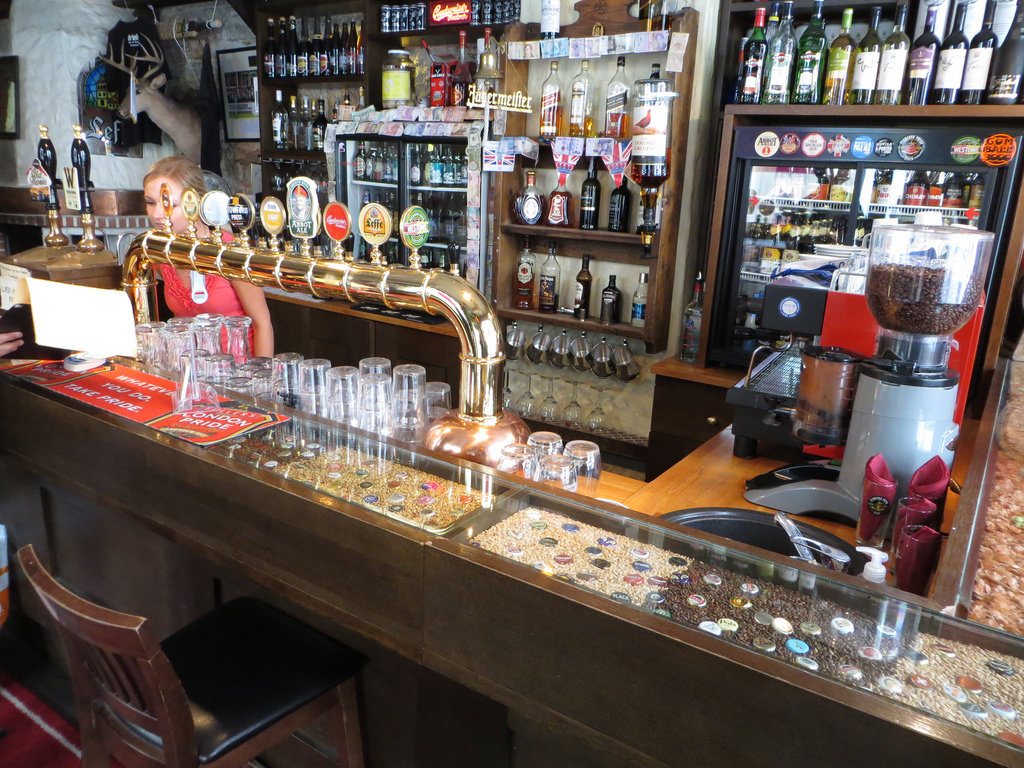
The bar and beer fridges at Drink Baar

Drink Bar & Grill
Located in Väike Karja 8, Drink Bar & Grill  looks like a trendy, modern bar from the outside and keeps up this appearance when you walk in the front door at the corner. A shiny brass pipe on the bar sports 9 beer taps and on the wall behind the bar you'll see rows of bottles of liquors, whiskys and beer. There are also two beer fridges behind the bar, and the two girls working there were fast and efficient, but seemed more like general shop assistants than beer tenders.

I wasn't too impressed by the draft beer selection, though they had BrewDog Punk IPA, as I was looking for Estonian beers and only 3 of the 9 taps matched that criteria. Two of these were their own house beers, called Drink Light and Drink Dark, basically rebranded versions of Hele and Tume from Sillamäe Õlletehas. The last Estonian beer was Sillamäe München Vaskne, which I had just had at Hell Hunt. On bottle it wasn't much better, many of the bottles were from British breweries such as Shepherd Neame, Harviestoun, Meantime and Wychwood.

Drink Baar, as it's also called, may top the Tallinn pub list at RateBeer, but for me it was just ok - there are better places to go for beer in Tallinn.

Stonewar beer mugs and candle light at Olde Hansa

Olde Hansa
This is a serious tourist trap, not far from the Town Hall square, but the interior of Olde Hansa is artfully decorated according to medieval tastes, with solid wooden tables and benches, live candles as the source of light and stylish menus written in a medieval font and fashion. While soft medieval music is played over the loudspeakers, the guests are served food on stoneware plates and drinks in stoneware mugs. Kitsch? Perhaps. But really well done.

Though Olde Hansa is primarily a restaurant, serving a number of tasty medieval dishes - from wild boar to beer and elk, it also offers an interesting strong beer served in those stoneware mugs. I never found out what the beer was called or where it was brewed, the waitress didn't know, but it was certainly made with spices and honey and tasted nothing like the other beers I had in Tallinn. So, Olde Hansa is really worth a stop, for a medieval food and beer experience.

Does Brewery Õlleklubi look like a brewpub? Well, it ain't!

Brewery Õlleklubi
This one should probably not have been listed under my picks from Tallinn, but I feel the need to write a few words to warn future beer travelers. Located at the start of the "long street", at Pikk 1, Brewery Õlleklubi gives the impression of being a brewpub, first by talking about "Our brewery" in their English beer menu and secondly by having their logo stamped on their four draft beers:

- Hansa Zeldzaam (5.2% pilsner)
- Hansa Eerste (4.6% pale lager)
- Voor Sterke (6% dark beer)
- Hansa Vandaag (4.5% made with honey)

However, none of these are brewed locally. They're not even brewed in Estonia but in Latvia; Hansa Voore Sterke is a rebranding of Tumšais from Krāslavas Avots, Hansa Eerste a rebranding of Gaišais from Rezeknes Alus and Hansa Zeldzaam and Vandaag are brewed by Bruveris in Riga.

Adding to this insult, the three girls working in the bar showed little interest in the beer they sold and couldn't answer a single beer related question. Besides, service was incredibly slow even though it was just me in the room and three vacant bartenders. So, there are probably 34 better pubs to try in Tallinn!

The tiny bar at Kodu Baar with my glass of Pihtla

Conclusion
Don't expect to find beer nirvana when you arrive in Tallinn and you must be very tolerant with regards to lager beer. But there are several wonderful beer places and a pretty decent brewpub in old town, so you shouldn't have to go thirsty while exploring the historical sites of old Reval.


Photos from the visit to Tallinn can be found at Flickr: Tallinn scenery and beer photos.

Tuesday, July 23, 2013

Inns and outs in London

After a long, bitter slumber where the essential question was whether you were a fan of beer served without the addition of gas ("real ale", mind you) or with (lagers), the British beer scene and in particular London has made a remarkable recovery,  in terms of exciting new craft breweries, over the last few years.

The success of BrewDog may have helped, kicking in a few mental doors, because now new breweries are founded all over the United Kingdom. Even in Wales. According to a recent article in The Guardian, the number of breweries in the UK has more than doubled in ten years - Britain is now home to more than a thousand breweries!

This post is a brief recount of my trip to London in May 2013, my first in more than two years.

Bird's eye view of London from The Shard


London
This famous city needs no introduction so instead I'll say a few words about another topic that greatly interests me: History. London is famous for its historical sites and museums, in particular the British Museum, and one of the points on my agenda this year was to visit its Pompeii and Herculaneum exhibition. I also wanted to see an exhibition from a more recent historical period, the life and art of David Bowie at the Victoria & Albert Museum. Alas, they both fell through. The David Bowie exhibition because it was sold out until the end of June and the Pompeii exhibition because it was so popular that when I finally got inside there was no way I could see the displays and much less read the display texts because people were literary standing on top of them. So, museums in London are out of the question for me.

However, I did get to experience one great thing not related to beer, and I mean great as in impressively large - or rather tall. The Shard or Shard of Glass is a skyscraper built near London Bridge in Southwark from 2009 to 2012. At 306 meter it is the tallest building in the European Union. Like most tall buildings it has an observation deck, The View, on the 72nd floor - some 244 meter above the waters of River Thames! This deck opened up to the public in February 2013, just in time for my trip. Like the earlier mentioned museums, the observation deck at The Shard is very popular but in this case I was willing to spend close to an hour in line to use my £25 ticket.

When I finally got up there I knew it was worth the wait, the view from The Shard is absolutely stunning. From such a height you'll see how the Thames twists and turns its way through London and you'll get a better understanding of the layout of the city, from the Docklands in the east, via Tower, the City, Westminster and Southwark. I would recommend going in the morning, for two reasons. The first is that the queues won't be that long (they tend to accumulate, especially if there has been a technical problem), the second is that the sun (if the sky is clear, and that's a big IF in England) will be in the east or south east, allowing you to capture great photos towards the west (Southwark, Westminister) and north (City, Tower).

Tickets to The Shard can be bought in advance from their website or on-site, if not sold out.

The Shard seen from Borough High Street

London pubs and inns
There is no way anyone can do justice to the rich beer culture in London in a single post, based on a brief 2-day visit to the British capital, so this is just my pick of places with a focus on the new ones that didn't exist when I last was in London or that I didn't know about earlier. While Euston Tap was the hottest thing back in 2010, now you've got BrewDog Camden and the two pubs of the Craft Beer Co, at Clerkenwell and Islington. This time, I also visited an old inn and the site of what was once the largest brewery in the world.

BrewDog Camden - the first outside Scotland

BrewDog Camden
Located at the intersection of Greenland St and Bayham St, a block from Camden Town tube station, BrewDog Camden opened its doors to the public in December 2011. It was the fourth BrewDog pub to open up and the first one outside Scotland.

As all the other BrewDog pubs, the one in Camden shares a youthful, modern design with bare brick walls, simple furniture and a large, dominating bar. It offers around ten BrewDog beers and some 4-6 guest beers on draft, in addition to a good selection of bottled beer from craft breweries around the world.

During my visit, BrewDog Camden offered the rare Dana + Eldorado blend of IPA is Dead on draft, it was a strange blend that I found hard to drink. I much better liked their Bracken's Porter, named in honor of the BrewDog mascot, the Labrador Bracken, which passed away last October. There was two other new beers from BrewDog on draft, 10 Heads High and Punk Monk. The former is a tasty imperial amber ale of 7.8% and the latter a special version of their regular Punk IPA, brewed with a Belgian yeast-strain and dry-hopped with Chinook, that I found really captivating. Among the guest beers, De Molen Lentehop and Saison Dupont, the modern benchmark for saison, were the two highlights for me.

I found the atmosphere in BrewDog Camden really nice and got enganged in beer discussions with several locals on both of my visits to the pub, including a long one about the merits of English bitter.

After having visited the BrewDog Aberdeen and Edinburgh pubs in Scotland, I feel I can conclude that this is a concept that seems to work equally well in London. Well done, BrewDog.

Craft Beer Co. Clerkenwell, the highest rated pub in London

Craft Beer Co, Clerkenwell
The original Craft Beer Co pub opened up June 2011 in 82 Leather Lane in Clerkenwell, it is currently (July 2013) rated slightly higher on RateBeer than the second Craft Beer Co pub, which opened up in Islington last year. I had heard much praise about this place and knew that former BrewDog-employee Tom Cadden was involved, so I had high expectations when I walked in their front door a couple of hours after the noon opening.

The pub offers 21 (3x7) taps with draft beer and, as far as I could count, 15 beer engines serving real ale from cask. Personally, I'm not a big fan of real ale since so many English bitters, the most common type of real ale, taste so similar to me. However, at Craft Beer Co they had real ales from some of the new English craft breweries, including Dark Star and Tiny Rebel, so I did try a couple. The pub also offers some 400 types of bottled beer, so there is plenty to choose from for a beer tourist.

Because I arrived early in the afternoon, it was fairly quiet in the bar and I found a good spot to sit down, but I suspect the place can get a bit packed at night as there really isn't that many places to sit. Thus, I would recommend going early, both for the seating and to be able to ask the bartender about beer.

Harbour Imperial Chocolate Stout No 1

Because of the high number of taps I decided to focus on the draft and cask beers, many of them from small craft breweries in the UK. There were three new breweries that caught my attention, two of them with beer on draft:

  • Weird Beard Five O’clock Shadow is an interesting take on an IPA, at 7% abv it's more malty and sweet than most American IPAs. Weird Beard Brew Company is a fairly new craft brewery, founded in 2012 by two award-winning homebrewers, Bryan Spooner and Gregg Irwin. They started out borrowing brewing time until they opened up their own small brewery in Boston Business Park in Hanwell, London, early 2013.
  • Harbour Imperial Chocolate Stout No 1 is an 8.7% abv imperial stout aged on bourbon barrel, a smooth, rich and well-balanced beer that impressed me more than any other English beer I had on this visit to London. Harbour Brewing is another young craft brewery, located in North Cornwall in the south west of England and launched in 2012 by brewer Rhys Powell and his friend Eddie Lofthouse.

The third brewery was from Wales and had a real ale on cask:

  • Tiny Rebel The Vader Shuffle is a 6.3% abv oak-aged Belgian-style porter(!) It was a sweet fruity beer, very flavorful, and it really impressed me as a good cask ale. Tiny Rebel is a small 16 hl craft brewery launched in early 2012 by the brothers-in-laws Gareth Williams and Bradley Cummings. Originally a hobby in a garage they opened their commercial plant in a 3,000 square foot industrial building in Maesglas, Newport, becoming the first micro brewery in this city.


Enjoying the Anarchy Citra Star at The Rake

The Rake
Whenever I'm in London I always visit Borough Market near London Bridge in Southwark, home to the brewpub-cum-restaurant Brew Wharf, to the traditional real ale pub The Market Porter, to Utobeer beer shop and last, but not the least, The Rake. The Rake is a really tiny pub owned by the people behind Utobeer, it has a small "beer garden" area in the back and what it lacks in floor space it gains in selection of quality beer. There is always something good on draft, usually from up and coming English craft breweries, so The Rake is a great place to explore new English breweries.

During my May visit, The Rake was running a campaign for a new craft brewery called Anarchy Brew Co from Morpeth, Northumberland, in the north of England. Four Anarchy beers were offered on draft, Short Fuse, Citra Star, Crime Scene and Grin & Bare It. I tried Citra Star, which was an excellent hoppy blond ale (hopped with Citra, I would assume) and Crime Scene, a tasty 5.5% amber ale. Both were excellent brews, especially for such a young brewery which came into operation as recently as January 2012. I expect to see more great beers from Anarchy Brew Co in the future.

The George Inn - the last coaching inn in London

The George Inn
In November 2012, English beer writer Pete Brown published his latest book "Shakespeare's Local" in which he describes the bygone era of coaching inns in general and The George Inn in particular. It's a well written book that inspired me to do a pilgrimage to the last remaining coaching inn in London. But first a few words about London's coaching inns.

From medieval times and well into the 19th century, people or goods going to London would travel by horse, first by horse and carriage and later on the fast stagecoaches that we know so well from cowboy movies. But you could only enter London during daytime, when night fell the city gates would close to keep peace and quiet in the city. If you came from the south, the road to London went through Southwark which in those days were outside the city (the gate was on London Bridge). If you came late or brought goods to be sold at the markets in London the next day, you wanted to stay at an inn as close to London as possible so that you could get into the city as soon as the gates opened the next morning. Thus, Borough High Street in Southwark, which leads straight onto London Bridge, was lined with inns from medieval times.

From the street a coaching inn would not look very impressive, as it was just a large gap in the wall, large enough for a stagecoach to pass through, but once inside in the cobblestone yard the galleried inn would stretch out on both sides, with stables for horses and rooms for rent.

With the advent of the railway in the mid 19th century, the coaching inns went into decline as fewer and finally no travelers or goods came through Southwark on coaches. By the 1870s only one inn remained, The George, and even this one was facing extinction when its north range was pulled down in 1874, to make space for Guy's Hospital. Fortunately, the south range survived and is now protected by the National Trust.

Nobody, not even Pete Brown, knows for sure how old The George is or whether the famous bard used to frequent it (The Globe is located in Southwark, so Shakespeare must surely have been a guest at some of the inns) but historical records show that The George existed at least as early as 1542 in what is now 77 Borough High Street in Southwark. The current building dates from 1667, when it was rebuilt after the Great Fire of London the year before.

Though most of the guests at The George are tourists, at least when I was there (heck, I'm a tourist too), I found the atmosphere charming. The old and crooked facade of the galleries, the secluded yard which reduced the noise from the busy street outside and the old interior, it really gave me a sense of pre-Industrial era England.

The George also serves a decent fish and chips dish and offers five real ales on tap (all from Greene King, unfortunately), so it's a nice place to go for lunch. If you come for lunch you'll also beat most of the crowd, since The George only opens at 11 am (except for noon on Sundays), making it easier to find a table in the yard, when that is open during the summer, or in one of the rooms inside the inn.

The former Truman Black Eagle Brewery in Brick Lane

Old Truman Brewery
Feeling inspired, by the visit to The George and a blog post by beer writer Martyn Cornell, I decided to check out some more beer, or rather brewing, history in London. This time in Brick Lane in the East End, near Spitalfields, where the buildings of the former Truman Black Eagle Brewery can still be found.

The history of Truman's Brewery goes back to 1666, the year of the Great Fire of London, when the Black Eagle Brewery was established on a plot of land next to what is now Brick Lane. It grew steadily until the 18th century when demand for Porter led it to expand more rapidly, becoming one of the largest porter breweries in London. Its growth continued into and through the 19th century, in 1873 it purchased the Philips Brewery in Burton and became the largest brewery in the world. This was a clever move since porter was losing popularity to the pale ales of Burton.

After three centuries of successful growth, the second half of the 20th century brought more difficult challenges for Truman, now known as Truman, Hanbury & Buxton. One thing was the stiffer competition from big national and international beer groups, but just as serious was the lager craze that swept across England in the 1970s and 80s. Truman had its heart in British ales, not in lagers, so this was a disturbing trend to the management of the brewery. Just as it was to serious British beer lovers, who went on to found CAMRA in 1971, in defense of British cask ales. Unfortunately, Truman's Brewery had no similar tactics to play and struggled on until 1989, when the management gave up the fight and closed down the brewery in Brick Lane.

The former Truman's Brewery

Some 25 years later, the old brewery chimney with the letters "TRUMAN" can still be seen, the gate with the black eagle is still there and references to Truman, Hanbury & Buxton can be found on many buildings along Brick Lane and adjoining streets. The former brewery buildings now houses shops, night clubs, pubs, restaurants and art galleries, so they're kept alive, sort of, but I still felt sad knowing that a brewery that had been successful for 300 years had been closed down so recently.

Shoreditch High St is the closest tube station and if you decide to go there are two other tings to check out. The first thing is food, if you like curry you've come to the right place since Brick Lane is at the heart of the city's Bangladeshi-Sylheti community, giving it the nickname Banglatown. Brick Lane is lined with excellent curry houses. The other thing to check out is the Old Spitalfields Market, it lies on the other side of Commercial St and is one of the top markets in London, offering fashion, food, vintage and general market. It's open seven days a week.

When in Rome ...

More photos from this visit to London can be found at Flickr: The Shard and London beer.

Friday, June 28, 2013

Liège - the daughter of Meuse

The city of Liège in the French-speaking region of Wallonia, in the southeast of Belgium, has just as long and illustrious history as Bruges, Ghent, Antwerp and Brussels, but these days it seems to have ended up in the Belgian backwaters and is largely forgotten by tourist brochures and the beer fans who travel to Belgium from all corners of the world.

I won't claim to have done the city justice by staying there for only two days, but at least I got a feel for what it's like today and what it must have been like in former times. This post is a recount of my brief visit in May 2013, to explore the local beer scene and the city of Liège itself.

River Meuse, the mother of Liège, seen from Sainte-Walburge


La Naissance de Liège
A sculpture on the Pont des Arches bridge across river Meuse in Liège is called La Naissance de Liège or The Birth of Liège and shows a woman with a child in her arms. This is an allegory for Liège being the daughter of the river, which is rather obvious when you view the city from the vantage point of Mount Sainte-Walburge north of the city. From there, the Meuse can be seen flowing through the heart of Liège, fondling the shores and creating the island of Outremeuse along the way. River Meuse, by the way, is not only one of the major rivers in western Europe, with a length of 925 km, it's actually the oldest river in the world, having drained out in the North Sea for some 380 million years.

Like Bruges and Ghent in Flanders, Liège has had its share of famous, historical persons, the most powerful being none other than Charlemagne or Charles the Great, the king of the Franks and from 800-814 AD the mighty Holy Roman Emperor ruling all of western Europe. Like his father, Pepin the Short, Charlemagne was born in the village of Herstal, just outside modern Liège, in the 8th century, but his rule was felt all over Europe and was remembered for centuries after. All traces I could find of him in Liège today was the equestrian Charlemagne statue in Parc d'Avroy.

In 985, Liège became the capital of a prince-bishopric which basically means an area controlled by a bishop who had the powers of a prince to extract taxes and make laws for his minions. The first prince-bishop was a man called Notger who transformed the city into a major intellectual and ecclesiastical centre, which maintained its cultural importance during the Middle Ages.

In 1468, the independent and unruly city of Liège was laid siege to by Duke Charles the Bold of Burgundy who, just to be on the safe side, enlisted the help of the French King Louis XI. The siege almost ended in a disaster for the Duke when a troop of 600 men, under the leadership of nobleman Vincent de Bueren, charged up the Sainte-Walburge hill with the plan to capture the King and Duke. However, this plan failed when the troops from the city started fighting the Burgundian soldiers instead of going straight into the camp to capture the leaders. This gave the Duke and the King time to rally their troops into a counter-offensive and beat back the attackers. The next day the Burgundians sacked Liège and put the city to the torch. According to legend the city burned for seven weeks. Today this brave but failed attack is remembered with a sense of pride by the people of Liège, who in 1880 named a new stairway Montagne de Bueren in honor of Vincent de Bueren.

The Montagne de Bueren stairway in Liège

During the Counter-Reformation in the 16th and 17th century the diocese of Liège was split up and gradually lost its role as a regional power. But Liège remained in the hands of the Bavarian prince-bishops until the French Revolution broke out in July 1789, this inspired the people of Liège to start their own revolution, overthrowing the prince-bishop and establishing the Republic of Liège in August 1789. Though the republic fell to Austrian forces in 1791, this event had shook the system of prince-bishops so when French troops captured Liège (and Bavaria) in 1794, the city was more than ready to throw out its prince-bishops again. This time for good.

With the fall of Napoleon in 1815, France had to let go of Liège which was incorporated into the newly formed United Kingdoms of the Netherlands where it remained until the Belgian Revolution of 1830, which saw the formation of an independent Kingdom of Belgium. This signalled the start of a golden era for Liège, because Belgium was second only to Britain in joining the industrial revolution and it was in Wallonia, not the arable farm land of Flanders, that Belgian industry were located. Liège became one of continental Europe's first large-scale steel making centres, this required many workers so the population ballooned and the city grew out of bounds.

Walking around in Liège today, you'll notice that areas outside old town often have apartment buildings from the mid to late 19th century, many of them unkept for decades or even totally abandoned. The reason for this is that by the time of World War I the industry in Wallonia was already in decline. Today there's hardly any industry left, giving outlying areas of the city an "empty shell" feel.

Walking down the narrow Au Pérî street 

However, the spirit of Liège has started to stirr again, even if you still see lots of old and abandoned buildings. The brand new Liège-Guillemins railway station, a wonder of engineering based on a design by Spanish architect Santiago Calatrava, opened in September 2009 and has become a tourist attraction in itself as well as an important hub on the high-speed railway network through Belgium.

Unlike Flanders, which is flat as a pancake, Liège is located in a hilly terrain which means there are steep hills to climb, if your are so inclined, rewarding you with great views of the city below and of the River Meuse. One of the most popular climbs is up the 374 steps of the 28% inclined Montagne de Bueren stairway, which leads up from the Hors-Château street to the Citadel on Sainte-Walburge. From the upper parts of the stairway you'll have a great view of Liège. The sweaty climb is worth it, trust me.

That Liège is about to "wake up" should be clear from the fact that it was one of two candidate cities for the 2017 World Expo, if it had been selected (it wasn't, the World Expo 2017 will be in Astana, Kazakhstan) it would surely have had an enormous impact on the largely rundown but historically rich city. Now, its modernization will take place more gradually than if the World Expo had come here, so if you want to visit Liège to get a sense of what this city was like in its 19th century heydays there's still time.


Getting there
Belgium has an extensive railway network so whether you come from Brussels, like I did, or Antwerp in the north, there are almost hourly train departures in the directon of Liège. I went by train from Bruxelles-Midi railway station to the new Liège-Guillemins station, which cost me less than an hour and €14. You really can't beat time or price.

If you insist on going by car, the European highway E40 passes by Brussels and goes straight to Liège, a drive of about 100 km or 1 hour. Liège even has an airport, but it's mainly a cargo airport (the 7th most important in Europe) though since 2005 it has also had a passenger terminal. But I would still recommend going by train.

Le Vaudrée II on 149 Rue Saint Gilles in Liège


The beer scene
As mentioned in the intro, Liège doesn't draw large crowds of beer tourists so you will be pretty much on your own with the regulars when you visit a pub or brasserie in the city.

Le Vaudrée II
Le Vaudrée is actually a chain of beer restaurants, originating in Liège but now found at 6 other locations in the Walloon Region of Belgium. The original Le Vaudrée was started by Camille Dumez in the mid 1980s, it can still be found in Rue du Val-Benoît on the southern outskirts of Liège. However, since 1990, there has been a second brasserie, creatively named Le Vaudrée II, on Rue Saint Gilles in the heart of old town Liège.

Even though the original Le Vaudrée currently has a higher rating at RateBeer and a few more beers on tap than the second location, I decided against going there because it was located 4 km from my hotel and in the opposite direction of old town. Fortunately, Le Vaudrée II was not a poor alternative.

Le Vaudrée II is located on 149 Rue Saint Gilles, just a 4-5 minutes walk from Liège Cathedral. It's open from early morning until well after midnight on every day of the week, offering breakfast, lunch and dinner accompanied by high quality Belgian beer. On tap, they serve 24 draft beers and on bottle more than 900 different types, so there was no chance I would get bored after one night! Among the more interesting draft beers, when I was there, they served Tripel Karmeliet, Gulden Draak 9000, St Feuillien Saison, Val-Dieu Brune and Mc Chouffe. On bottle I was intrigued by a series of beers from Brasserie Artisanale Millevertus, ranging from a nice Brune to a weird saffron beer. Another nice find was La Brasserie à Vapeur that makes a very funky saison called Vapeur en Folie.

In addition to the excellent beer selection, Le Vaudrée II also has a more than adéquat food menu offering a selection of cold and warm dishes, soups, fish, pork and beef, some of them even grilled on stone plates. The first night I had a tender beef with their own Vaudrée sauce (made with myrtle, white wine, cream, tomato, mushroom. Ardennes ham and tarragon!), which cost me €20 and tasted really delicious. The second night I tried the mixed grill plate, for a euro more, which was also good but more ordinary.

The bar with 24 beers on tap at Le Vaudrée II in Liège

The service at Le Vaudrée II was surprisingly fast and good, I hardly had time to sit down or finish a glass of beer before the bartender came over to ask me for my order. And, to my great relief, the bartender spoke a fairly decent English, allowing me to ask questions about the different beers. This is not typical for native French speaking regions in Europe so this is a great pluss in my book. So, if you find yourself in old town Liège, Le Vaudrée II is the place to go both for great beer and food.

Taverne Saint Paul
Tucked away around the corner from La Cathédrale St Paul de Liège, in the narrow but busy pedestrian street Rue Saint Paul, the 125 year old Taverne Saint Paul is something as unusual in Wallonia as a "brown café" so it was an obvious place to visit when in old town Liège.

Established in 1881, in the building of a former coaching inn, Taverne Saint Paul provides a respite from the daily hustle and bustle. Here time literarily stands still, exemplified by the clock inside the café which has been set deliberately wrong, so that customers have no way of knowing the correct time of day. In 2012, the 29 year old Maxime Piette took over the reins of the café promising not to change a bit, and that still seems to hold true as far as I could see.

Visitors to Taverne Saint Paul are greeted by a dark brown interior, on a sunny day it will seem almost dark in there, with well worn wooden furniture and walls covered with old memorabilia. Usually beer ads, but also old grandfather clocks and cigar boxes. The small bar sports 6 beer taps, which included Hoegaarden, Leffe Blond and Chimay Blanche, and also offer some 30 types of beer on bottle. It may not be the most inspiring selection, but I found the quiet and tranquil atmosphere intoxicating and stayed for longer than I had planned.

The bar at the 125 year old Taverne Saint Paul in Liège

L'Antre du Vaudrée
Just across the street from Le Vaudrée II, on 130 Rue Saint Gilles, you'll find the best beer shop in Liège, L'Antre du Vaudrée. As the name implies, this shop has the same owner as the Le Vaudrée chain of beer restaurants.

The shop is well stocked with beer from all parts of Belgium and like the restaurant across the street it offers an amazing 900 types of beer on bottle. The man behind the counter spoke reasonably well English, allowing me to ask questions about beers and breweries. When I had made my choices, based on what I had tasted at Le Vaudrée II, it turned out the shop was short in stock on one of them. But the fellow behind the counter was of the resourceful kind and solved his problem elegantly by running across the street to "borrow" a few bottles from the beer cellar of Le Vaudrée II!


Concluding remaks
Even though I only visited two beer establishments and a good beer shop, I found Liège to be a very good beer destination as it brings you really close to Belgian beer roots in an environment virtually free of tourists and RateBeerians (unlike in Brussels, Bruges or Ghent where you can't avoid them). So, even if this post may cause more "beer trotters" to visit Liège, I plan to make more trips to this old industrial city in eastern Belgium and the next time I will try to visit the original Le Vaudrée.

The new Liège-Guillemins railway station from 2009

For more photos from Liège see the following Flickr sets: Beer and the City.

Thursday, June 20, 2013

On the trail of pale ale in Burton-on-Trent

During a recent stay in London, a growing beer destination in itself with numerous new pubs and micro breweries, I decided to take a daytrip out of the city to visit a small town in Staffordshire by the name of Burton upon Trent.

Burton upon Trent, also known as Burton-on-Trent but I'll just call it Burton from now on, is a town of about 43 thousand inhabitants. It's located by the River Trent in East Staffordshire, some 10 miles south west of Derby. Burton may not mean much to people nowadays, despite being home to the National Brewery Centre in England, but it hasn't always been like this. A mere century ago this small town was at the very heart of a vast and successful English brewing industry, home to some of the biggest and most famous breweries on the planet. So, what happened?

Burton-on-Trent, a gateway to English brewing history

History
The history of brewing in Burton goes back at least a thousand years, but for a long time brewing was an activity performed at inns or taverns to make beer to their guests. Only at the start of the 18th century did commercial breweries appear, the first one was opened by a Benjamin Printon right next to the Burton Bridge in 1708.

Commercial brewing didn't immediately take off in Burton, because its remote, inland location made it expensive to transport barrels of beer outside the town. But in 1712, George Hayne opened the River Trent Navigation and constructed a wharf and other buildings to help Burton become an important commercial centre. This allowed Burton beer to be shipped to Hull, and from there to the Baltic Sea and Prussia, as well as to London where it was being sold in 1712. At this time, the Porter of London was all the rage so the brewers of Burton probably brewed much dark beer.

But it was pale ales that would make Burton famous. Burton is known for its "hard water", rich in calcium, which accentuates hop bitterness and flavor in a beer. This is not so important for dark beers but crucial for hoppy pale ales (when science finally caught up with brewing it was found that by adding sulphate, often in the form of gypsum, to "soft" water you could get something similar to the water in Burton - this process is now known as "Burtonisation").

A number of breweries opened in Burton in the second half of the 18th century, including Worthington in 1760 and Bass in 1777, to take advantage of the new trade routes and the excellent brewing water. The Napoleonic wars, in the early 19th century, brought an end to the trade with the Baltic, instead the Burton brewers focused more on London and a bit later the growing overseas market. The building of a railway to Liverpool in 1839 enabled brewers to export their beer throughout the British Empire and in particular to India, for which the India Pale Ale became so famous.

The second half of the 19th century was a golden era for Burton which dominated the brewing trade, at its height one quarter of all beer sold in Britain was produced here. Burton became so famous for its excellent brewing water and Burton pale ale that many breweries elsewhere either moved to or opened up a second bewery in Burton. London brewery Ind Coope did so in 1856 and Truman, Hanbury, Buxton & Co followed in 1873. AB Walker & Sons from Liverpool opened a brewery here in 1877 and in 1892 the famous Manchester brewery Boddington and Leicester based Everard & Co opened up breweries in Burton. By 1880 there was a total of 30 breweries operating in Burton, many of them large ones with international export.

The famous red triangle trademark of Bass
- at Coopers Tavern in Burton
However, the popularity of Burton ales caused a serious issue for the Burton breweries: Counterfeit. At the time many small breweries, in other parts of England, started selling their beer as "Burton ales" too and often reusing barrels from famous Burton breweries. This became such a big problem, both for the Burton breweries and their loyal customers who didn't want to get ripped off with a counterfeit, that when the United Kingdom introduced the Trade Mark Registration Act on January 1st 1876, the first man in line at the registration office was an employee of Bass. He had spent New Year's Eve queueing up to register the Bass Red Triangle for their pale ale, which became the very first trademark in the UK! In fact, Bass, Ratcliff & Gretton Limited received the first two registrations, the second trademark was the Bass Red Diamond for their strong ale.

The red Bass triangle, in particular, was soon a common sight all over the world, ensuring customers that this was the real deal. Sadly, after Coors bought Bass in 2000, they dropped this 125 year old trademark. Today you'll only find it on old beer ads, often used as decoration on pub walls around the globe.

In the last couple of decades of the 19th century, Bass was the greatest brewery in the world - employing some 3,500 men and boys only in Burton and brewing one and a half million barrels of beer annually (1902). With a UK liquid barrel taking 36 imperial gallons or 163,6 liter, that should amount to 245 million liter beer per year.

In addition to the highly successful India Pale Ale, Burton breweries also brewed a number of strong ales. In 1903, Bass introduced their Bass No 1 which became the first beer in the world commercially designated as a barley wine. Unfortunately, that style and other types of strong ales virtually disappeared when war broke out in Europe in 1914. In England, the authorities added taxes and forced brewers to reduce the amount of malt used in brewing beer, so that more of the food cereal could be used for making bread, the result was much weaker beers, evolving over the decades into that most common English ale of today - the low alcohol bitter.

Because of the war and the anti-drinking attitudes of the Liberal government, causing high taxes and lower gravity beers, and the advances of brewing science, allowing brewers elsewhere to recreate the Burton water, the Burton breweries went into a sharp decline at the beginning of the 20th century. In 1928 only 8 breweries remained and by 1980 there were only three large ones - Bass, Allied and Marston's. A decade into the 21st century only the Marston's brewery remains independent, Carlsberg having taken over Allied in 1992 (selling it to Bass in 1997) while Bass was acquired by InterBrew in June 2000 who sold the Burton brewery division to Coors.

Today, Burton is just a pale shadow of its former self, but there is still much of interest if beer and history is your fancy. I certainly found it worthwhile to make the two hour train ride up from London. Here's what I managed to explore in the span of seven hours.

An old brewery wagon at The National Brewery Centre

The National Brewery Centre
The National Brewery Centre is located near the intersection of Guild St and Horninglow St in Burton, next to the former Bass brewery. This museum started out as the Bass Museum of Brewing, while Bass was still around. After Bass had been acquired and sold to Coors, it was renamed the Coors Visitor Centre & The Museum of Brewing which was the largest tourist attraction in Burton until Coors decided to close it in June 2008. Fortunately, a steering group was established to investigate a re-opening and in May 2010 the museum was relaunched as the National Brewery Centre.

Naturally, I started here to get my bearings and an understanding of what Burton must have been like as a brewing town in its heydays. I arrived shortly after the doors opened on a Saturday, so I had the entire museum to myself. Vistors are guided through the museum by following a painted path and numbered stations. You start inside a big hall with numerous displays, showing old brewing equipment with a rich documentation, often with old photos, informing guests on how the equipment was used.

After spending time learning about the brewing and conditioning of beer, you continue outside to another building that houses the stables where you can still view real brewery horses (18 year old Charlie was chewing away on some hay while I walked passed him). There are also some beautiful horse-drawn carriages on display, that was used to transport beer, as well as old lorries from the first half of the 20th century. Further on you arrive at what looks like a small train station where two small, old-style locomotives can be viewed from up close. One of them was used by Worthington and the other by Bass for transporting beer on the rails leading from the brewery to the main railway line where I assume the carriages were connected to larger locomotives.

A Burton Union System outside The National Brewery Centre

In addition to its water, Burton was also famous for its unique way of fermenting beer: The Burton Union System. This system was based on the principle of recirculating overflow beer and was originally patented in 1838 by Mr Peter Walker, a brewer from Liverpool. The idea was as follows.

A row of casks are connected via swan neck pipes to a trough above them, so when beer ferments inside the casks the foam is pushed out and up the pipes by the pressure. Here the yeast remained while any liquid (wort or beer) ran back down another set of pipes to bottom troughs and from there into the casks again, to join the fermentation. Gradually beer in the casks would become bright and free from yeast as the process continued. When the process was complete, the supply from the side rods to the casks was cut off and the taps on the underside of the casks opened to allow the beer to run into the bottom troughs and from there into the racking squares below.

The advantages of the Burton Union System was that it reduced the loss of beer during fermentation and provided an easy way of collecting good yeast for future use. It remained widely used by Burton brewers, well into the second half of the 20th century, but today it's seen as impractical and difficult to maintain and clean. No commercial breweries use it anymore, with one single exception: Marston's use it when brewing their famous Marston's Pedigree bitter.

The principles of the Burton Union are explained inside the brewery museum and a complete double set, consisting of 2 x 26 casks, has been preserved near the car park, just behind the fence along Guild Street.

After the very interesting visit to the brewery museum I decided to continue down Horninglow Street, towards Burton Bridge, to visit Burton Bridge Inn for lunch.

A hearty lunch at Burton Bridge Inn

Burton Bridge Inn and Brewery
Located on Bridge Street, just twenty yards from Burton Bridge across the River Trent, this Inn opened up in 1980 in the premises of the former Fox & Goose Inn and just across the street from where Benjamin Printon opened up the first commercial brewery in Burton 273 years earlier. Since 1982, the Inn has also had its own brewery - Burton Bridge Brewery - providing fresh real ales to serve its visitors.

Located in the back of the Inn, Burton Bridge Brewery started up in May 1982, long after Burton had gone into decline as a brewing centre. But unlike the large breweries of Allied (Ind Coope) and Bass, which has since disappeared, Burton Bridge Brewery has survived and is currently the second largest brewery in Burton when it comes to making cask conditioned ales (after Marston's).

Burton Bridge Inn is a cozy, rural English pub with a small central bar splitting the facilities in two, with smoking on one side and the non-smoking room on the other. When I was there, the pub offered five Burton Bridge ales on tap - from a dark porter via amber to light golden ales.

As any good Inn should, Burton Bridge serves homemade food and I ordered a burger for lunch. It came with fried egg and bacon on top, and big, chunky fries on the side. It was really well made, nothing fancy but tasty and filling. And it paired well with the beers I tasted.

I can't say any of the beers really impressed me, but they were handpulled, proper real ales. And the porter was fairly decent though it is the slightly stronger Festival ale, at 5.5%, that according to the young barkeeper is their best selling beer.

After lunch at Burton Bridge Inn, I walked around the bridgehead, looking at a group of kids learning how to canoe on River Trent, before heading back into town for my next planned stop - Coopers Tavern.

The awesome Coopers Tavern in Burton

Coopers Tavern
One of the most remarkable and memorable pubs I've ever been to, and I've been to many, is the Coopers Tavern on 43 Cross Street in Burton. Located just across the street from what was once the Ind Coope Brewery but now Molston Coors, this pub has history infused in its walls, with the charming landlady, Mary Bagley, operating the handpulls. Bagley has been the hostess at Coopers since August 2006 and has even started her own beer festival at the pub, held in August every year.

From some of the regulars and from signs on the walls I managed to piece together some semblance of a history. Originally, the Cooper's Tavern was built as a house for Bass's "brewer in charge". Records show that it later became an overflow store for special malts and then in 1826 the store for Bass Imperial Stout. The brewers would routinely sample the stouts, so a few tables and chairs sneaked in. Then beer was drawn directly from the barrels, as there was no proper bar. The place was known simply as "The Coopers" as a brewer's joke and it was their own private club for nearly 30 years, until it became licensed for the public in 1858.

Today, the walls of Cooper's Tavern are covered in old Burton memorabilia, from the Bass and Ind Coope breweries, such as mirrors and beer ads. There are two small rooms with wooden tables, chairs and benches where guests can sit down, in addition to the backroom where the beer is poured. The room you enter from the street is known as The Ind Coope Room while the one to the left of the entrance is The Bass Room. Because both Bass and Ind Coope are gone, there's no practical difference - you drink whatever you like in both.

The small "bar" at Coopers Tavern
On tap, Coopers Tavern offers only real ale and real cider from a number of small breweries. Including one from the next door neighbor, The Backyard Brewery. This is a tiny micro brewery run by a former Molson Coors employee who was asked by Mary Bagley if he could brew some cask beer for the tavern, and he agreed to do just that. So this is really short travelled beer and only available at Coopers.

In addition to Backyard Brewery and some guest beers, Coopers Tavern is the flagship of the re-launched Joules Brewery, serving a number of Joule's ales. Ironically, the old Joule's brewery was bought by Bass in 1974 but is now once more an independent brewery while Bass has become history!

The reason for the close ties with Joules is that Coopers Tavern acted as midwife when Joules was reborn: It was here in May 2007 that Molson Coors, who had taken over the ownership of Joules after acquiring Bass, was offered a 'pie and a pint' for Joules. The contract, which made Joules an independent brewery after 27 years of ownership, was signed at Coopers Tavern on February 4, 2009, and sealed with four pints of Bass and a toast raised to the building of the fourth Joules brewery.

The Coopers Tavern still draws beer straight from the cask, preserving the old Burton institution, and they serve some tasty pies - I can warmly recommend the pork & stilton. And with history oozing from its walls and the charming landlady bringing you handpulled beer, the Coopers Tavern in Burton is a great place to contemplate English brewing history, over a pint or three of real ale.

The Roebuck Inn
From Coopers Tavern I walked a couple of blocks to The Roebuck Inn on 101 Station Street, which has a beautiful facade with a gilded sign above the entrance with the large, horned head of a roebuck stuck above the name. As the name of the street indicates, this Inn is very close to the railway station in Burton, so it's a great place to while away the last minutes in Burton before catching an evening train back to London (or wherever you return to).

The Roebuck was built in the 19th century and offers all the charm of old worldly England, with a range of 8 real ales and a beer garden out back. The publican was a lady with a sandpaper kind of raspy voice that would have made Rod Stewart blush, and she would share jokes with regulars across the room while making sure to keep the ale flowing when people stopped by after work.

I asked for local beer from Burton and they offered one, a beer called Reservoir Premium from The Gates Burton Brewery. This small, independent brewery started brewing as recently as summer 2011 but despite its short history, the 4.6% abv Reservoir Premium bitter was surprisingly well made, with a lovely fruit character balancing a nice malt sweetness - making it more interesting than many regular bitters I've tasted over the years.

The Roebuck Inn on Station Street in Burton

Marston's
When in Burton you should consider paying the Marston's brewery a visit. Founded in 1869 and located on Shobnall Road, about a mile north west of the railway station, Marston's is the only remaining independent brewery from the Burton heydays and the only commercial brewery in the world that still uses the Burton Union System for brewing beer.

However, to get a tour of the brewery you need to be in a group of at least ten persons and the email I sent a month prior to going to Burton, asking if I could join another group for a tour, went unanswered. So, if you fail to get an appointment you'll only be able to visit the brewery shop and that may not be worth it if your time is limited.

---

All in all, Burton is well worth a visit as it will help you get a sense of this historical epoch of English brewing. You'll find signs of its brewing history littered all around the town and the large breweries, now brewing only lager, are still an impressive sight. The brewery museum and the Coopers Tavern should be visited by anyone interested in the history of brewing.


A small, blue locomotive made for Worthington in 1926
- on display at the National Brewery Centre

More photos from this Burton visit can be found at Flickr.