Sunday, October 28, 2012

Oslo Beer City - a follow up

Back in June I wrote a piece on Oslo Beer City, looking back at its rapid development and the current state of a vibrant beer scene. Four months later feels like an eternity, when I look back at all that has happened in Oslo this fall, so to do justice to the original post, here is a follow-up with the most recent events.

Beer Palace
Address: Holmens Gate 3
Re-opens: November 14, 2012
Type: Beer bar
Taps: 30

At the beginning of August 2012, the Beer Palace pub on Aker Brygge closed its doors for some serious renovations. The bar upstairs and several rooms were rebuilt and a new cooling room with extra tap lines have been constructed. From what I've been told, the new bars will have more than thirty tap lines - making Beer Palace one of the best stocked draft beer pubs in Oslo.

The bar is scheduled to re-open on November 14th.

Soon-to-open Crowbar & Bryggeri in Torggata.

Crowbar & Bryggeri
Address: Torggata 32
Opens: Late 2012 / early 2013
Type: Brewpub
Taps: 5-6

This is a brand new brewpub that will open up in Torggata 32, where the old Greek restaurant Zorbas used to be and, more recently, the short-lived Closer Café & Bar. Erk Potur, who also owns Café Laundromat, has put 10 million kroner into renovating the place and buying a brand new 5 hl microbrewery from Flecks in Austria. Brewmaster Dave Gardonio, formerly of Ægir Bryggeri, has been employed to design and brew a range of new beers.

Beer writer Espen Smith, who also helped planning the brewpubs Amundsen Bryggeri & Spiseri in Oslo and Sundbytunet at Jessheim, has helped to plan the style and look of Crowbar - which will be "rougher" than the other brewpubs with a focus on meat and beer.

No opening date has been published, but the micro brewery should be operational in November.

Grünerløkka Brygghus
Address: Thorvald Meyers Gate 30 B
Opens: "Sometime" 2013
Type: Brewpub
Taps: Unknown

After more than two years as a gastropub, this place is set to live up to its name ("brygghus" means "brew house" in Norwegian) by starting its own micro brewery sometime in 2013, making it the 5th brewpub in Oslo (unless beaten to the finish line by someone else).

No date has been posted yet, but it seems that the daily manager, Kjetil "Kjell Pop" Johnsen, has picked up some brewing skills and will act as the inhouse brewer at Grünerløkka Brygghus.

Mathallen
Address: Maridalsveien 17
Opened: October 2012

This indoor food mart opened up at the old iron works property Vulkan by the Akerselva river in Oslo in October 2012. In addition to stalls selling short traveled, small producer food - from cheese and cured meat to fresh seafood and vegetables - the place also sports som really nice beer places.

  • Øltorget: This is a small but well stocked beer pub, run by the people behind Ølakademiet and Akersberget restaurant in Oslo. The pub offers ten beers on tap, but have around 20 tap lines for future expansion. The place also plans to have about 300 types of beer on bottle.
  • Grünerløkka Brygghus: This is a satellite of the pub at Grünerløkka, offering 8 different beers on draft and serving warm food made behind the bar.

Smelteverket
Address: Maridalsveien 17 (below Mathallen)
Opened: October 5, 2012
Type: Bar
Taps: 6

About 50 meter long and only 5 meter wide, with space for 200-250 guests, Smelteverket has opened up in the cellar underneath Mathallen at Vulkan. It's the perfect place to go when you're feeling overwhelmed by the crowds upstairs. Its claim for fame is the 25 meter long bar, surely the longest in Norway, and the twenty iron cast windows, along the outer wall, providing great views of the Akerselva river just outside.

Smelteverket with its 25 meter long bar.
There are four "filling stations" along the long bar, where guests can order 6 different beers on tap, usually some industrial lagers but also a couple of craft beers. On my first visit to Smelteverket they had Ægir IPA and Kinn Thorvald's Red Ale on draft. Smelteverket has the same owner as Grünerløkka Brygghus, Jan Vardøen, so the two pubs will most likely share many draft beers.

After only a few weeks Smelteverket has turned into a commercial success, it's usually packed at night, so make sure to be there early to get a seat. Because Smelteverket also has an entrance from the bridge at Nedre Foss its opening hours are independent of Mathallen.

BRU: Vulkan Pub
Address: Maridalsveien 13 (next to Mathallen)
Opens: November 2012
Type: Beer pub
Taps: Unknown

Located in Maridalsveien 13, right next to Mathallen and just a few steps away from the old bridge factory at Vulkan, BRU: Vulkan Pub will be one of the smallest in Oslo with a floor space of just 19 square meters.

The pub is owned and will be operated by the people behind Ølakademiet, who also run the Øltorget pub in Mathallen and the old Akersberget resturant just up the hill. The pub is scheduled to open in November and is closely associated with a new micro brewery, Vulkan Brygghus, that is located at the same address and will brew beer for Vulkan Pub, Øltorget and the Akersberget restaurant.

Smalhans
Address: Waldemar Thranesgate 10, entrance from Ullevålsveien (St Hanshaugen)
Opens: November 9, 2012
Type: Restaurant with draft beer
Taps: Unknown

Smalhans is a new restaurant opening up in Waldemar Thranesgate 10 at St Hanshaugen on November 9th. This location has been used as a restaurant since 1921, but the Smalhans concept is a new one with focus on reasonable prices and good rustic food. The place will also offer Norwegian craftbeer an draft, including beer from HaandBryggeriet, Schouskjelleren and Ægir.


Oslo Beer City keeps getting better ... 2013 should be an amazing year!

Wednesday, October 17, 2012

Munich Oktoberfest 2012

For a number of years I've thought about visiting the famous Oktoberfest in Munich, the world's largest beer festival. This year I finally got the chance as I had already planned a road trip through Germany in the right time period, but before delving into my own impressions of the 2012 festival I'll say a few words about its history and current status.

Welcome to the Oktoberfest 2012.

The Oktoberfest history
The origins of the Oktoberfest goes back to October 12th, 1810, when Crown Prince Ludwig - the future king Ludwig I of Bavaria - married his beloved Princess Therese of Saxe-Hildburghausen. At this time, the state of Bavaria had existed for only four years so the people in Munich were jubilant and proud to celebrate the marriage of their own future king and queen. And celebrate they did!

The wedding celebrations lasted five days and took place on the meadows in front of the city gates, where people could watch horse races while indulging in beer and food. The horse races and celebrations proved so popular that they were repeated at the same place the next year, giving rise to the tradition of the Oktoberfest. Oktoberfest has been held almost every year since 1810, it has only been canceled 24 times - because of either Cholera outbreaks (in 1854 and 1873) or war (the Franco-Prussian War and the two world wars).

While the original Oktoberfest started out as a relatively short and small, local festival, for and by the citizens of Munich, it has now expanded into a 16 days long beer and food extravaganza, with more than 6 million visitors annually - from all over the world. It has become the biggest tourist attraction in Munich, bringing in close to half a billion euro to the city's coffers every year.

The Ochsenbraterei tent, famous for its grilled oxen.
- Sponsored by one of the Big Six.
Despite all the tourists and the cheap souvenir stands, the festival is still very much a Munich festival - rooted in the local beer and food culture. The big tents are all sponsored by the original "Big Six" Munich breweries; Augustiner-Bräu, Hofbräuhaus, Löwenbräu, Hacker-Pschorr, Paulaner and Spaten. Late arrivals, such as the world famous Schneider Weisse brewery - established in 1872, are not found on the Oktoberfest bill.

Today the meadow where the Oktoberfest is still held lies safely within the city of Munich, just a kilometer south west of the Hauptbahnhof main railway station, and it has been named after Ludwig's young bride: Theresienwiese or Theresa's meadow, often just called the Wiesn.

For the 2012 Oktoberfest, which started September 22 and ended October 7, there were 14 large tents and a number of smaller with a total seating capacity of about 100,000. The larger tents can typically seat from 5,000 to 8,000 guests and they usually feature an oompa ensemble, playing traditional Bavarian drinking songs. The smaller tents are more focused on either entertainment or speciality food, such as the famous Fischer-Vroni tent which has been selling all kinds of grilled fish (and more recently sushi) since opening up in 1948.

The how and when
Despite being a big city of 1.4 million, the massive influx of visitors to the Oktoberfest - in the millions - means that the Munich hotels will get swamped and turn up their prices. Many of the hotels will be fully booked long before the festival starts, so even if you're willing to spend big bucks for a room in central Munich you may not be able to find any.

It's both cheaper and easier to find vacant rooms outside the city, and transport is not a big problem since the metropolitan area has a very efficient railway system which can take you from the outlying districts to the heart of Munich in less than 45 minutes.

Because of this, and for reasons which will become apparent in a future post, I decided to stay in Freising, a town some 40 km north east of Munich, not far from the international airport. From Freising you can take the fast commuter train, which departs a couple of times every hour and run all day long. This train takes less than 30 minutes to München Hauptbahnhof, in the heart of the city, which is just a short walk from the Theresienwiese or from Marienplatz for that matter.

Ein, swei, drei - prost!
At a quarter to 10 on a sunny Monday morning in September I went in through the main gate at the Wiesn, ready for my first Oktoberfest. Many other visitors had already arrived and were walking around between the tents, taking photographs or just enjoying the fine weather while waiting for the festival tents to open.

A long queue of several hundred kurt lederhosen clad men had already formed in front of the Hacker-Pschorr tent, but that was fine by me as I had no intention of going in there.

Augustiner Festhalle with an oompa band on stage.
My tent of choice was Augustiner Festhalle, sponsored by the oldest brewery in Munich,  Augustiner-Bräu. This brewery has made beer in Munich since 1328!

Not only is Augustiner-Bräu the oldest brewery in Munich, but they make the beer that many locals claim to be the best - the Augustiner Edelstoff Helles. And, finally, the Augustiner Festhalle is the only tent at Oktoberfest where the beer is served like in the old days, straight from large, 200 liter woodens casks, only assisted by gravity. Thus, for me the choice was rather simple.

Inside the Augustiner Festhalle there was still plenty of space at 10 am, roughly half the tables were free while the other half were reserved. It turned out that most of the free tables had been taken by the time I noticed them, but since many of the reserved tables were reserved from 4 or 5 pm, probably for groups of people coming straight from work, I sat down by a table that was free for the next seven hours. That was plenty of time to enjoy the beer, food and atmosphere in this tent.

As I'd never been to Oktoberfest before I was uncertain about how to order beer and first tried asking a man standing by the large wooden cask in one of the four schänkes (a schänke is basically a filling station for beer), but he pointed at the girls running around with large beer mugs so I sat down again and finally managed to attract the attention of one service lady. Two minutes later she was back with a Maß - a 1 liter beer mug - of the 5.6% strong Augustiner Edelstoff Helles.

I had worried it would be tough to empty the large mugs of beer, before the beer went flat, but it turned out to be no problem at all. The Edelstoff is such a tasty, refreshing and drinkable beer that before I knew it I was looking down into the wide glass at a small puddle of golden liquid far down there at the bottom.

Drinking large volumes of beer was also helped / promoted by the many girls walking down the aisles in the tent, offering freshly baked, warm and salty brezn from big baskets. Brezn is better known as brezel in the rest of Germany or pretzel in the US. This salty delicacy is a match made in heaven with German helles beer, take my word for it.

Schänke number 2 (out of 4) in the Augustiner Festhalle
- serving Edelstoff Helles straight from the cask.

The first couple of hours, the large tent remained fairly quiet and relaxing, but around noon just about all the seating space had been occupied and I noticed people standing along the sides, waiting for someone to leave or for their reservation to kick in. It was getting harder to move around, both for the beer mug carrying girls and for those guests needing to go to the toilets, as a large number of standing guests blocked the aisles.

Around noon the stakes were raised when an oompa band entered the raised stage in the middle of the tent and launched into a series of drinking songs of which I just caught the omnious "ein, zwei, drei - prost!" upon which the band leader raised his own Maß and toasted together with the audience before swallowing a good mouthfull.

It was about this time that I realized it was time to move on if I wanted to see some of the other tents, as the Augustiner Festhalle was now approaching a very packed condition. So after two nice hours and three Maß of Edelstoff I left the tent to take a look outside the tent.

The horse drawn Augustiner-Bräu Faßwagen from 1901
- still used for transporting wooden beer kegs.
Outside things had become a lot more chaotic than when I arrived, it seemed that several tents were so full that bouncers had been posted to stop more guests from entering - so instead people roamed around between bratwürst stalls and the smaller tents.

When I looked up towards the main gate I saw a continous stream of people entering, so it was obvious it would just get more cramped at the Oktoberfest. Thus, after pushing my way through the crowds for a few minutes and taking photographs of the Augustiner-Bräu Faßwagen, a beautiful horse drawn wagon from 1901 which came with more wooden beer casks for the Augustiner Festhalle, I extricated myself from the crowd and left the Wiesn for a quiet biergarten in Munich.

Concluding remarks
The Oktoberfest is a strange mixture of circus, carnival and Bavarian holiday, you'll see all kinds of people from all walks of life. The party factor is high and probably grows as day turns into night, so if you're up for that and a bit cramped space the Oktoberfest should be rigth up your alley.

As for myself, it was worth making the effort and I did enjoy the short spell in Augustiner Festhalle before it started getting rowdy in there. This was a once in a lifetime event for me, I will certainly return to the lovely biergartens and cozy bierstüberls of Munich, but not during Oktoberfest.

A Maß of Augustiner-Bräu Edelstoff Helles
- my best memory from Oktoberfest.

More photos from the 2012 Oktoberfest can be found in this Flickr set.

Tuesday, October 9, 2012

A Leipzig beer or so the story Gose

During my September 2012 road trip through Germany I made a stop in Leipizg, the historical city in Saxony where matemathician and Newton's nemesis Gottfried Leibniz was born, to check out its current beer scene and in particular to locate and taste the almost extinct beer style known as Gose.

The Altes Rathaus or Old City Hall in Leipzig.

So the story Gose
You may never have heard of this style of beer before and it was a close call that few of us would have, because in the 1960s Gose went extinct! Fortunately, with the growing interest in old beer styles, the Gose has been revived and is now growing in popularity both in Germany and in America.

Gose belongs to the famliy of sour wheat beers which once was brewed across much of northern Germany and the low countries (today Belgium and the Netherlands), of which Berliner Weisse and Geuze are two other remaining examples. Common among these beers were the low alcohol, usually from 3-5% abv, and high attenuation, making them dry and less sweet than many other styles. This made for a refreshing, everyday beer that could be drunk in large quantities.

Goedeker's Döllnitzer Ritterguts Gose
- the original since 1824.
The style gets its name from the town of Goslar, in Lower Saxony, where it was first brewed in the early 18th century. In those early days, Gose was a spontaneously fermented beer, but when brewing science improved in the 1880s the brewers in Leipzig turned to top fermenting ale yeast and added lactic acid bacteria to recreate the sourness of the wild fermentation.

Gose is brewed with at least 50% malted wheat, and because it's also brewed with coriander and cooking salt it doesn't comply with the strict Reinheitsgebot - the Bavarian purity law. But that offense was not at all uncommon in the north of Germany, where local brewing traditions held sway until the pilsner craze arrived in the mid 19th century.

By the end of the 19th century, the city of Leipzig had adopted Gose as its own beer and a number of local breweries were making it. The beer was so popular that dedicated Gose bars, called Gosenschenke - "Gose tavern", appeared all over the city.

However, the popularity of Gose took a nosedive at the start of the 20th century, and at the outbreak of World War Two only one brewery - Rittergutsbrauerei Döllnitz - brewed it. When that brewery folded in 1945, one of its brewers - Friedrich Wurzler - took the Gose knowledge with him and started his own Friedrich Wurzler Brauerei.

The Friedrich Wurzler Brauerei continued making Gose, even after Wurzler died, but in 1966 this last gosebrauerei closed too. The Gose had gone extinct. And it would probably have remained so, if not for the opening of the Gosenschenke Ohne Bedenken in 1986, an event I'll return to a bit later in this post.

Where to try it?
There are several places in or near Leipzig that now goes under the term Gosenschenke, selling fresh Gose from draft or in the famous long neck bottles. For this visit I decided to stay in Leipzig proper, which ruled out some remote places and breweries, but at least I was able to visit the place where Gose was revived as well as a proper Gosebrauerei.

The old Bayerischer Bahnhof railway station in Leipzig.

In the south of Leipzig, at Bayerischer platz, tourists can marvel at the beautiful portico and architecture of the oldest, preserved railway station in Germany: The Bayerischer Bahnhof or Bavaria Station.

This railway station first opened up in 1842, taking passengers to Bavaria and beyond. By the 1870s more than a million passengers left from this station every year and it had several golden decades, around the turn of the century, with long distance trains stopping here to pick up passengers for Rome or Naples.

However, the two world wars slowed down the long distance traveling and in 1943 the station was heavily damaged by Allied bombs. After the war, in East Germany, there was little money to restore the ruined buildings, so the station was left in disrepair. Fortunately, talk of demolishing the building never went any further and in 1975 the Bayerischer Bahnhof was declared a National Monument. Thanks to Bavarian railway enthusiasts the old portico was later reconstructed the way it had been before the war.

In 1999, the owner of Schneider Bräu in Weißenburg, Thomas Schneider, made a deal with the national railway company, Deutsche Bahn, who owned the old railway building, that he would renovate and restore the building to its former glory but with the addition of a brewpub. A brewpub that would make the old Leipzig speciality, Gose.

Gosebrauerei Bayerischer Bahnhof in Leipzig.

After 14 months of renovations and construction, Gasthaus & Gosebraueri Bayerischer Bahnhof opened up on July 19, 2000, in the old railway building, with a modern brewhouse constructed by Kaspar Schulz in Bamberg. An adjoining biergarten was also added, allowing guests to sit outside, under shady trees, on warm summer days.

During my visit, Bayerischer Bahnhof was fenced in due to construction work so I had to walk around the back and enter through the biergarten. This construction work, by the wat, has been ongoing for several years and is related to the new Leipzig City-Tunnel, which will link Bayerischer Bahnhof to the Hauptbahnhof, 2 km to the north.

The biergarten was really quiet and cozy, with a couple of dozen tables in the shade of the leafy trees and a schenke which served cold beer and warm brezel (i.e. pretzels). With the railway building on one side and a quiet residential area on the other, I couldn't hear any city traffic so it felt like being in the country!

The schenke offered four different draft beers, one of which was their Gose:

  1. Original Leipziger Gose (4.6%)
  2. Schaffner - Bayerischer Bahnhof Naturtrübes Pils (5%)
  3. Kuppler  - Bayerischer Bahnhof Weisse (5.2%)
  4. Heizer  - Bayerischer Bahnhof Schwarzbier (5.3%)

The Gose poured a hazy golden color with a big, white head. It sported a mild sour fruit aroma and had a mild salty mouthfeel with a tart lemon flavor. Fairly refreshing and good. Other than the Gose I only tried the schwarzbier, which combined a good roasted malt character and dark chocolate really well.

I wouldn't mind spending more afternoons here, with a cold Gose and a fresh Brezel.

Bayerischer Bahnhof Original Leipziger Gose
@ Gosenschenke Ohne Bedenken

Gosenschenke Ohne Bedenken
Ohne Bedenken, which means "without concern", has played an important role in the revival of Gose and the history of this Gose tavern goes back to the heydays of Gose. In 1899 the Cajeri family moved to Gohlis, back then a little village just north of Leipzig, in Hauptstraße 38 (now Menckestr 5 in Leipzig). Here they opened the Gosenschenke Ohne Bedenken. A few years later, in 1905, a large biergarten was added too.

Gosenschenke Ohne Bedenken stayed in business, under several different owners, until the dark days of World War Two. In 1943, the biergarten and the houses surrounding it was completely destroyed by Allied bombs, and after the war the place struggled to stay afloat until it closed without a notice in 1958. Eight years later, the last Gosebrauerei in Leipzig and the world closed down. The Gose tradition of Leipzig was gone.

Gosenschenke Ohne Bedenken in Leipzig
- where Gose was revived.
For twenty years nobody drank Gose or hardly talked about it, until one Lothar Goldhahn bought the old property of Ohne Bedenken and decided to renovate the Gosenschenke. Naturally, he wanted to make it as authentic as possible, which meant serving Gose. But where could he get that?

Goldhahn talked to several old timers, who still remembered how the beer had looked and tasted, to piece together an idea of what the Gose had been like. He then asked several local breweries if they would like to brew this beer for Ohne Bedenken, but none of them dared to brew the strange beer. In the end Goldhahn managed to convince Schultheiss Berliner-Weisse Brauerei in Berlin to brew Gose for him. In 1986, Gosenschenke Ohne Bedenken re-opened and could proudly serve Gose to its guests.

In 1990, the current owner Dr. Hartmut Hennebach bought the Gosenschenke and has faithfully maintained it ever since, helping to spread the gospel of Gose and revive an almost lost beer style. Today, Ohne Bedenken has a thriving biergarten where locals as well as beer turists can sit down under shady trees and enjoy a fresh Gose from draft.

During my visit, the Gose on draft was the Original Leipziger made by Gosebrauerei Bayerischer Bahnhof, which I had already tasted at the brewpub, so that was a bit disappointing. The only other Gose available was a bottled version called Original Ritterguts Gose, which was actually very good - more salty and sour than the one from Bayerischer Bahnhof.

In addition to Ohne Bedenken and the Bayerischer Bahnhof I also tried out Brauhaus an der Thomaskirche, mainly because of its central location in old town Leipzig. Located on the square by the St Thomas Church, this brewpub offers regular German lager beers but no Gose.

Even though the pub seemed a bit touristy I thought the beer menu looked decent, as they offered both an unfiltered (naturtrüb) pilsner and a bockbier on draft, so I sat down for lunch.

The Thomaskirche Pils poured a hazy, golden color with a large white head. It smelled of fresh grass and had a light mouthfeel with a very lively carbonation. It had a nice malt character with a mild floral hop flavor, but the strong carbonation probably hid some of the taste. Still a pretty tasty pilsner.

The Bockbier also turned out to be highly carbonated, with an almost acidic bite to it, but I still got some ripe fruit notes and sweet caramel in the flavor, so it seems to be a good bockbier.

Overall, I found the Thomaskirche beers good, but a little less carbonation would have brought out more of the subtle malt and hop flavors and caused a better review from me.

The Brauhaus an der Thomaskirche in Leipzig makes no Gose.

More photos from my visit to Leipzig can be found in this Flickr set.

Sunday, October 7, 2012

One night in Rostock

In September 2012 I went on a 2-week long road trip across much of Germany and Austria, in search of good beer, or should I say bier, cozy bierstübls and lively biergartens. This adventurous trip will probably spawn a series of future blog posts, in this first post I will focus on the first stop in Germany - the old Hanseatic League city of Rostock.

Rostock harbor is not as busy as it once was.

Rostock
The city of Rostock has a long and illustrious history, going back to the 11th century when Polabian Slavs established a settlement named Roztoc - meaning broadening of river - on the lower Warnow river. After being burned to the ground by the troops of Danish king Valdemar I, in 1161, the place was resettled by German traders who Germanized the name to Rostock. 

In the 14th century Rostock joined the Hanseatic league and quickly became one of the most important trade ports on the Baltic sea, sending out ships as far north as Bergen on the west coast of Norway. By the end of the 15th century the dukes of Mecklenburg had managed to enforce their rule on Rostock, and the city lost its independent status.

Because of its strategic location at the mouth of the Baltic sea, across the strait between Denmark and Sweden, Rostock was repeatedly taken during the Thirty Years War (1618-48), both by Danes and Swedes, and later also by the troops of Napoleon.

In the early 20th century Rostock became an important centre for airplane manufacturing, with large factories located in Warnemünde. The first jet plane was actually tested in Rostock. Towards the end of World War Two, Rostock was badly damaged by allied bombing. When the war ended Rostock found itself in the newly formed East Germany, where it got a prominent position as the main port on the Baltic sea. Most of old town was faithfully rebuilt to its pre-war look.

The German reunification in 1990 was the start of a slow decline for Rostock, it lost its importance as a port and trade city to the larger ports in the former West Germany and many people moved west to find jobs. The population in Rostock has fallen from 260,000 in 1986 to about 200,000 today.

Where to go in Rostock
Because I only spent one night in Rostock I didn't get that much time to explore the city or its pubs, but I did visit two lovely places.

View inside Zum Alten Fritz in Rostock.

Down by the old harbor, at Warnowufer 65, one is greeted by a sign pointing the way to "Störtebeker's kneipe", which turns out to be the pub section of Braugasthaus Zum Alten Fritz.

The "Old Fritz" is a charming public house from around the turn of the last millennium, with its own biergarten - seating 200 persons, a large outdoor terrace, the aforementioned pub and a restaurant section seating 173 persons. As I felt for eating something, I sat down in the restaurant. Shiny copper ventilation pipes passes under the vaulted ceiling and low walls, made of red brick stone, section the room into smaller enclaves. A central bar looks like part of a brewery, with shiny copper "kettles" used for decoration in the back.

To my great relief, an inside smoking ban has been in effect at Zum Alten Fritz since January 2012, so it was a joy to smell the food and beer inside, with no distracting smoke. During my visit, they offered five lager beers on draft and six types on bottle - all of them brewed by Störtebeker Braumanufaktur (formerly known as Stralsunder Brauerei) in nearby Stralsund.

The five draft beers:
  1. Pilsener-Bier: This is a 4.9% German pilsener, with a nice hop aroma and a dry, refreshing taste. Quite good actually.
  2. Stralsunder Pils: Another 4.9% pilsener, this one less aromatic and more ordinary.
  3. Schwarz-Bier: This is a 5% schwarzbier, with an elegant malt character. Fairly typical of the style.
  4. Zwickelfritz Hell Naturtrüb: This is a 4.9% unfiltered helles, with fresh, floral hops, a smooth mouthfeel and nice fruit and grass notes in the taste. Very good. 
  5. Zwickelfritz Dunkel Naturtrüb: This is a 5% unfiltered dunkel, with nice sweet and roasted malt notes.
The Zwickelfritz Hell was the most impressive of the draft beers.

Störtebeker Keller-Bier 1402, delicious!

On bottle they had a larger variation in styles, offering both ales and lagers. This is what they had on the menu when I was there:

  1. Bernstein-Weizen: This is a 5.3% German hefeweizen. Fairly ordinary, with banana and spicy yeast flavors.
  2. Roggen-Weizen: This is a 5.4% dunkel hefeweizen brewed with rye, which resulted in a very interesting aroma of fruits and rye bread, but there was a weird phenolic note in the taste.
  3. Stark-Bier: This is a 7.5% baltic porter, smooth, rich and tasty with notes of dark fruits, fresh coffee and chocolate. Yummy.
  4. Keller-Bier 1402: This is a 4.8% kellerbier with a nice floral aroma and flavor of hay, grass and farmyard. Absolutely lovely.
  5. Atlantik-Bier: This is a 5.1% top fermented pale ale, with a lovely American hop character (citra, amarillo). It was just a couple of weeks old, really fresh and tasty.
  6. Hanse-Porter: Supposedly a Baltic porter, but at only 4% it was way too sweet.

Thus, I found much of interest at Zum Alten Fritz and some really enjoyable beers, in particular the Atlantik-Bier and the prize winning Keller-Bier which won Gold at the World Beer Cup 2010 (see pdf). The service was quick and excellent and the food tasty and filling, so I had a great time at the braugasthaus.

Only after returning to Norway did I learn that Zum Alten Fritz is actually a chain of pubs, associated with the Störtebeker brewery, which started up in 1998 and now can be found at four locations across the state of Mecklenburg-Vorpommern. Still, the pub in Rostock is worth seeking out if you're spending a night in old town.

This place was actually recommended to us by the friendly bartender at Zum Alten Fritz, when I asked for other places to try good local brews. Brauhaus Trotzenburg is located a bit south west of old town, near the old city zoo, so I ended up taking a taxi - about 10 minutes drive - to Tiergartenalle 6, to check out this place.

The bar area at Brauhaus Trotzenburg in Rostock.

The name "Trotzenburg" is a bit misleading since there never was a burg, German for castle, here. What we know is that an older homestead was turned into a simple tavern in 1839 which slowly turned into a popular restaurant, made even more popular with the opening of a biergarten in 1899. In 1913 the restaurant took the name Trotzenburg, which it kept for the rest of the century. By the end of the 1980s it had fell into disrepair and was in danger of getting demolished, but in 1998 it was purchased by a local investor working together with the Ostsee Brauhaus and in 2001 the place reopened as the Brauhaus Trotzenburg - a modern brewpub.

The interior of the brewpub feels very spacy, with large open rooms under a high ceiling. The furniture and decoration is simple, rustic and solid - with wooden tables, chairs and benches. Old German sayings have been painted in Gothic type on the bare walls, and a few beer posters and banners have been put up for decoration.

The inhouse brewery has a capacity of 1200 L and is in the capable hands of brewmaster Alexander Schreiber, who brews two regular beers for the pub and several seasonals - including Maibock in the spring, Hefeweizen in the summer, a märzen Festbier in the fall and a Weinachtsbier for Christmas.

During my visit, they had the following beers on draft:

  1. Original Helles: This is a 4.9% helles, with aroma of fresh cereal, a smooth mouthfeel and a good cereal and malt flavor.
  2. Spezial: This is a 4.9% Vienna style lager, with a red tinged golden brown color. Elegant malt character but a bit mild.
  3. Festbier: This is a 5.2% bock, brewed for oktoberfest. Malty aroma, smooth mouthfeel and a sweet caramel malt flavor with some ripe fruit notes. A nice festbier but a tad too sweet for me.
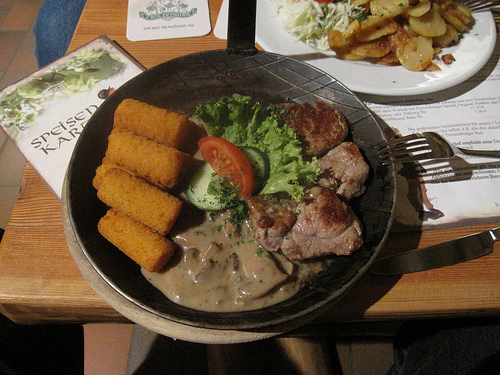
Like the place itself, the food was also rustic and local. I received my meal in a metal pan, steaming hot, it was hearty and good - with pork chops in a brown mushroom sauce and potatoes in the form of croquettes.

Rustic eating at Brauhaus Trotzenburg.

Though I had a more interesting beer experience at the "Old Fritz" I really enjoyed my visit to the "Trotzenburg", the main downside is that you really need a ride to get here, as it's some ways off if you're in old town Rostock.


Photos from my visit to Rostock can be found in this Flickr set.

Sunday, September 9, 2012

Visit to Larvik Mikrobryggeri

On a sunny Friday in September 2012, I made a short daytrip to the town of Larvik in Vestfold, Norway. Larvik is situated between the mouths of the rivers Numedalslågen and Farriselva with a long waterfront and a big harbor on the Oslo fjord. Besides its harbor, with daily ferries to Denmark, Larvik is known for its old ironworks and wood industry at Fritzøe Verk, for being the hometown of explorer Thor Heyerdahl and ship builder Colin Archer and for its mineral water Farris. Perhaps, one day, it will also be known for its brand new brewpub - Larvik Mikrobryggeri.

The gates to Fritzøe Verk and Larvik Mikrobryggeri.

Assuming you're in Oslo, the quickest and easiest way to get to Larvik Mikrobryggeri is to come by train. Trains depart hourly from Oslo Central Station and takes about 2 hours to Larvik, the only downside is that the last train back to Oslo leaves Larvik at 21:33. From Larvik railway station walk northwest, along the waterfront, past the new Fritzøe Brygge complex. Follow the signs to Fritzøe Verk. The brewpub is located in the buildings of Larvik Museum in Nedre Fritzøegate 2.

The idea to start a brewpub in Larvik came to Terje Henriksen one day in 2009 and he brought it up with two friends from Larvik Beer Club, Roy Dahl and Jørn Einar Gjertsen. They liked the idea too, and the three of them spent the next couple of years visiting brewpubs in and outside Norway to learn as much as possible about running a brewpub.

Late 2010, they heard about a pub closure in Larkollen near Moss and bought the furniture and bar from the owners of the closed pub. In January 2011, with a group of volunteers, they drove to Østfold, dismantled the pub and brought all the stuff back to Larvik.

With the equipment of a proper pub at their disposal they now needed a location and found one, in an old brick building from 1854 in Nedre Verksgård at Fritzøe Verk. The building was no longer used for industry but had been taken over by Larvik Museum. The town council thought it would be great to have a brewpub there, and allowed Larvik Mikrobryggeri to start constructing their pub and brewery there.

The bar at Larvik Mikrobryggeri.
While renovating the old building, Larvik Mikrobryggeri opened up a shareholder program and signed up 133 local shareholders in the spring of 2011. With the financial situation taken care of, brewmaster Terje Henriksen ordered a 500 litre micro brewery from Leif Stana in Bratberg Produkter, who has custom built micro breweries for a number of Norwegian breweries.

The pub officially opened its doors to the thirsty public on 3 December 2011, but the micro brewery had not been installed yet, so to give the pub an edge they offered two "house beers" on draft that was contract brewed for them at Lillehammer Bryggeri - Larvik Bødker Pilsner and Larvik Weissbier. In addition to the draft beer, the pub also offered a good selection of bottled beer from Belgium, England, USA, Germany and Norway.

In May 2012 the micro brewery finally arrived from Hardanger and was quickly installed in a room next to the bar. The first beer brewed on the micro brewery was a German-style Kölsch, named Svenner Skum, which was put on draft on June 8, 2012, finally making Larvik Mikrobryggeri a fully fledged brewpub.

Some 46 years after Larvik Bryggeri closed in 1963, the town of Larvik finally had a working brewery again!

Since June, Larvik Mikrobryggeri has brewed two other types of beer - an English Bitter and most recently a German-style Oktoberfest beer called Festival. This latter beer was labeled "a topped bayer" on their Facebook page, and Oktoberfest / Märzen on RateBeer.

The 500 L micro brewery at Larvik Mikrobryggeri.
Unknown to me, brewmaster Terje Henriksen has been ill for a while, so the micro brewery had been inactive for so long that the pub had run out of their Bitter when I paid my visit on September 7. The Oktoberfest beer was also close to empty, in fact I got the very last glass of their Festival beer before the tank ran dry! Still, the few hours I spent at the brewpub was worth the trip.

Larvik Mikrobryggeri is a cozy and quiet pub, even on a Friday night, and in the summer season it's great to sit outside in the historical surroundings of Fritzøe Verk. The draft beer selection wasn't that impressive, despite the seven tap lines. They offered two light and tasteless lagers from Union Bryggeri in Skien and the even less tasty Arctic Ice from Mack. Larvik Bødker Pilsner was ok and their own Svenner Skum kölsch decent, but with two empty tap lines this meant I had to go for bottles after just a couple of draft beers.

But the bottle menu was decent, offering beers such as Tripel Karmeliet, Wye Valley Wholesome Stout, Samuel Smith's Nut Brown Ale, Anchor Porter and Kulmbacher Mönchshof Bockbier. I had no problems stretching the time for my train ride home.

Another thing I missed was some good pub grub, since Larvik Mikrobryggeri is located some distance outside downtown Larvik. But this can be solved by calling one of the local pizza shops and have them deliver food at the pub.

Before she left, I had a short conversation with Elin Svendsen, the daily manager of Larvik Mikrobryggeri (who has just resigned because of health issues). She mentioned that Terje Henriksen is planning to brew more interesting beers in the fall, including a porter and a Christmas beer, so I will certainly consider making a second visit to Larvik Mikrobryggeri later this year.

In the meantime, I hope they get the micro brewery up to speed to keep their currently empty tap lines flowing with fresh beer.

Larvik Svenner Skum - a decent Kölsch

The complete set of photos from this visit can be found at Flickr.

Sunday, August 26, 2012

Grünerløkka mat- og mikrobrygg festival

On August 24 and 25, 2012, Grünlerløkka mat- og mikrobrygg festival was held for the fifth year running. After a humble start in September 2008, on the pavement outside Parkteatret, this has become a very popular and well known food and beer festival in the Norwegian capital. This blog post is a brief report from the opening day this year.

Early visitors at the 2012 festival, before it got crowded.

The festival
Except for the first year, when the festival was held outside Parkteatret, the festival is held in the back yard of Café Vespa, in Københavngata 4, just north of Sofienbergparken in Oslo. It's arranged by the Jan Vardøen-owned Grünerløkka Brygghus gastropub.

As its Norwegian name implies, "mat- og mikrobrygg" meaning "food and micro brew", this festival is all about good quality food and beer. However, because of limited exposure to the food selection this year (there were looong lines by the time I became hungry) I will keep to the "micro brew" part of the festival in this report.

This year saw a couple of changes at the festival. First and foremost, you couldn't pay with cash or credit card at the beer or food stalls anymore, but had to use tokens. The tokens were purchased at the entrance, for 300 NOK you got 10 tokens. This is a sensible change, because it should take less time at the head of a queue to transer two tokens for a beer than to find the correct amount of cash or even use a credit card to pay. However, the execution was a bit flawed since you had to return to the entrance and line up with those waiting to get in. Thus, it could easily take 10-15 minutes to obtain more tokens, which ruined the gain of quicker service at the beer stalls.

The other change was that the organizer, learning from last year, had erected big party tents to let visitors take cover in case of rain. And this proved to be a good precaution, because we got some rain this year too! It was also said that the gate would close when the festival area was full, to avoid the crowded atmosphere and long queues of last year. This turned out to be the case, but in my view they did so a bit late because the festival area was already very crowded by the time I saw the big gate closing. This had several bad effects.

  • The line of people for the restroom was constantly long, forcing you to plan well ahead so that you could line up in time to relieve yourself. Or else you would have to do like some did, run for the park! 
  • The crowded area also made it near impossible to sit down to eat or get some rest, since all the seating space were taken. And those seated always ran the risk of getting beer poured down their necks from people bumping into each other as they tried to pass behind the back of those seated.

Aside from these issues, the festival was a resounding success with a record number of craft breweries attending, nine in all bringing draft beer as well as bottled beer. Visitors could choose from more than 40 beers on draft and a lot more on bottle, including many new and rare beers. It was certainly enough to keep even the most hardened beer geek occupied for two full days.

Here follows an alphabetical list of the attending breweries.

Amundsen Bryggeri & Spiseri
Oslo based brewpub Amundsen Bryggeri & Spiseri, which opened up in February 2011, attended the festival for the first time this year. They brought along three draft beers, the 4.7% hefeweizen Hveteøl, the 4.6% Pale Ale and the brand new 7% black IPA called Black Bird. The latter was a really smooth and hoppy black ale.

BrewDog
Scottish punk brewers BrewDog had stand at the festival, manned by their importer - Cask Norway, serving some of the most interesting beers at the festival. On draft they offered Punk IPA, Hardcore IPA and 5 AM Saint, all excellent beers but these days fairly common. Even in Oslo. It was the bottle menu that attracted my attention, with three novelties: Abstrakt AB:10 - an 11.5% imperial brown ale aged on wine barrels from Malaga, International Arms Race - a 7.5% Flying Dog collaboration beer,  and Dog A - a 15.2% imperial stout brewed with vanilla, coffee and naga chili!

Hornbeer
Like BrewDog, nobody from the Danish brewery Hornbeer were actually present at the festival. Instead, their Norwegian importer Beer Enthusiast manned a stand serving some draft beers from Hornbeer, including the tasty 11% Caribbean Rumstout and the 9.3% Hophorn black IPA.

HaandBryggeriet
From Drammen, west of Oslo, HaandBryggeriet has attended all of the five festivals so far. This year Ole Richard Lund and Rune Eriksen represented the brewery, and they brought along some well known draft beers, including the popular 6.2% Fyr & Flamme IPA and the massive 11% Odin's Tipple imperial stout. On bottle they brought along two new ones, the smooth and nicely roasted 6.5% Sundvolden Porter (only released in 3360 bottles) and the 8.2% Fatlagret Porter - a porter aged on akevitt barrels, just like the old Akevitt Porter.

HaandBryggeriet Sundvolden Porter
- brewed for Sundvolden Hotel
Kinn Bryggeri
Based in Florø in Sogn og Fjordane, on the west coast of Norway, Kinn Bryggeri is less than three years old but already among the top breweries in Norway. Like last year, founder and brewer Espen Lothe showed up with a number of outstanding draft beers. Including the 9.5% Bøvelen abbey tripel and the 10% Svartekunst imperial stout.

Midtfyns Bryghus
Danish brewery Midtfyns Bryghus attended because they had another engagement in Oslo. Its owner, Eddie Szweda, manned the stand, serving several great draft beers. Including the awesome X Porter (originally brewed with Menno Olivier from De Molen) and the brand new 5.9% American Pale Ale with Wasabi and Ginger - fittingly served with a sushi taster!

Nøgne Ø
The oldest and most successful Norwegian craft brewery, Nøgne Ø, is also a veteran of this festival, and this year they brought several new beers with them. On draft they offered a potent pilsenser, the 9% Imperial Python Pilsner, as well as the 6.5% White IPA - a collaboration with Bad Attitude brewed in Switzerland. They also served the new batch of Pumpkin Ale from tap, which tasted very different from the one last year and seemed a bit thin.

Sundbytunet
Bryggerikjelleren at Sundbytunet is the domain of the old Nøgne Ø brewer, Frank Werme. Since opening up less than a year ago he has already attended several beer festivals and made a collaboration beer with Italian brewer Teo Musso from Le Baladin. At Grünerløkka, Frank brought with him several excellent draft beers - including the 6.7% Emmigrant IPA and the 6.5% Vinterporter. The last one is a gem of a porter, smooth and tasty.

Ægir Bryggeri
Based in Flåm in Sogn og Fjordane, on the west coast of Norway, Ægir Bryggeri is a veteran at this festival, attending for the 4th year running. This year, founder Evan Lewis stayed home to attend matters with his brand new brewery complex which opened up for the 5 year anniversary in June. This year, Ægir brought along a brand new beer, called Dirty Blonde. From what I heard, this 4,7% ale was made by aging the regular Bøyla Blonde Ale in an old Lynchburg bourbon barrel. The result was fruity and good. They also offered Sumbel Porter on draft and a new batch of Lynchburg Natt on bottle.

It can also be mentioned that Brooklyn Brewery had a stand, serving one draft beer.

Concluding remarks
Grünerløkka mat- og mikrobrygg festival is still the best craft beer festival in Oslo, 2012 had an even more impressive list of breweries and beer than last year. Its friendly atmosphere and good location makes it a great place for people to come and discover beer.

The 2012 festival also revealed some problems that have to be addressed.

  1. The current location has become too small for such a popular festival, causing crammed conditions and long queues at the few restrooms available. It would be nice to have seating space for all visitors.
  2. Tokens should be sold at more than one location, or at least be moved away from the entrance, allowing those already inside to more easily purchase tokens.
But these are minor issues. Overall, the festival was arranged in an excellent manner by the people at Grünerløkka Brygghus and I send my warmest thanks to everyone involved - also the brewers and breweries. Thank you very much for this year!

Ægir Dirty Blonde on draft at the festival.

More photos from the festival can be found at Flickr.

Saturday, August 25, 2012

Midtfyns Bryghus at Amundsen

On Thursday August 23, 2012, Erik Nielsen and Eddie Szweda of Midtfyns Bryghus visited the brewpub Amundsen Bryggeri & Spiseri in Oslo, to brew a special beer and give a beer tasting. This blog post is a brief summary of that eventful day and night.

Midtfyns Bryghus at Amundsen in Oslo.

Midtfyns Bryghus
Midtfyns Bryghus was founded in late 2004 in Brobyværk, on the island of Funen (Fyn) in Denmark. The first beer was released in March of the following year, but the brewery struggled to make a profit - hardly selling for a million Danish crowns in its first year of operation. It wasn't until Eddie Szweda took over the reins in November 2006 that things started to get better for the small brewery.

Eddie Szweda is a US expat who is married to a Danish woman and has lived in Denmark for the last 19 years, speaking the language fluently. When he took over the brewery, he changed the way Midtfyns Bryghus brewed their beers and completely revamped the beer lineup, introducing a number of exciting new beer styles. Over the next few years, Midtfyns Bryghus would consistenly be named one of the top craft breweries in Denmark, and they've won the "Årets ølnyhed" (best new beer of the year) competition, hosted by the Danish Beer Enthusiasts, three times:

- For 2007 with Midtfyns Imperial Stout
- For 2009 with Midtfyns Chili Tripel
- For 2010 with Midtfyns Rough Snuff

No other Danish brewery has won this competition three times.

Brewing Rough Snuff
Rough Snuff is a remarkable beer, in many ways. It was originally created by home brewer Erik Nielsen and made with real snuff (snus). Eddie Szweda got to taste it and liked the beer so much that he asked Erik to brew a full batch at Midtfyns Bryghus, which he duly did. And it turned out really well. However, shortly after being voted the best new beer in 2010, Rough Snuff was banned by the Danish authorities because it was brewed with real snuff, which is illegal according to EU regulations. Thus, a Rough Snuff II was created, brewed without the use of snuff, and this is the beer you'll find in most beer shops and bars today - not the long gone original.

Tom Alfred Øimo and Erik Nielsen brewing up to something
This legal business was the reason why Erik Nielsen and Eddie Szweda decided to make a trip across Skagerak and visit Oslo in August 2012 - to brew Rough Snuff according to the original recipe, in a non EU country. That latter part is crucial here, the beer in itself is illegal to brew in the European Union, but it can be brewed elsewhere and still be sold within the EU.

On August 23, the brewer at Amundsen, Tom Alfred Øimo, opened up his 500 litre brewhouse to welcome Erik Nielsen for a memorable Rough Snuff brewing session. Using real snuff. This batch should be ready in time for the Oslo Ølfestival in early October, but it will not be bottled only sold from keg.

Erik Nielsen, by the way, now has his own contract brewery, Ø-Bryg.

Beer Tasting
Eddie Szweda is an experienced beer tasting leader, according to beerticker.dk he holds some 160 beer tastings annually and has so far had more than 10 thousand people at his tastings! So, it was only natural to add a beer tasting event to the program at Amundsen. Thus, with Rough Snuff fermenting happily a few feet away, some fourty guests turned up for the Midtfyns Bryghus beer tasting at 7 o'clock.

Eddie Szweda of Midtfyns Bryghus

The plan was to taste five different beers, three from keg and two from bottle, but because two of the kegs had gone bad we ended up with only one beer on keg - the Wasabi and Ginger pale ale - plus an extra beer on bottle, the Gleipner:

  • Midtfyns American Pale Ale with Wasabi and Ginger (5.9% pale ale)
  • Midtfyns Ale (6.5% ESb)
  • Midtfyns Chili Triple (9.3% abbey tripel)
  • Midtfyns / De Molen X Porter (8% imperial porter)
  • Midtfyns Gleipner (9.2% black ipa)
  • Midtfyns Barley Wine (10%)

For some reason or other, the largely Norwegian audience felt more comfortable with English, so despite being fluent in Danish - a sister language to Norwegian - Eddie Szweda held the beer tasting in English but with Danish terms liberally used throughout. He started by telling us about the brewery, that Midtfyns Bryghus makes batches of 800-1100 litre and that all of their bottles have been manually filled and capped. At most they can bottle 9,000 bottles per week. That's craft brewing for you!

Another thing he was very proud of was the beer brewed for the 100 year anniversary of the Danish Blind Socity. It was a brown ale which came in bottles with blank labels, they carried not text whatsover. Except for braille. Thus, a normal seeing could not tell what kind of beer it was, only a blind with knowledge of braille!

Midtfyns Wasabi and Ginger Pale Ale
The beer tasting started with a brand new beer, the American Pale Ale with Wasabi and Ginger. Eddie Szweda got the idea for this beer while enjoying a meal of sushi with a tasteless Japanese lager, which didn't really stand up to the food. After playing around with some ingredients he ended up with a mildly hopped American pale ale, spiced with wasabi and ginger.

The beer poured a cloudy orange color with a white head. It had a mild spicy aroma, with a green apple fruitiness and hints of ginger. It had a nice, light mouthfeel with a soft carbonation. The taste was fruity too, with a mild ginger flavor and some herbal spiciness. The wasabi added a mild hot touch at the very end, but very subtle. This is a surprisingly balanced and good ale, and it does go really well with sushi.

As for the other beers at the tasting, Midtfyns Ale, Gleipner and Barley Wine were of the more average kind, but still pleasant to drink. The highlights for me, in addition to the wasabi and ginger pale ale, were the Chili Tripel and the X Porter.

The Chili Tripel is an awesome abbey tripel, with all the right fruits and yeasty spices but with a surprisingly warm touch from the chili at the very end. The high alcohol is well concealed making this a very drinkable beer. Eddie Szweda told us that the Chili Tripel is their best selling beer, accounting for 22% of Midtfyns' annual sales.

The X Porter, originally made with dutch brewer Menno Olivier from Bouwerij de Molen, after the Copenhagen Beer Festival 2010, is a silky smooth imperial porter with a lovely "dark aroma" of roasted malts, licorice and chocolate and a rich taste of coffee, cocoa and mild caramel. It's a rich and delicious beer. 

At the end of the night, Eddie Szweda walked around answering questions and asking what people thought of the various beers he had presented during the tasting. I can safely say I had a great time, enjoying some excellent beers from Midtfyns.

Thank you very much to Amundsen, Beer Enthusiast, Erik Nielsen and Eddie Szweda for making this a great night!


More photos from the brewing session and beer tasting can be found at Flickr.