Thursday, May 31, 2012

21st Weekend of Spontaneous Fermentation

Belgium is well known for a wide variety of beer styles and for its many beer festivals, one of the more special and longest running festivals is the Weekend of Spontaneous Fermentation which was held for the 21st time on May 26-27, 2012.  This is an account of my second visit to this unique sour ale festival.

Kerk Sint-Gerardus Majella in Opstal, Buggenhout

How to get there?

Opstal is a small village on the outskirts of Buggenhout in East Flanders, about 25 km or 40 minutes drive north west of Brussels. It is not necessarily easy to get to Opstal, I don't know about the buses but you can either share a cab or take a train to the nearest train station and walk from there. Taxis are rare to find in the countryside, so don't count on finding one if you get off at a small railway station.

Feestzaal Beukenhof on Broekstraat 18
The nearest train station to the Feestzaal Beukenhof on Broekstraat 18, where the festival is held, is the one in Heizijde - a little over 2 km or 20 minutes walk away. If you're in Brussels, go to the Bruxelles-Nord train station where you can catch several trains an hour to Heizijde. From Heizijde start by walking north along the Klein-Antwerpenstraat which changes into Kakemanstraat, follow this road until it ends and then turn left onto Varentstraat. Follow this road into Opstal and finally turn right on Broekstraat where the festival area is located just past the church, on the other side of the road. The train ride should take a little over half an hour, so all in all it will take you close to an hour to get from Brussels to the festival.

I ended up sharing a taxi with three friends, to cut the travel time and expenses. It still took us a good 40 minutes to get there, because of outdated GPS data and a confused driver who failed to read the road signs (taxi drivers in Brussels seem lost as soon as the leave the city, so always be alert). We arrived a little later than planned, almost half an hour after the opening, for a grand total 60 Euro. 

So, even though taxi is the fastest and easiest way to get to the festival, always make sure to have plenty of time to get there for the 3 pm opening.

The Weekend of Spontaneous Fermentation

Weekend der Spontane Gisting, as it's known in the local Flemish dialect, or The Weekend of Spontaneous Fermentation is an annual beer festival arranged by an organization called De Opstalse Bierpallieters - "the beer tasters of Opstal" - in Opstal, Buggenhout. This 2-day festival is always held on the last weekend of May, 2012 being the 21st time it was held.

Casks of young lambic and kriek lining the wall.
What makes this festival so special is that it focuses exclusively on one of the most remarkable beer styles that exists in the world today, a type of beer that has died out in most other countries, that of spontaneous or wild yeast fermentation. 

Spontaneous fermentation is actually a pretty wide category and not really a beer style. The common theme is that you don't use a regular "tamed" yeast culture, such as Saccharomyces cerevisiae (for top fermented ales) or Saccharomyces carlsbergensis (for bottom fermented lagers). Instead, the brewer relies on the ambient air of the brewery to provide the untamed, wild yeast to start the fermentation. This is a much less controlled way of fermenting beer, with many potential problems such as infection due to the open cooling vats (coolships), but it also produces some of the most amazing beer styles you can immagine:

  • Fruit lambic: Usually dry, fruity and colorful beers.
    • Most often made with cherries (kriek) or raspberries (framboise / framboos).
    • Other fruits used may be peaches, currants or strawberries.
    • Some brewers sweeten their fruit lambics to make them easier to sell.
  • Faro: This is a type of geuze with brown sugar added for sweetening.
    • Faro was very popular in late 19th century Brussels but is now almost gone.
  • Geuze / gueuze: A blend of several years, refermented in the bottle.
    • Many geuze blenders use a blend of 1, 2 and 3 year old lambics, where the young lambic provides sugar for the bottle refermentation and the older character.

The geuze, in particular, has made a revival thanks to its dry, fruity and often sparkling - Champagne like - character. Thanks to its production and long maturation, the geuze is known to cellar well for up to 20-30 years!

The Weekend of Spontaneous Fermentation 2012.

The atmosphere and the beers

In 2012 the festival was held on May 26-27 at the Tapperij Beukenhof in Opstal. Like the year before, the entrance was free, so you only had to pay for what you tasted - and the prices are really reasonable, with twenty year old bottles of geuze going for only 15-20 Euro!

This has to be one of the most relaxing festivals in the world, every visitor is seated by one of the many tables and all orders are placed by holding up the hand, just like in school, so that one of the staff notices and comes over to your table. The beer menu is numbered so you just have to point to the items of interest and indicate if you want more than one glass, in case you want to share a bottle. It works really well, as it removes the concept of queues and gives plenty of space on the floor, allowing guests to pass freely to the restrooms or in and out of the festival.

Parallel tasting cask lambics from four different breweries.
The visitors to the 21st Weekend of Spontaneous Fermentation were treated to a great mixture of young and and old sour ales. Like last year most of the lambic brewers of Belgium and some of the blenders had sent in casks with lambic and kriek.

In all there were 12 different lambics served on cask, including very nice ones from 3 Fonteinen, De Troch, Hanssens, De Cam and Cantillon, as well as 8 kriekenlambieks.

It's smart to start out with the young lambics as they tend to be simpler and less acidic than some of the aged oude geuze bottles. As for the amount of alcohol, don't worry - most lambics are just 5% abv and the tasting glasses are 15 cl - so take your time and do parallel tastings to see how the lambics differ in fruitiness, sourness, bitterness, woodiness and other characteristics. It's both fun and educational to compare notes with table neighbors.

When through with the cask ales it's smart to gang up with some of your table mates to share bottles, many of them are 75 cl and best shared with 3-4 others. There are some 37.5 cl bottles too, but that is still a lot to drink if you want to get through a large number of beers in one sitting. So, sharing bottles is a great way to get through more beers and to make new friends.

One of the older bottles I tried was the 1993 Sélection Lambic Gueuze from Belle-Vue, a beer that hasn't been made since 1999 (probably because Belle-Vue was bought up by InBev). Unfortuanetly, this 19 year old geuze was way over the top, oxidized and with a strong lemon acidity making it almost undrinkable. 

Cantillon Zwanze 2010 - still a winner.
A far better choice was the 2004 vintage of Boon Oude Geuze Mariage Parfait, still fruity and fresh and really well balanced sour ale for just 10 Euro. 

Among the younger sour ales, the Cantillon Zwanze 2010 is always a winner with its wonderful floral (elderflowers) sourness - a refreshing beer I can drink bottles of alone. 

Another bottled highlight was the Girardin Fond Gueuze Bierpallieters 2009, the official Jubileumbier for the 2011 festival. It combined lemon sourness and a mild brettanomyces character with mild oak and dry leaves in a wonderful way. Too bad we were not allowed to buy any bottles to bring home this year.

For those who can't drink sour ales for an entire day, the festival has made an exception to the rule of only having spontaneously fermented beers on their menu: The two local Buggenhout breweries, De Landtsheer and Bosteels, are both represented with their world class beers. De Landtsheer with their Malheur series - including the 10, 12 and Malheur Bière Brut - while Bosteels come with Kwak and Tripel Karmeliet. 

Finally a few words on the food. The festival doesn't serve warm food or any large dishes of cold food, so it's common to bring snacks and food on your own, but they do have a very nice cheese and salami platter and also some sort of sandwiches (which I haven't tried).

Conclusion

After my second year at The Weekend of Spontaneous Fermentation I feel stronger than ever that this is one of the best beer festivals on the planet, it's small, it's quiet and it has the best selection of young and old sour ales you could ever dream of trying. Thus, I have already reserved the last weekend of May 2013 for another visit to Opstal. 

Photos from the festival can be found at Flickr: 2011 and 2012.

Thursday, May 24, 2012

Le Baladin beer tasting in Oslo

In May 2012, Norwegian beer importer Beer Enthusiasts invited the founder of the Italian "farmer brewery" Le Baladin, Teo Musso, to Norway to talk about his beers and make a collaboration beer. This is a short report from the Le Baladin beer tasting and dinner held at Baltazar Ristorante in Oslo on May 23.

Teo Musso at Baltazar Ristorante in Oslo

Le Baladin

Back in 1986 beer was not a very hot topic in Italy but a young Teo Musso decided he wanted to do something about that and opened a pub named Le Baladin in his hometown of Piozzo, located roughly 60 km south of Turin in the Piedmont region of Italy. His confidence and reputation gradually grew and in 1996 he took the logical next step and opened a microbrewery: Birra Baladin was born.

In the 16 years since the start of his brewing career, Teo Musso has honed his skills and perfected a style of balanced, often Belgian inspired, beers - ranging from the all malt Super Baladin to Nora, brewed with a special resin from Ethiopia, instead of hops, and Kamut, an ancient type of wheat still grown in Egypt, which is about twice as large as modern day wheat and has a nutty flavor.
Baladin Lune Riserva Teo Musso 2010

Today Le Baladin has a world wide distribution with their own pubs in a number of big cities, including New York and Rome, but so far with only a limited distribution in Norway. Which was why the new Norwegian beer importer, Beer Enthusiasts, had invited Teo Musso and  Cico Fallarini, the general manager, of Le Baladin to Norway for a few days of beer tasting and promotion in Trondheim, Stavanger and Oslo. Teo Musso even managed to squeeze in a brewing session with Frank Werme (the former Nøgne Ø brewer) at Sundbytunet, supposedly a Saison brewed with hawthorn and juniper.

Baltazar Ristorante

The beer tasting in Oslo was hosted by Baltazar Ristorante, an Italian restaurant near Oslo Cathedral. It started on the outside of the restaurant, a little after 6 pm, with a regular beer tasting - in plain view of the cathedral.
The visitors to the beer tasting, a mixture of beer bloggers and local pub owners, were treated to the following beers:

  • Isaac (5% abv Belgian style wheat beer)
    • Named after Teo's son, this wheat beer spans the flavor spectrum of the Mediterranean (Teo's words) with oranges from Sicily and spices from North Africa. A fruity and refreshing witbier.
  • Birra Nazionale (6.5% abv blonde ale brewed with 100% Italian ingredients)
    • This is a fruity and spicy ale, with notes of lemon, banana, cloves and coriander, but still fairly dry (Teo Musso stated a 96% attenuation), reminding me of Duvel.
  • Nora (6.8% abv traditional ale brewed with kamut wheat)
    • Named after Teo's wife, Nora was brewed with the ancient kamut wheat from Egypt, a special Ethiopian resin, instead of hops, and flavored with ginger and myrrh. The result is tasty and rich beer.
  • Super Baladin (8% abv all malt, Belgian type strong ale)
    • This all malt beer is one of the smoothest, most subtle beers I've ever tasted, with notes of almond, mild fruity esters and a subdued malt sweetness.
  • Lune Riserva Teo Musso 2010 (11.5% abv barley wine, barrel aged blend)
    • This beer, aged for one year on Italian white wine barrels, was the highlight of the tasting session. It had a wonderful grape or litchie berry character, oak, vanilla and malt sweetness rounded off by a light oxidized note, bringing my thoughts to a good sherry. Awesome!

During the tasting, Teo Musso told us about each beer and despite repeated claims of speaking English pourly, he did a great job in conveying the nuances of his many creations. After the conclusion of the tasting, basically when all the bottles were empty, we headed inside the restaurant for a 4-course beer dinner.

Le Baladin beer dinner at Baltazar Ristorante

A couple of weeks prior to the dinner, the kitchen chef had been given a taste of four different Baladin beers and was asked to compose one dish for each beer. The result was a brilliant display of beer and food pairing, which even took Teo Musso by surprise. The dinner started out with a salmond carpaccio dish, then we got a parma ham and cheese before a rich sausage and pork dish, with kamut grains cooked in the fat of the sausages. The sausage fat and kamut was really tasty and filling, and paired really well with Nora - which was brewed with kamut. Finally, we were served a delicious desert of sorbet and melted cheese, which was served with Lune Riserva Teo Musso 2010. Yummy!

At the end of the evening, Beer Enthusiasts treated us to a very rare beer - the Baladin Terre Riserva Teo Musso 2010, a 12% abv barley wine that was aged for 1 year in different Italian red wine barrels before blending. The result reminded me most of all of a white port wine, with a mild oxidized oak note, ripe berries and a rounded sweetness. It was simply delicious!

Conclusion

With Le Baladin in their portfolio, Beer Enthusiasts have a very good card to play in the restaurant market, as several of the Baladin beers basically begs for food pairing. The dinner at Baltazar Ristorante proved that to all of us. Great beers require great food.

Thank you to Teo Musso for taking the time to talk about his beers, to Baltazar Ristorante for taking the chance to host a beer event in a wine restaurant and to Amund and Jørn Idar of Beer Enthusiasts for being such great beer enthusiasts - keep up the great work!

Baladin Terre Riserva Teo Musso 2010

A comple set of photos from this event can be found at: Flickr.

Tuesday, May 22, 2012

Copenhagen Beer Celebration 2012

This is my highly subjective report of the venue, the atmosphere, the beers and the overall experience of the first Copenhagen Beer Celebration beer festival, arranged by Mikkeller in Copenhagen, on May 11 and 12, 2012.

The background

Until 2011, Mikkeller used to have a very popular stand at the annual Copenhagen Beer Festival, one of the largest and most popular beer festivals in Europe. But Mikkel Borg Bjergsø, the man behind Mikkeller, was getting impatient with the large festival, he felt it was becoming too bland, focused on big brands instead of all the exciting things taking place in the craft brewing world. So, he decided to pull out and create his own beer festival. It would be a lot smaller and more focused on creativity and novelty in brewing. Copenhagen Beer Celebration was born.

Beer fans lining up for Day 1 of Copenhagen Beer Celebration
In the fall of 2011, Mikkeller established a group to work out the logistics of the festival and set the most important parameters: CBC would be a 2-day festival with top quality craft breweries from America and Europe, Mielcke & Hurtigkarl were invited to create a beer dinner for the festival and only a thousand tickets  would be sold per day to avoid overcrowding. When the news of the festival broke, beer geeks from around the world immediately marked May 11-12, 2012, in their calendars. The tickets were released for sale at 11:11 am on 11-11-2011, with hundreds if not thousands pushing the reload button in their browsers to find the link that would take them to the web page for purchasing tickets. Most of the tickets sold out in a matter of hours.

Six months later I anxiously waited in line outside the entrance to the Sparta Hallen.

The venue

Sparta Hallen is a big indoor sports arena located at Gunnar Nu Hansens Plads 11 in Østerport, Copenhagen, not far from Parken - the national football stadium in Denmark. Inside Sparta Hallen, the organizers had set up a number of tables and benches for the dinner guests, these could be used by all guests until dinner started at 5 pm but from then on only for the dinner guests. The beer booths were placed along the walls and on an island in the middle of the room. 

To obtain a beer sample, a visitor needed special orange plastic tokens, some samples cost 1 token, most 2 and a few expensive beers as much as 3 tokens. The tokens could be bought at Mikkeller Ølbar before the festival opened or at a special booth next to the entrance after the festival started. You would then typically buy a bag of 15 tokens for DKK 200. The token system is well proven and worked really well here too.

Copenhagen Beer Celebration in Sparta Hallen, Copenhagen

As for toilets, the organizer had placed special urinals and booths just outside the arena, next to another exit than the main one, which made it easy for guests to get to them when nature called.

Each ticket included dinner at a certain time, to ensure that everyone was served, and dinners were served at 5 pm, 6 pm, 7 pm and 8 pm on both days. In addition to the official beer dinner food was sold in the form of hot dogs at a central stand. The idea was good, but the execution poor - by default hot mustard was added to the sausages, which is not such a smart thing when you're trying to taste complex flavors in beer - hot mustard basically stuns the taste buds, rendering them useless for minutes.

Breweries

More than twenty breweries were represented at the festival, many of them with their own brewers behind the taps. From the US, Hoppin' Frog founder and headbrewer Fred Karm manned his own stand, while Three Floyds were represented by Nick Floyd - pouring beer with his massively tattooed arms. At the stand of Stillwater Artisanal Ales, Brian Strumke pulled the taps, while brewmaster Terry Hawbaker manned the stand of Cabinet Artisanal Brewhouse. Finally, Westbrook Brewing was represented by its young founder and brewer, Edward Westbrook.
Headbrewer Urbain Coutteau and his De Struise Taptrailer

From Europe, Nøgne Ø was well represented as both brewer Ingrid Elisabeth Skistad and the new general manager, Tore Nybø, were present.

De Struise Brouwers brought their entire brewery staff along from Belgium, led by founder Urbain Coutteau who was very proud to present their latest invention: The Taptrailer, an amazing 30 tap line mobile beer cooler and bar! Because they couldn't get the Taptrailer into Sparta Hallen, it was parked outside by the entrance.

And, of course, Mikkel Borg Bjergsø could be seen at the Mikkeller stand while his brother, Jeppe Jarnit-Bjergsø, would hang around at the Evil Twin or the Drikkeriget stand. The latter also served beer for breweries that didn't send people to the festival, such as Cigar City.

The following breweries had their own stands at the festival:
  1. BrewDog (Scotland)
  2. Uncommon Brewers (USA)
  3. Fanø Bryghus (Denmark)
  4. Evil Twin Brewing (Denmark)
  5. To Øl (Denmark)
  6. Three Floyds Brewing Company (USA)
  7. Mikkeller (Denmark)
  8. Brodies (England)
  9. Brouwerij de Molen (Netherlands)
  10. Hoppin' Frog Brewery (USA)
  11. Stillwater Artisanal Ales (USA)
  12. Croocked Moon (Denmark)
  13. Xbeeriment (Denmark)
  14. The Kernel (England)
  15. Dieu du Ciel! (Canada)
  16. Nøgne Ø (Norway)
  17. Amager Bryghus (Denmark)
  18. De Struise Brouwers (Belgium)

In addition to these, beers from Cigar City Brewing, Jolly Pumpkin Artisanal Ales and The Lost Abbey / Port Brewing were served at the Drikkeriget stand.

The Nøgne Ø at Copenhagen Beer Celebration

Beer highlights

Even though I had two days at my disposal, it was impossible to taste all of the beers available at the festival. It didn't help if I only focused on new beers, skipping those I had tried before, the selection was just too vast. So I had to make some hard priorities, like all the other guests.

The beers that stood our for me at the festival were
  • Hoppin' Frog BORIS the Crusher Oatmeal Stout (9.4%)
  • Hoppin' Frog Hop Masters Abbey Belgian-Style Double IPA (8.5%)
  • The Farmer's Cabinet Marry Me In Goslar (4.4% gose)
  • The Farmer's Cabinet Layover in Berlin (3% berliner weisse)
  • De Molen Bakker wort Brouwer Bunnahabhain (13.9% imperial stout)
  • De Molen Hemel & Aarde (10% imperial stout)
  • De Sruise Dirty Horse 1983 (7% sour ale)
  • De Struise Tsjeeses Reserva 2009  (10% abbey tripel)
  • De Struise Black Damnation XI - Special K (22% imperial stout)
  • To Øl Sort Mælk (13% imperial stout, aged in whisky barrels)
  • Three Floyds Arctic Panzer Wolf (9% double ipa) 
  • Three Floyds Behemoth (12% barley wine)
  • Evil Twin Sour Barrel #1 (5% sour ale)

All of these were on draft and awesome, but the highlight of the festival was actually a bottled beer - Marshal Zhukov's Imperial Stout from Cigar City Brewing, an intense but well balanced beer that had my taste buds tingling for minutes after each sip. Awesome!

Cigar City Marshal Zhukov's Imperial Stout
- a world class beer

Though most stands saw their share of visitors, it seems pretty clear to me that De Struise Brouwers' clever Taptrailer stand was by far the most popular at the festival. According to what De Struise wrote after the festival, they did impressingly well - in two days they sold 700 liters of beer in 7,000 servings of 10 cl - which means that each of the roughly 2,500 visitors had at least 3 tasters from De Struise!

Conclusion

All in all, Copenhagen Beer Celebration was a massive success and a great start for a new festival tradition in Copenhagen. The main positive things to point out are: 

  • The awesome beer selection, many world class and rare beers.
  • Revival of rare styles, such as Gose, Grisette and Berliner Weisse.
  • The friendly atmosphere, even as guests started to feel the influence of the high ABV beers.

Personally, I found the 4.4% ABV Gose-style Marry Me In Goslar from Cabinet Artisanal Brewhouse to be  one of the big surprises of the festival, it was crisp, refreshing and delicious.

The Farmer's Cabinet Marry Me in Goslar
- a great rendering of a German Gose.

On the negative side, things the organizer will have to address to make it a better festival next year:

  • Not enough seats or tables, especially after dinner was served at 5 pm.
    • Tables and seats are essential while taking notes as well as for getting some rest during a long festival. Not everyone finds comfort in sitting on the floor. 
  • The food part was a bit disappointing:
    • Hot mustard by default on hot dogs is a bad idea at beer festivals, it stuns the taste buds.
    • The beer dinner pairing didn't work, lambic and pork was a poor combination. Consult a master cicerone next time.
    • Queueing up for "group dining" created chaos and stress, this doesn't work well at festivals. For how food should be served at beer festivals, look at Borefts.
  • The available beers were poorly advertised on many stands.
    • Provide blackboards and chalk for listing beer, information is King!

So, will I come back next year? Probably not. The festival is slightly too big for my preferences, I'm more of a Borefts and Alvinne kind of guy - with 500-600 guests at most. But this was still a great beer festival and I highly recommend going next year - you won't find a beer selection like this anywhere!

Westbrook  Brewing Mourvèdre
- a delicious barrel aged quadrupel

Photos from Copenhagen Beer Celebration 2012 can be found at: Flickr 

Thursday, May 17, 2012

Attending Sour & Bitter 2012

In November 2011 word got out that Danish beer importer Drikkeriget was planning their own, very exclusive, beer festival in May 2012. Only 250 tickets would be sold for an event that would include the appearance of 3 Fonteinen from Belgium, one of my favorite lambic breweries.

To obtain a ticket people had to email Drikkeriget and make a money transfer within a given date, I was fortunate enough to obtain a ticket for myself and spent the next five months counting down to May 10, 2012.

3 Fonteinen Oude Geuze Armand & Tommy
- one of the new releases at Sour & Bitter.

Drikkeriget

Before continuing this saga, a few words should be said about Drikkeriget. This company, owned by Henrik Boes Brølling and Jeppe Jarnit-Bjergsø, has become one of the most important craft beer importers in Europe with a good network in both America, Asia and Europe. These two also own a beer shop, the world famous Ølbutikken in Copenhagen, which for long was their main outlet for the imported beers. While Ølbutikken is still ranked among the best beer shops in the world, Drikkeriget now distributes beer much wider than just Copenhagen or even Denmark.

For a number of years now Drikkeriget and Ølbutikken have been associated with great sour ales, in particular with lambics from Belgium. Ølbutikken has got an exclusive deal with Cantillon in Brussels who receives fresh blueberries from Denmark twice a year and brews the rare Blåbær Lambik exclusively for Ølbutikken. Drikkeriget, on the other hand, has bought up large stocks of geuze and krieks from 3 Fonteinen, helping this lambic brewery survive financially. It was this latter brewery that had been invited as the guest of honors at Sour & Bitter 2012.

By the way, Jeppe is the twin brother of gypsy brewer Mikkel Borg-Bjergsø aka Mikkeller and recently started brewing professionally too - as Evil Twin Brewing - in case you wondered.

The venue

As their venue of choice, Drikkeriget had rented a warehouse-like building at Refshalevej 163A on the Refshaleøen island in the north east of Copenhagen. This warehouse is the home of Zonen for Madkultur ("zone for food culture") and features a big, industrial sized kitchen that would be put to good use during the festival.

Not being that familiar in Copenhagen and knowing that the venue wasn't that centrally located I opted to go by cab to get there. Arriving at Refshaleøen I would have been hard pressed to locate the festival, but fortunately I saw other beer geeks walking into a certain warehouse so I followed suit.

Bean bags used as chairs at Sour & Bitter.
Inside, Drikkeriget had erected two stands along one of the walls - one for serving draft beer from Pizza Port and one for serving bottled beers from Port Brewing, Lost Abbey, The Bruery and 3 Fonteinen.

Along another wall, some tables had been put up but not sufficiently many to cater for all 250 guests so a number of blue bean bags were stacked up in the middle of the room to be used as chairs. I personally preferred tables and regular chairs, in order to write notes and take photos, and fortunately I arrived early enough to secure space at a table. For next year, I hope Drikkeriget will set up more tables, because so many of the guests were forced to stand or sit on the soft bean bags, causing beers to be spilled and notes impossible to write down.

The star factor

Because of the exclusiveness and small size of Sour & Bitter 2012, the brewer-to-guest ratio was very high and I actually became a little star struck - walking among so many famous brewers from Europe and America! 

Some of the brewers at Sour & Bitter were off duty, just chilling out before Copenhagen Beer Celebration the next day. I recognized the guys from Brouwerij de Molen, always with a new beer in their hands, as well as Hoppin' Frog and Three Floyds from America. Others were there to look after their beer, such as Jeff Bagby from Pizza Port.

In black cap Armand Debelder of 3 Fonteinen
- guest of honor at Sour & Bitter 2012.

Despite all the great beers from Pizza Port, Port Brewing / Lost Abbey and The Bruery, the guests of honor at Sour & Bitter 2012 were two unassuming Belgian brewers - Armand Debelder and Michaël Blanckaert from 3 Fonteinen in Beersel, Pajottenland. They used this opportunity to promote several new sour ales and some rare, old beers that few have been able to taste. Naturally, Armand and Michaël were constantly being surrounded by a flock of people, ranging from beer geeks to brewers, so I never got the chance to pay my respects and congratulate them on the new brewery being constructed at 3 Fonteinen.

The food 

Like all good beer festivals Sour & Bitter made food availble to its guests, but unlike all other festivals I've been to it was done in such a manner that I basically gave up the idea. It felt more like an art concept than food for a hungry beer drinker. 

Instead of selling food at dedicated stalls, the host had servants carry food around on big serving plates. One food item at a time, be it ribs, cheese or a salad. While doing so, the light was dimmed so that small lights on the serving plates could be seen by the guests, who would flock to each and help themselves with food. No guests had plates, so the food had to be placed on napkins and eaten by hand. Which turned out really messy when the food item was a greasy piece of ribs!

I personally gave up the idea of eating there, as I didn't want my notebook and beer glass to become stained in grease. What irked me even more was that it was next to impossible to take down further beer notes while the light was dimmed, I barely saw the color of the beer in my glass and much less the letters in my notebook! Fortunately, the light was turned back on after a few complaints had been made.

For next year I hope Sour & Bitter will either provide a food stall selling regular pub grub or at least provide their guests with plates and silverware to eat their food from, this was too artsy and really messy.

The Lost Abbey Veritas Ale 008
- a personal favorite at Sour & Bitter

The beer selection

When it came to the beer selection, Sour & Bitter 2012 sounded really promising when I first heard about it 6 months ago. And when I finally arrived at the festival and walked along the stands of Pizza Port, Port Brewing / Lost Abbey, The Bruery and 3 Fonteinen I knew the festival would live up to the high expectations.

Where else in the world can you find sixteen - 16 - Pizza Port beers on draft!? And where can you find rare bottles of Cuvee de Tomme, Isabelle Proximus, Veritas and Sinners from Lost Abbey / Port Brewing? And how about the 14 year old Millennium Geuze made by De Cam and 3 Fonteinen back in 1998 or the rare 3 Fonteinen Oude Lambiek or their Framboos 2010?

Thus, I knew I had to plan well to get through it all so I started out carefully with the 10 cl samples from Pizza Port who came with a good range of imperial porters and stouts. To obtain a sample you had to buy a small slip of paper with the numbers 1 to 4 on it for DKK 100, allowing you four samples of Pizza Port. 

Pouring a Pizza Port Coffee Monster at Sour & Bitter

Starting out with the 9.3% abv Coffee Monster from Pizza Port Carlsbad, a rich espresso beer with a massive dose of  chocolate, I tried a number of good imperial stouts and porters - in particular enjoying the 8.5% abv Jules Winfield imperial stout, creamy and smooth, from Pizza Port Solana Beach. I worried that the more hoppy beers would ruin my taste buds, so I mostly stayed with the dark beers.

A bottle of Isabell Proximus at Sour & Bitter
After tasting a number of Pizza Ports it was time to try out the sour beers, in particular the rare ones from The Lost Abbey / Port Brewing. First one out, The Lost Abbey Sinners 08 didn't quite live up to my expectations, as it felt a bit watery and oxidized, but the next one, Veritas 008, was a beauty of fresh apricot and nice sourness, almost like a really young Cantillon Fou'Founes! Cuvee de Tomme 2008 also went down well, though less fresh than Veritas. Isabelle Proximus, brewed at Port Brewing in 2006, had a good lactic acid character combined with some lemon sourness and a funky brett note, reminding me of a Rodenbach Grand Cru on steroids - nice.

The Bruery also had a number of beers with them, and I did try their Sour in the Rye (very decent), Oude Tart (a bit mild and ordinary) and Trois Poules Francais (refreshing and drinkable), but at this point I was ready for the master of geuze blending - Armand Debelder of 3 Fonteinen - and the beers he had brought to Sour & Bitter.

3 Fonteinen Framboos 2010 is the first framboise (raspberry) lambic made at 3 Fonteinen in more than ten years, so it was an obvious beer to start with. It was rich in raspberries with a good fruit sourness but still a bit young in my view, lacking the vinous and funk character of older lambics. Next out was the blend made with Tomme Arthur of The Lost Abbey, the Oude Geuze Armand & Tommy, which had a lovely sourness, mild barnyard notes and a tart finish.

3 Fonteinen / De Cam Millennium Geuze
- a 14 year old sour ale masterpiece.
The 4 year old Oude Lambiek, bottled in May 2011, was another exciting beer to try and though it didn't reach all the way up for me, it lacked the carbonation to bring out the flavors, it was a nice and drinkable sour ale.

The highlight from 3 Fonteinen, at least for me, was the 14 year old Millennium Geuze that geuze blender De Cam had made together with Armand Debelder at 3 Fonteinen in the autumn of 1998. It was still amazingly fresh, with a good, fizzy carbonation, nice fruitiness and a rounded sourness. An ageless masterpiece!

Because the bottles from 3 Fonteinen was large 75 cl and cost a good deal, the Millennium Geuze a hefty DKK 600, it was nice to be able to share with friends around the table, so those who came alone to Sour & Bitter may have missed out on some of the beers because of the size and price of some beers.

At the end of the festival, it was announced that beers from 3 Fonteinen would be sold from two vans parked outside, so the guests lined to buy their share of Framboos 2010 (just 3 bottles per person), Armand'4 Oude Geuze (all four seasons) and other sour ale gems from the festival.

3 Fonteinen Framboos 2010 at Sour & Bitter
- one of the most sought after beers in the world

Conclusion

For a first time festival, Sour & Bitter really was a success story. The atmosphere was great and the beer selection world class. But there were things to improve, such as the number of tables and not to forget the way they provide food for their guests. Remember, this is a beer festival not an art event. Good luck in 2013!

Photos from Sour & Bitter 2012 can be found at: Flickr.

Wednesday, May 2, 2012

Nøgne Ø - 10 years and still going strong

The Grimstad, Norway, based Nøgne Ø - Det Kompromissløse Bryggeri, is the biggest, best known and oldest craft brewery in Norway, celebrating its 10 year anniversary in 2012. This post is a brief account of their history and my recent, first, visit to the brewery.

The tasting room at Nøgne Ø brewery in Grimstad.

The early years

Nøgne Ø was founded by two homebrewers, Kjetil Jikiun and Gunnar Wiig, in 2002 in the small town of Grimstad in the south of Norway. Kjetil, a commercial airline pilot for Scandinavian Airlines, had discovered American craft beers on his many trips across the Atlantic. And that inspired him to start homebrewing in 1997.
Der bodde en underlig gråsprengt en på den ytterste, nøgne ø,
han gjorde visst intet menneske mèn hverken på land eller sjø.
Dog stundom gnistret hans øyne stygt, helst mot urolig vær,
og da mente folk at han var forrykt, og da var det få som uten frykt
kom Terje Vigen nær.
In January 2002, the two registered the name Nøgne Ø - Det Kompromissløse Bryggeri, where the "Nøgne Ø", meaning "Naked Island" in Norwegian, was taken from an epic poem called "Terje Vigen" by Henrik Ibsen. The second part basically means "the no-compromise brewery", informing everyone that the brewers would not make compromises when brewing beer, neither on quality nor ingredients. In May 2003, they brewed their first beer and within a year they had a line-up of beers that included Wit and Bitter as well as American inspired beers such as Amber, IPA, Porter and Imperial Stout.

The first couple of years were really hard for Nøgne Ø, because there was no market for their beers in Norway. Pubs would frequently decline Nøgne Ø's offer, complaining that such beers wouldn't sell. Still, they kept on brewing and offering their beers and slowly gained a foothold in some bars and restaurants. Gunnar was more into British and German styles and eventually left the running of the brewery to Kjetil, selling his shares in the brewery to new owners.

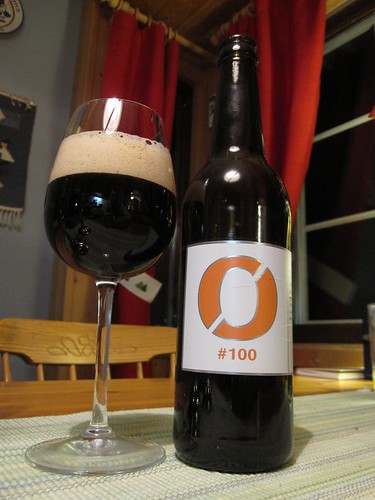
A bottle of Nøgne Ø #100
In 2004, Tore Nybø and his sister Cecilie bought a large post in the brewery, during a critical phase when the brewery had almost stopped because of a conflict between the owners. Fortunately, the Nybøs sided with Kjetil and helped him get the brewery up to speed again. Tore, also a seasoned homebrewer, even helped Kjetil compose and brew his 100th batch - #100, today one of their flagship beers - later that year.

The brewery continued to struggle over the next couple of years, but slowly started making a profit and by the fall of 2005 they had outgrown the garage they had used since 2003. With the help of a new investor they found a new brewery location - Gamle Rygene Kraftstasjon. Located on the border between Grimstad and Arendal, this old hydro electric power plant was leased for ten years and converted into a brewery. And in February 2006 the new brewery was operational.

In Norway things were moving slowly, most beer drinkers and bars still went for industrial lagers and the few decent beer pubs you could find only sold craft beer on bottle, not on draft. What helped make Nøgne Ø better known in their home country was their annual Christmas beers - God Jul - which has won the Christmas beer tests in many Norwegian newspapers, year after year, resulting in many beer drinkers trying a Nøgne Ø beer for the first time.

However, it was through export that Nøgne Ø started making a profit, first selling their beer to Denmark and then, thanks to the Shelton Brothers, to the large US market.

2008 - Nøgne Ø strikes Gold in the US

For the World Beer Cup in San Diego in April 2008, Nøgne Ø submitted beers in several categories, but without very high expectations. The result was an astounding success, they took home two medals - a Gold for their Dark Horizon (First Edition) imperial stout and a Silver for their Porter! It was the first time a Norwegian brewery had won medals at the World Beer Cup, and their success made them a household name in the US craft beer market, leading to higher sales figures and collaboration beers with the likes of Jolly Pumpkin and Stone Brewing Company.

This success came at a time when things were finally starting to change in Norway, by the end of 2008 a number of beer bars in Oslo, Kristiansand, Stavanger, Bergen and Trondheim had erected beer towers with the Nøgne Ø logo on them and started selling great craft beer on draft. It was a watershed, suddenly beer drinkers had non-Lager alternatives when they wanted a draft beer. From 2008 to 2010, the beer scene in Norway changed so dramatically that writing in 2012 it's hard to believe that it once was so poor!

Anyhow, with the Gold medal in their pocket Nøgne Ø became a very popular brewery internationally, not only for collaboration beers (they've brewed with Dugges from Sweden, Tamamura-Honten from Japan and Terrapin from the US, to name a few) but also as a contract brewery. Mikkeller was early on their doorsteps, asking them to brew his Beer Geek Breakfast in the spring of 2008, later he added Beer Geek Brunch Weasel and George to the line-up brewed at Nøgne Ø. Another gypsy brewer to approach them was Christian Skovdal Andersen of Beer Here fame, he had the Mørke Pumpernickel Porter brewed at Nøgne Ø.

Gift from Japan, a wooden sake barrel.

Between brewing beer and touring for Nøgne Ø, Kjetil also spent some time in Japan to learn how to brew sake. He brought that knowledge with him, a ton of Japanese high quality rice and some sake yeast back to Norway and created a small sake brewing plant at Nøgne Ø. In 2010 they released three different sakes, making Nøgne Ø the first official sake brewery in Europe!

2012 - The current situation

As they entered 2012, Nøgne Ø was brewing and selling more beer than ever before, but a couple of tough decisions had to be made. First of all, should they stay or should the grow? The lease at Gamle Rygene Kraftstasjon, which they had outgrown, didn't expire until 2015, so if they decided to stay they could not grow much for the next three years. After much delibaration it was decided to find a new location and construct a larger brewery.

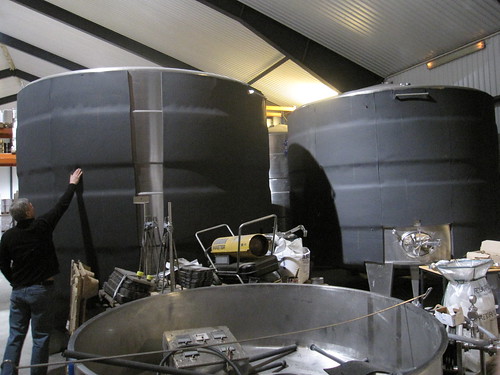
Tore Nybø inspecting new fermentation tanks.
The other tough question was that of the General Manager of the brewery. Despite the successful growth since he was hired in 2010, Haldor Berge had little understanding of the beer scene and the brewing process and Kjetil felt he needed someone more familiar and understanding in that role. In the end, the choice fell on his longterm partner and part-owner, Tore Nybø, who took over the job as General Manager of Nøgne Ø on March 1st 2012, heralding a new era for the brewery.

With Tore safely in the chair, Nøgne Ø is now planning ahead for a large new brewery, which will be constructed in an old boat warehouse - when the current occupants have moved out in the fall 2012. The new brewery should be operational in the spring 2013 and will feature a large tasting room and restaurant for visitors to the brewery.

On my visit to the brewery in April 2012, Tore and Kjetil was busy with a number of projects for the near future. Kjetil was in the process of packing a number of different beers for shipment to the US, where they will participate at the World Beer Cup in May 2012. One of these beers is their unique Red Horizon, a 17% abv strong ale brewed with sake yeast! It will be very interesting to see how that beer is received by the beer judges, perhaps another medal for Nøgne Ø?

While at the brewery I also got the opportunity to taste a brand new beer, Citrus Hystrix IPA, which is an India Pale Ale made for the restaurant chain Bølgen & Moi and brewed with rye, oats, kaffir lime (aka Citrus Hystrix) and tangerine juice! It tasted like no other IPA I've tasted before, fruity and spicy but still with a good hop bite to it. This beer will probably appear on cask at several beer festivals this spring, at least at Haand 2012 in Drammen, Norway.

During the visit, Tore told us that while Nøgne Ø used to export 65% of their beers, only two years ago, they now only export about 25% - everything else is soaked up by the growing Norwegian market. Which is great news for us Norwegians. To keep up with the demand, they've hired an external warehouse where they have installed a number of large fermentation tanks. When they make a new batch of beer, they use a tractor to pull a 50 hl tank of wort up to the warehouse where they pump it onto a tank for fermentation! It's a slow and tiresome job, but it's the only way to make enough beer at their current brewery.

As we're approaching spring 2012, things have never looked so good for Nøgne Ø. They've got a new General Manager, who knows and cares about craft beer, they've got a number of new beers out, the demand for their beers just keep growing and they've got the plans ready for a shiny, new brewery which should start operating in the spring 2013.

Happy 10th anniversary, Nøgne Ø!

Gamle Rygene Kraftstasjon - the current home of Nøgne Ø.

Photos from the visit to Nøgne Ø can be found at: Flickr.

PS. Because of their attendance at the World Beer Cup, Kjetil and Tore will be touring the US in late April and early May, attending Nøgne Ø beer tastings and visiting breweries. Back in Europe, others from Nøgne Ø will man the stands at Haand 2012, Copenhagen Beer Celebration and Copenhagen Beer Festival in May 2012.

Thursday, April 12, 2012

Ægir Bryggeri - beer for gods

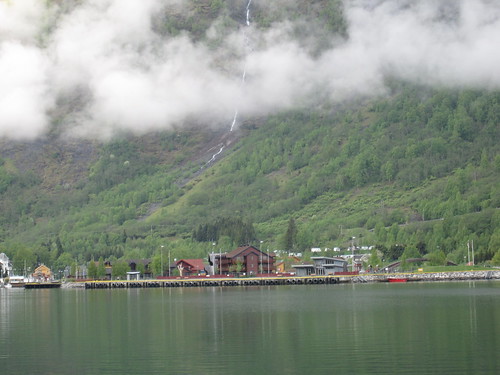
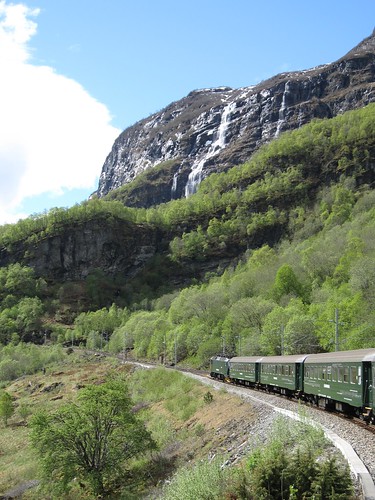
Beautifully located between steep mountains at the innermost part of the Aurlandsfjord, a southern arm of the famous Sognefjord on the west coast of Norway, the small community of Flåm has attracted tourists for centuries and still is a popular stop for cruise ships going up the Sognefjord. Flåm is also the end station of the 20 km long Flåmsbana railway line, known as the most beautiful train ride in Norway, going between Flåm at sea level and the Myrdal Station on the Bergen Line at 866 m above sea level.

Flåmsbrygga where large cruise ships arrive in summer.

Besides its breathtaking natural attractions, Flåm also offers a world class brewery - Ægir Bryggeri - which this post will be about.

The small start

Back in 2004, American design consultant Evan Lewis and his Norwegian wife, Aud Melås, decided to move from California back to her native Flåm in Norway. It was part of a dream for both, she wanted to run a hotel and restaurant business while Evan, who had been a homebrewer since the age of 17, dreamed of turning his hobby into a profession.

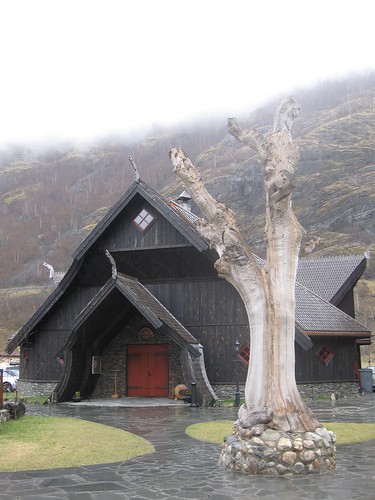
Ægir brewery and pub in Flåm.
After a couple of years of constructions, the Flåmsbrygga hotel and restaurant opened up, followed in the summer 2007 by the brewpub, housed in a beautiful, Norse dragon-style, wooden building next to the hotel.

Named after the brewer of the gods in Norse mythology, Ægir Bryggeri was a small 10 hl brewpub with a capacity of 1,400 hl beer per year. A simple bottling facility was installed too, to allow Ægir to distribute their beer outside Flåm. In those days craft beer was still in its infancy in Norway, even the best beer bars only sold craft beer on bottle, not on draft, so a bottling line was essential for wider distribution.

The impressive growth

Thanks to some very good, high quality base beers, such as the crisp Bøyla Blonde Ale, the tasty Sumbel Porter and the American style India Pale Ale, and the great atmosphere of the brewpub, Ægir experienced a phenomenal growth and almost instant recognition in Norwegian beer circles - it has been voted the Best Brewpub in Norway every year since 2008 by the 100 thousand members of Norøl and Norbrygg!

Because of the rapid growth, Evan hired brewer Dave Gardonio from Toronto, Canada, to help out with the daily operations at Ægir. By the end of 2009, Ægir sold 60% of their beer outside Flåm and there was no way they could keep up with the growing demand at their essentially brewpub-sized brewery. They would either have to refuse more orders or come up with a plan for how to meet the growing demand.

In Early 2010, Evan decided to "outsource" his most popular bottled beers, to have them brewed on contract at another brewery, to save the Ægir brewing capacity for making draft beers and for experimenting with new beers. He chose to have his bottled beers brewed at De Proefbrouwerij, a world famous contract brewery in Lochristi, Belgium, that already had craft brewing legends such as Mikkeller and BrewDog as clients.

View of the central fireplace at the Ægir pub in Flåm.

On my previous visit to Ægir, in May 2010, they had just received the first bottles of India Pale Ale from De Proef and Evan admitted it was difficult to exactly reproduce the aroma and flavor of the Flåm brewed original. But after some tweeking and feedback to De Proef, green light was given and bottled Ægir beers started to arrive from Belgium.

And the exceptional growth continued, both the bottled beers and now also kegged beers took off like never before in Norway. New beer bars, selling craft beer on draft, appeared in all the bigger cities. A few restaurants even did the unheard thing of pairing dishes with beer on their food menus! In the span of 2010, Ægir beer sales grew by a staggering 115%!

Ægir Natt Imperial Porter - a personal favorite.

Thanks to contracting out the brewing of Rallar Amber Ale, Sumbel Porter, India Pale Ale and other Ægir fixtures, Ægir had time to play around with new recipes too, introducing new beers from their brewpub - such as the Roggenbier (draft only) and the tasty Natt Imperial Porter - a personal favorite. They also barrel aged the latter, creating the very popular Lynchburg Natt.

A new brewery takes shap

With their continued growth, it became obvious to Evan that they not only should but could, thanks to the financial strength of a popular brand, bring their bottled beer production back to Flåm. Plan for a 510 m² warehouse in Flåm was redrawn and expanded to a 1,200 m² building, to house both the planned warehouse, a brand new brewery, a small distillery and a new bottling line.

The new 1,200 m² Ægir Bryggeri complex in Flåm.
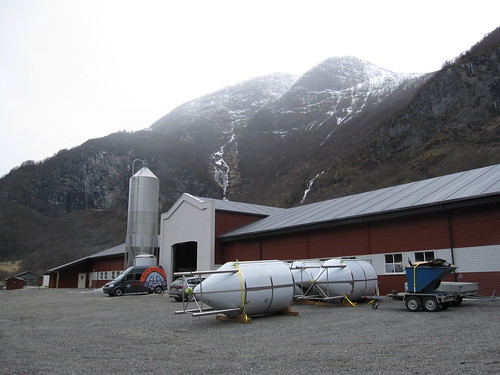
A plot of land on the banks of the Flåmselvi river, on the south side of the E16 highway through Flåm, was selected for the new brewery complex and construction work started in 2011. By the time of my recent visit, in April 2012, the large building was finished and the warehouse and a 180-litre distillery was already in use.

The new brewery will consist of a 35 hl four-vessel brewhouse from Newlands Systems Inc in Canada, with six 70 hl fermenters and two similar sized conditioning tanks, giving Ægir an initial brewing capacity of 8,000 hl per year - about six times higher than the brewpub. And they have enough space to expand the brewing capacity up to 35,000 hl/yr!

Outlooks for 2012

Most of the tanks and the bottling line have arrived in Flåm, but still awaits final assembly at the new brewery. Right now it looks like the brewery installation will take place in May 2012, so we may see the first Ægir beers roll out of the new brewery in time for their 5 year anniversary. Taking the production of their bottled beers back to Flåm, after two years of contract brewing in Belgium, would be a great way to celebrate five years in the brewing business.

In the meantime, the old brewpub is brewing at full steam to fill up orders from Vinmonopolet and other beer thirsty clients. Vinmonopolet, the Norwegian government owned chain of liquor stores, wanted a Norwegian brewed Abbey Dubbel style of beer and Ægir rose to the task, taking inspiration from their very popular Ægir Julebrygg (green label), and created Ægir Skumring Dubbel - a 7% sweet, spicy and fruity dubbel. Ægir will also get their Scotch Ale listed at Vinmonopolet later this year, so that's even more great news.

Ægir Skumring Dubbel - a tasty new beer.

In addition to brewing beer, Ægir is also experimenting with their own distillery. Expect more types of akvavit to be bottled and ready for Christmas (an important akvavit season in Norway) this year.

As mentioned above, this summer Ægir Bryggeri will celebrate their 5 year anniversary. Expect news of a big party to be published soon. If you're in Norway at the end of June you may wish to consider a trip to Flåm :)

Getting there

Visiting Ægir and Flåm may seem like a daunting task, it does look fairly remote when you look at a map of Norway. But it's truly worth it, the trip to Flåm will take you through some of the most scenic parts of Norway, with long fjords, waterfalls and steep mountain sides hiding deep valleys. 

View from the train on Flåmsbana.
As briefly mentioned, at the start of this post, there are several modes of transport that can get you to Flåm. Many visitors will come by the sea, on big cruise ships, and in that case you're all set. If you're in Bergen during the summer season you could also take the Fjord1 ferries, they connect many communities on the west coast and also stops at Flåmsbrygga.

If the sea is not your thing you still have two choices - either to come by rail or by road.

There are daily trains going between Oslo and Bergen, following the Bergen Line across the mountains and stopping at the Myrland Station. There you will have to get off and take the Flåmsbana train which departs hourly in the summer season and takes you down to Flåm in less than an hour.

If you decide on driving, it's a two and a half hour or 166 km long trip along the E16 highway from Bergen. From Oslo it's between 330 and 350 km, depending on the specific route you take, the longer (E16) is actually the shortest in time - taking about four and a half hours to drive.

The best time to visit is in May-June, before the onset of tourist season and the large cruise ships, or in the early fall when the tourists have left. Then Flåm returns to a tranquil place and the brewpub becomes less crowded.

Photo sets from Ægir and Flåm can be found at Flickr: May 2010 and April 2012.

Sunday, April 1, 2012

Abbaye Notre-Dame d'Orval

For beer lovers, the small country of Belgium provides an almost infinite source of variation on what constitutes a beer - from sour, wild yeast based ales, fruit beers, spiced beer and farmhouse ales to the various abbey styles (dubbel, tripel, quadrupel). And, not to forget, the famous Trappist beers, still being brewed by monks of the Order of Cistercians of the Strict Observance - better known as Trappists.

The Authentic Trappist Product logo.

Trappist beer

Trappist beer is not really a beer style, even though you will often find them listed under the same heading at beer pubs around the world. A Trappist beer can be blond or dark, it can be sweet or dry, it can be strong or it can be low in alcohol. The only thing that unites the Trappist beers is how they are made: They have to be brewed at a Trappist monastery and by the monks (though there is some leeway, the monks can hire secular workers to handle some of the brewing operations).

In 1997, eight Trappist monasteries founded the International Trappist Association to prevent non-Trappist companies from abusing the Trappist name. Their Authentic Trappist Product logo can only be carried by products that have been made at genuine Trappist monasteries - be it cheese, jam or beer.

Today there are seven Trappist monasteries brewing beer, one located in the Netherlands - the Onze Lieve Vrouw van Koningshoeven known for their La Trappe series - and six in Belgium: Abbaye Notre-Dame de Scourmont (Chimay), Sint-Benedictusabdij de Achelse Kluis (Achel), Abdij Sint-Sixtus (Westvleteren), Abdij van Onze-Lieve-Vrouw van het Heilig Hart (Westmalle), Abbey of Notre-Dame de Saint-Rémy (Rochefort) and Abbaye Notre-Dame d'Orval (Orval). I've noted the name of their beers in parentheses. There is also a Trappist monastery in France, L'abbaye du Mont des Cats, but their Biere Trappiste is brewed by the Trappist monks in Scourmont and so does not qualiify as an authentic Trappist beer.

This post is about one of the six Belgian Trappist breweries: Abbaye Notre-Dame d'Orval.

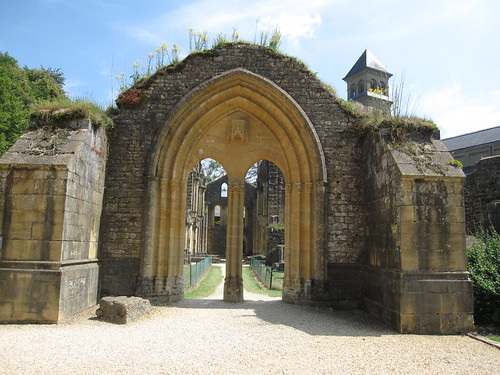
Ruins of the old Orval Abbey, destroyed in 1793.

Abbaye Notre-Dame d'Orval

Abbaye Notre-Dame d'Orval or Orval Abbey was founded in 1132 by a group of Cistercian monks from the Trois-Fontaines Abbey in Champagne, who settled in the remote Gaume region in the far south east of Belgium, just a kilometer north of France, in what is now known as the Belgian province of Luxembourg.

Trout with a golden ring.
Orval means "golden valley" and a popular myth says it originated with Countess Mathilde of Tuscany (1046-1115). One day, while she was out hunting in the woods of the Count de Chiny, she stopped in a valley to drink from a fountain there. By accident her wedding ring fell into the water. She went to a nearby chapel and began to pray. A trout then appeared on the surface of the water, carrying in its mouth the precious ring. Mathilde cried out: "This is truly a golden valley!"

Despite wars and fires the abbey functioned for more then six hundred years, until 1793 when the French Revolution arrived at their gate. In revenge for having sheltered Austrian troops, the French revolutionary troops burned down the abbey and dispersed the monks. Just like they soon would do with the monasteries in Bavaria.

For a hundred years all that remained were the ruins, but in 1887 the land and ruins were acquired by the Harenne family. In 1926, they made a donation of it to the Cistercian order, allowing them to return and rebuild the Orval Abbey. Between 1926 and 1948, the new monastery was constructed, and in 1935 Orval regained the rank of abbey.

Orval Trappist Beer

In 1931, the monastery hired the German brewmaster Martin Pappenheimer (1883-1942) to create a recipe for a beer they could brew. Together with the two Belgian brewers, Honoré Van Zande and John Vanhuele, who were employed to brew at the monastery, he came up with a unique recipe.

Orval Trappist Beer.
Inspired by English brewing, Orval is a top fermented beer that is dry-hopped for 2-3 weeks (large "tea" bags full of hop cones get soaked in the beer as it slowly goes through secondary fermentation). Commonly done in English brewing, dry-hopping was and, to some extent, still is a novelty in Belgium. Finally, to give the beer a real Belgian twist, a local wild yeast of the Brettanomyces strain gets added to the beer, giving it that funky, tart expression as it ages in the bottle.

To this day, Orval only brews this one beer of 6.2% ABV, though they also make a weaker 3.5% ABV version, called Petite Orval, for use by the monks at the monastery.

Orval beer is sold in a specially designed bottle and served in a specially designed Orval glass. And if you look closely at the logo on a bottle you will notice the jumping trout with the golden ring in its mouth, mentioned above in the Countess Mathilde myth. Supposedly, the well that fed the fountain where Mathilde lost her ring is the same well that is used as water supply when brewing the Orval.

A l'Ange Gardien

In July 2011, the monastery opened up a restaurant and tasting room, called A l'Ange Gardien, just outside the walls of the abbey. A l'Ange Gardien, which is French for "guardian angel", serves beer and cheese made at Orval Abbey, allowing visitors to enjoy the Trappist treats almost onsite.

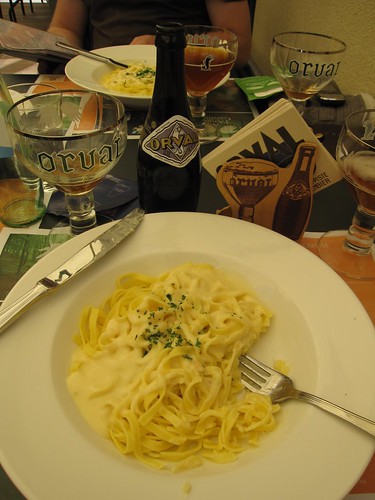
Tagliatelles à la crème d'Orval

The restaurant has a good food menu too, usually with ingredients from the abbey - such as the delicious tagliatelle dish I had which came with melted Orval cheese on top. It went really well with the beer.


I highly recommend a visit to the beautiful and tranquil Orval, the only downside is that you really need a car to get there - it is too remote for public transport to have discovered the place. Which is part of the charm anyway :)

Photos from the visit to Orval can by found at Flickr.