Showing posts with label belgia. Show all posts

Friday, June 8, 2012

A trip to Ostend

Oostende, or Ostend in English, is a seaport city in West Flanders, between Zeebrugge to the northeast and Dunquerke, in France, to the southwest. With a population of just 70 thousand, a maritime setting with fishing industry and long sandy beaches, Ostend is a popular summer holiday destination for the Belgians. Recently it has also started sporting a pretty good beer scene, which was an added attraction for me when I found myself in Brussels with a couple of days to kill.

Lighthouse at the end of the Western Pier in Ostend.

Getting there

Ostend is the end station of a more or less direct railway line from Brussels. You can get there, without changing trains, in less than one and a half hour. Which is hardly longer than when going to Bruges. And with trains departing hourly from Bruxelles-Central it's both fast, cheap and easy to get to Ostend for a daytrip or for staying a few days.

The railway station in Ostend, a beautiful, baroque style building from just before World War One - a sightseeing target by itself, is located right next to the harbor in Ostend, within easy walking distance from a number of hotels along the Visserkaai and old town Ostend.

General sightseeing

Ostend has a fairly small old town, roughly a square of 0.5 km times 0.5 km - fenced in by the sea to the north, the harbor to the east, the Mercator yacht marina to the south and the Leopold II-laan to the west. Old town is basically where all the fun takes place, so you can easily get around on foot to visit the attractions, stroll along the beaches or out on the long Westerstaketsel - the Western Pier.

Marbi of Oostende on its side in the dry dock.
If you're interested in history it's also worth mentioning that the beaches of Ostend are lined with old bunkers from World War Two, built by the Nazi German authorities as part of their defenses against an Allied invasion - the so called Atlantic Wall. There is also a restored fort from the Napoleonic Wars, which is open to the public and even has a brasserie that is open all days, except Mondays, from April 1 to October 31.

Since June 2007 a free ferry service, the Roger Raveel, takes passengers from the city side to the fish market east of the harbor. On that side you will also find the aformentioned Fort Napoleon as well as the dry docks of Industrielle des Pêcheries - where, on my visit, the fishing vessel Marbo Oostende had almost overturned and destroyed parts of the dock.

If you consider going to Ostend in May, beware that the last weekend of May is when the annual Oostende voor Anker or Ostend at Anchor festival is held. This festival sees the population of Ostend grow from 70 thousand to several hundred thousands. Things will become more crowded and noisy then, with live music competing with the noise of steam driven cars, and there will be a hundred market stalls along Visserkaai, selling freshly cooked seafood, dried or smoked fish, artisanal cheese and produce, clothes, ropes and what not.

Another good reason for coming to Ostend is to explore some of the beer and food places that have popped up the last few years - from beer pubs such as 't Kroegske, Café Bottteltje and 't Eilandje to the highly acclaimed beer restaurant De Bistronoom.

Café Botteltje


Café Botteltje - the biggest beer selection in Ostend.
Located on Louisastraat 19, north in Ostend, Café Botteltje is an English style pub, with heavy wooden furniture and wooden panels on the walls. The beer selection, however, is very Belgian with 13 beers on tap and more than 300 types on the bottle menu. The place also sports a big genever selection, but I stayed with the beer.

During my visit, Botteltje had the refreshing Lefebvre Hopus on draft, as well as the delicious St Bernardus Tripel, La Trappe Dubbel and La Chouffe. The service was surprisingly fast, not typical for Belgium, with a waiter stopping by my table almost instantly when I had drained my glass. That's a big plus in my book. As for the food they served I went for their beer dinner, where each dish is paired with a beer (you get a glass of that beer with the dish). It was really well made, though some of the beer and food combinations were more OK than good.

All in all, if beer selection is what you're looking for - check out Café Botteltje.

De Bistronoom

A great place to go for lunch or dinner is De Bistronoom in the south of Ostend, on Vindictivelaan 22, overlooking the Mercator Yacht Marina. This place opened up three years ago but has already caught the attention of the RateBeer community, earning the restaurant a spot in the short list of the world's Best Beer Restaurants 2012.

De Bistronoom beer restaurant in Ostend.

De Bistronoom is owned by Christophe Pelfrène, the former chef of Ostende Queen, who has got what must surely be the biggest selection of 75 cl Belgian beer bottles - in his own words about 250 types! But he stresses that De Bistronoom is a beer restaurant, not a beer bar, so any RateBeerian who comes asking for a beer will politely be asked to visit one of the nearby pubs instead.

La Corne du Bois des Pendus La Triple 10º
- the only draft beer at De Bistronoom.
As chef for the De Bistronoom, Pelfrène enlisted the help of his girlfriend, Stefanie De Vos, who makes really subtle, regional dishes, nothing too spicy, that goes really well with Belgian beer.

Despite having two small children together, the youngest just a few months old, the two keep the restaurant open and running on all days, except Tuesdays and Wednesdays. They serve lunch from Noon to 2 pm and dinner from 7 pm until 9 pm. There is no a la carte menu because Pelfrène relies on what he can find fresh that day - typically fish fresh off a fishing vessel, before he and De Vos compose the lunch and dinner menu.

What I really liked about De Bistronoom, except for the delicious food and beer pairing - of course, was the relaxed atmosphere and how Pelfrène would come out with each dish, tell us about it and then inform us about the choice of beer. At the end of the night I felt like I was visiting the home of a friend, being served their homecooked food and beer from the cellar and chatting with the owner as if we'd known each others for years.

I just can't recommend De Bistronoom highly enough, this really is one of the best beer restaurants in the world. It's no wonder Chris Lively of Ebeneezer's Pub has asked them over to Maine to cook for him!

't Eilandje

The final place I'd like to mention (I missed 't Kroegske because they closed earlier than I thought) is a beer bar on the east side of Ostend, near the harbor and Visserskaai, in Bonenstraat 5: 't Eilandje.

't Eilandje, which means "the island", opened up in June 2011, so it’s a fairly new pub. But its atmosphere radiates old days, I'd say the 1940s or 50s, from the low, old-style jazz music they play to the decoration in the pub. It’s really a cozy and quiet place to sit down, and the guests are a bit more adult than at other pubs in the area.


Just like at De Bistronoom, a married couple is running 't Eilandje. Both seem very proud of their new place and took time to talk with us and tell us about the place and the beers they've got. They told us they had kept asking Rodenbach to send them kegs of Rodenbach Grand Cru and that Rodenbach finally gave in and now sends them kegs of this delicious beer on a regular basis.

The beer selection is limited, but pretty good. In addition to the Rodenbach Grand Cru they usually have the Goliath Tripel on tap and close to 30 different bottled beers, including St Bernardus Abt 12 and six of the seven trappist breweries (Westvleteren is the only one missing). In the summer season they've got an outdoor area, on the square, where you can sit and smell the salty sea air from the nearby harbor and watch the Ostenders walk by.

't Eilandje is a small but great and friendly beer pub.


Bouillon Airborne Biere Brune at Café Botteltje
- served in the proper earthenware mug.


Photos from the visit to Ostend at Flickr: Botteltje, De Bistronoom, 't Eilandje and Ostend.

Sunday, June 3, 2012

Sunday at de Grote Dorst

Back in March 2012 I made my first visit to the lambic café In de Verzekering tegen de Grote Dorst in Eizeringen in Pajottenland, Belgium. It was a special BBQ event on a cold Friday evening. At the end of May I again found myself in the Belgian capital, now on a warm and sunny Sunday, so I decided to make another visit to see what the café was like on a church Sunday.

Café In de Verzekering tegen de Grote Dorst in Eizeringen.

In de Verzekering tegen de Grote Dorst or just de Grote Dorst is located on the town square in Eizeringen, opposite the Saint Ursula church. It's only open from 10 am to 1:30 pm on Sundays and church holidays, because it is run in their sparetime by the brothers Kurt and Yves Panneels.

Because it was a Sunday, with few buses going from Brussels to Eizeringen, and I was accompanied by three friends, we opted for a taxi as our means of transportation (making sure it would pick us up again later). Eizeringen is about 15 km west of Brussels, but traffic and small roads means you should set aside at least half an hour in getting there.

Kurt Panneels behind the bar at de Grote Dorst.
We arrived a little after 10 am to find one of the brothers, Yves, busy bringing scooters out of the garage. It turned out he was renting out scooters, for 50 Euro per day, and was taking a group of visitors to the open day at geuze blender Tilquin. I politely declined the offer to join the group as I already had plans for the afternoon and also wanted to spend some time at de Grote Dorst before leaving the Brussels area.

Inside the café I found the other brother, Kurt, manning the bar, and plenty of vacant tables. So my friends and I sat down at a smaller one, and started ordering rare bottles from the cellar of de Grote Dorst.

A rare beer we got to try was a geuze the brothers had blended themselves, just like lambic café owners did a hundred years ago: Geuze tegen de Grote Dorst. This 5% abv geuze, a blend of 11 different lambics, had been bottled in December 2008, so it was three and a half years old when we got to taste it. It was a well made blend, not very complex, but with a nice lemon sourness, hints of oak and with a mild bitter finish. Refreshing and drinkable.

Eylenbosch Guzuze 1990 - still so fresh.
A more exciting entry on their beer menu was the twenty-two year old Eylenbosch Gueuze 1990, one of the last vintages made by this old brewery in Schepdaal. Eylenbosch, which had been making geuze since 1851, was acquired by the Keermaeker brewery (known for the Mort Subite brand) in 1989 and closed down in 1991. Since then Keermaeker has ended up in the Alken-Maes group who now owns the Eylenbosch name but without actively using it. Anyhow, the 1990 Eylenbosch Gueuze was the real deal. It poured a clear golden color, it smelled of ripe apples and sherry cask and the flavor was harmonic and sour, with notes of dry leaves, lemon, apples and sherry. A delicious and surprisingly fresh sour ale.

When church service ended at Noon, a number of the faithful crossed the small square and entered de Grote Dorst for a glass or two of kriek, gueze or lambic. It was interesting to watch this mixture of locals, often in their 70s or 80s, and the young, foreign beer geeks who had already been at the café for a couple of hours. It's no doubt the Panneels brothers have struck a chord in the local community with their old style Flemish lambic café, just as they have in the global beer community - the users of RateBeer ranked de Grote Dorst one of the best beer bars in the world both in 2011 and 2012. So, the future of de Grote Dorst is looking good.

Speaking of beer geeks. A couple of tables away from ours sat three German sour ale fans, including Ulrich "Uli" Kremer, a well know geuze blender from Duisburg who blends geuze under his own h.ertie label. I keep running into him at breweries, bars and beer festivals all over Belgium. It's a small world and at de Grote Dorst you will meet them all.

At 1 pm the taxi was back to pick us up and I said my heartfelt farewells to Kurt Panneels, promising to come back to this peaceful and great lambic café in the heart of Pajottenland very soon.

Geuze blender Uli, left, and Yves Panneels on the scooter.


Photos from my two visits to de Grote Dorst: March and May 2012.

Thursday, May 31, 2012

21st Weekend of Spontaneous Fermentation

Belgium is well known for a wide variety of beer styles and for its many beer festivals, one of the more special and longest running festivals is the Weekend of Spontaneous Fermentation which was held for the 21st time on May 26-27, 2012.  This is an account of my second visit to this unique sour ale festival.

Kerk Sint-Gerardus Majella in Opstal, Buggenhout

How to get there?

Opstal is a small village on the outskirts of Buggenhout in East Flanders, about 25 km or 40 minutes drive north west of Brussels. It is not necessarily easy to get to Opstal, I don't know about the buses but you can either share a cab or take a train to the nearest train station and walk from there. Taxis are rare to find in the countryside, so don't count on finding one if you get off at a small railway station.

Feestzaal Beukenhof on Broekstraat 18
The nearest train station to the Feestzaal Beukenhof on Broekstraat 18, where the festival is held, is the one in Heizijde - a little over 2 km or 20 minutes walk away. If you're in Brussels, go to the Bruxelles-Nord train station where you can catch several trains an hour to Heizijde. From Heizijde start by walking north along the Klein-Antwerpenstraat which changes into Kakemanstraat, follow this road until it ends and then turn left onto Varentstraat. Follow this road into Opstal and finally turn right on Broekstraat where the festival area is located just past the church, on the other side of the road. The train ride should take a little over half an hour, so all in all it will take you close to an hour to get from Brussels to the festival.

I ended up sharing a taxi with three friends, to cut the travel time and expenses. It still took us a good 40 minutes to get there, because of outdated GPS data and a confused driver who failed to read the road signs (taxi drivers in Brussels seem lost as soon as the leave the city, so always be alert). We arrived a little later than planned, almost half an hour after the opening, for a grand total 60 Euro. 

So, even though taxi is the fastest and easiest way to get to the festival, always make sure to have plenty of time to get there for the 3 pm opening.

The Weekend of Spontaneous Fermentation

Weekend der Spontane Gisting, as it's known in the local Flemish dialect, or The Weekend of Spontaneous Fermentation is an annual beer festival arranged by an organization called De Opstalse Bierpallieters - "the beer tasters of Opstal" - in Opstal, Buggenhout. This 2-day festival is always held on the last weekend of May, 2012 being the 21st time it was held.

Casks of young lambic and kriek lining the wall.
What makes this festival so special is that it focuses exclusively on one of the most remarkable beer styles that exists in the world today, a type of beer that has died out in most other countries, that of spontaneous or wild yeast fermentation. 

Spontaneous fermentation is actually a pretty wide category and not really a beer style. The common theme is that you don't use a regular "tamed" yeast culture, such as Saccharomyces cerevisiae (for top fermented ales) or Saccharomyces carlsbergensis (for bottom fermented lagers). Instead, the brewer relies on the ambient air of the brewery to provide the untamed, wild yeast to start the fermentation. This is a much less controlled way of fermenting beer, with many potential problems such as infection due to the open cooling vats (coolships), but it also produces some of the most amazing beer styles you can immagine:

  • Fruit lambic: Usually dry, fruity and colorful beers.
    • Most often made with cherries (kriek) or raspberries (framboise / framboos).
    • Other fruits used may be peaches, currants or strawberries.
    • Some brewers sweeten their fruit lambics to make them easier to sell.
  • Faro: This is a type of geuze with brown sugar added for sweetening.
    • Faro was very popular in late 19th century Brussels but is now almost gone.
  • Geuze / gueuze: A blend of several years, refermented in the bottle.
    • Many geuze blenders use a blend of 1, 2 and 3 year old lambics, where the young lambic provides sugar for the bottle refermentation and the older character.

The geuze, in particular, has made a revival thanks to its dry, fruity and often sparkling - Champagne like - character. Thanks to its production and long maturation, the geuze is known to cellar well for up to 20-30 years!

The Weekend of Spontaneous Fermentation 2012.

The atmosphere and the beers

In 2012 the festival was held on May 26-27 at the Tapperij Beukenhof in Opstal. Like the year before, the entrance was free, so you only had to pay for what you tasted - and the prices are really reasonable, with twenty year old bottles of geuze going for only 15-20 Euro!

This has to be one of the most relaxing festivals in the world, every visitor is seated by one of the many tables and all orders are placed by holding up the hand, just like in school, so that one of the staff notices and comes over to your table. The beer menu is numbered so you just have to point to the items of interest and indicate if you want more than one glass, in case you want to share a bottle. It works really well, as it removes the concept of queues and gives plenty of space on the floor, allowing guests to pass freely to the restrooms or in and out of the festival.

Parallel tasting cask lambics from four different breweries.
The visitors to the 21st Weekend of Spontaneous Fermentation were treated to a great mixture of young and and old sour ales. Like last year most of the lambic brewers of Belgium and some of the blenders had sent in casks with lambic and kriek.

In all there were 12 different lambics served on cask, including very nice ones from 3 Fonteinen, De Troch, Hanssens, De Cam and Cantillon, as well as 8 kriekenlambieks.

It's smart to start out with the young lambics as they tend to be simpler and less acidic than some of the aged oude geuze bottles. As for the amount of alcohol, don't worry - most lambics are just 5% abv and the tasting glasses are 15 cl - so take your time and do parallel tastings to see how the lambics differ in fruitiness, sourness, bitterness, woodiness and other characteristics. It's both fun and educational to compare notes with table neighbors.

When through with the cask ales it's smart to gang up with some of your table mates to share bottles, many of them are 75 cl and best shared with 3-4 others. There are some 37.5 cl bottles too, but that is still a lot to drink if you want to get through a large number of beers in one sitting. So, sharing bottles is a great way to get through more beers and to make new friends.

One of the older bottles I tried was the 1993 Sélection Lambic Gueuze from Belle-Vue, a beer that hasn't been made since 1999 (probably because Belle-Vue was bought up by InBev). Unfortuanetly, this 19 year old geuze was way over the top, oxidized and with a strong lemon acidity making it almost undrinkable. 

Cantillon Zwanze 2010 - still a winner.
A far better choice was the 2004 vintage of Boon Oude Geuze Mariage Parfait, still fruity and fresh and really well balanced sour ale for just 10 Euro. 

Among the younger sour ales, the Cantillon Zwanze 2010 is always a winner with its wonderful floral (elderflowers) sourness - a refreshing beer I can drink bottles of alone. 

Another bottled highlight was the Girardin Fond Gueuze Bierpallieters 2009, the official Jubileumbier for the 2011 festival. It combined lemon sourness and a mild brettanomyces character with mild oak and dry leaves in a wonderful way. Too bad we were not allowed to buy any bottles to bring home this year.

For those who can't drink sour ales for an entire day, the festival has made an exception to the rule of only having spontaneously fermented beers on their menu: The two local Buggenhout breweries, De Landtsheer and Bosteels, are both represented with their world class beers. De Landtsheer with their Malheur series - including the 10, 12 and Malheur Bière Brut - while Bosteels come with Kwak and Tripel Karmeliet. 

Finally a few words on the food. The festival doesn't serve warm food or any large dishes of cold food, so it's common to bring snacks and food on your own, but they do have a very nice cheese and salami platter and also some sort of sandwiches (which I haven't tried).

Conclusion

After my second year at The Weekend of Spontaneous Fermentation I feel stronger than ever that this is one of the best beer festivals on the planet, it's small, it's quiet and it has the best selection of young and old sour ales you could ever dream of trying. Thus, I have already reserved the last weekend of May 2013 for another visit to Opstal. 

Photos from the festival can be found at Flickr: 2011 and 2012.

Sunday, April 1, 2012

Abbaye Notre-Dame d'Orval

For beer lovers, the small country of Belgium provides an almost infinite source of variation on what constitutes a beer - from sour, wild yeast based ales, fruit beers, spiced beer and farmhouse ales to the various abbey styles (dubbel, tripel, quadrupel). And, not to forget, the famous Trappist beers, still being brewed by monks of the Order of Cistercians of the Strict Observance - better known as Trappists.

The Authentic Trappist Product logo.

Trappist beer

Trappist beer is not really a beer style, even though you will often find them listed under the same heading at beer pubs around the world. A Trappist beer can be blond or dark, it can be sweet or dry, it can be strong or it can be low in alcohol. The only thing that unites the Trappist beers is how they are made: They have to be brewed at a Trappist monastery and by the monks (though there is some leeway, the monks can hire secular workers to handle some of the brewing operations).

In 1997, eight Trappist monasteries founded the International Trappist Association to prevent non-Trappist companies from abusing the Trappist name. Their Authentic Trappist Product logo can only be carried by products that have been made at genuine Trappist monasteries - be it cheese, jam or beer.

Today there are seven Trappist monasteries brewing beer, one located in the Netherlands - the Onze Lieve Vrouw van Koningshoeven known for their La Trappe series - and six in Belgium: Abbaye Notre-Dame de Scourmont (Chimay), Sint-Benedictusabdij de Achelse Kluis (Achel), Abdij Sint-Sixtus (Westvleteren), Abdij van Onze-Lieve-Vrouw van het Heilig Hart (Westmalle), Abbey of Notre-Dame de Saint-Rémy (Rochefort) and Abbaye Notre-Dame d'Orval (Orval). I've noted the name of their beers in parentheses. There is also a Trappist monastery in France, L'abbaye du Mont des Cats, but their Biere Trappiste is brewed by the Trappist monks in Scourmont and so does not qualiify as an authentic Trappist beer.

This post is about one of the six Belgian Trappist breweries: Abbaye Notre-Dame d'Orval.

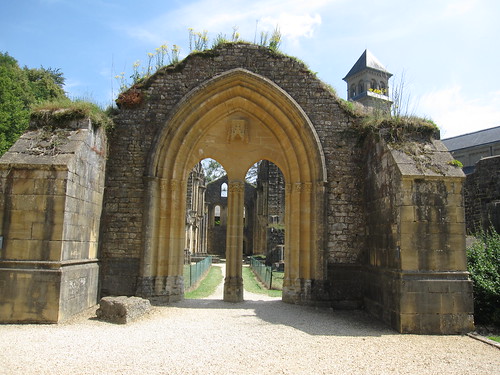
Ruins of the old Orval Abbey, destroyed in 1793.

Abbaye Notre-Dame d'Orval

Abbaye Notre-Dame d'Orval or Orval Abbey was founded in 1132 by a group of Cistercian monks from the Trois-Fontaines Abbey in Champagne, who settled in the remote Gaume region in the far south east of Belgium, just a kilometer north of France, in what is now known as the Belgian province of Luxembourg.

Trout with a golden ring.
Orval means "golden valley" and a popular myth says it originated with Countess Mathilde of Tuscany (1046-1115). One day, while she was out hunting in the woods of the Count de Chiny, she stopped in a valley to drink from a fountain there. By accident her wedding ring fell into the water. She went to a nearby chapel and began to pray. A trout then appeared on the surface of the water, carrying in its mouth the precious ring. Mathilde cried out: "This is truly a golden valley!"

Despite wars and fires the abbey functioned for more then six hundred years, until 1793 when the French Revolution arrived at their gate. In revenge for having sheltered Austrian troops, the French revolutionary troops burned down the abbey and dispersed the monks. Just like they soon would do with the monasteries in Bavaria.

For a hundred years all that remained were the ruins, but in 1887 the land and ruins were acquired by the Harenne family. In 1926, they made a donation of it to the Cistercian order, allowing them to return and rebuild the Orval Abbey. Between 1926 and 1948, the new monastery was constructed, and in 1935 Orval regained the rank of abbey.

Orval Trappist Beer

In 1931, the monastery hired the German brewmaster Martin Pappenheimer (1883-1942) to create a recipe for a beer they could brew. Together with the two Belgian brewers, Honoré Van Zande and John Vanhuele, who were employed to brew at the monastery, he came up with a unique recipe.

Orval Trappist Beer.
Inspired by English brewing, Orval is a top fermented beer that is dry-hopped for 2-3 weeks (large "tea" bags full of hop cones get soaked in the beer as it slowly goes through secondary fermentation). Commonly done in English brewing, dry-hopping was and, to some extent, still is a novelty in Belgium. Finally, to give the beer a real Belgian twist, a local wild yeast of the Brettanomyces strain gets added to the beer, giving it that funky, tart expression as it ages in the bottle.

To this day, Orval only brews this one beer of 6.2% ABV, though they also make a weaker 3.5% ABV version, called Petite Orval, for use by the monks at the monastery.

Orval beer is sold in a specially designed bottle and served in a specially designed Orval glass. And if you look closely at the logo on a bottle you will notice the jumping trout with the golden ring in its mouth, mentioned above in the Countess Mathilde myth. Supposedly, the well that fed the fountain where Mathilde lost her ring is the same well that is used as water supply when brewing the Orval.

A l'Ange Gardien

In July 2011, the monastery opened up a restaurant and tasting room, called A l'Ange Gardien, just outside the walls of the abbey. A l'Ange Gardien, which is French for "guardian angel", serves beer and cheese made at Orval Abbey, allowing visitors to enjoy the Trappist treats almost onsite.

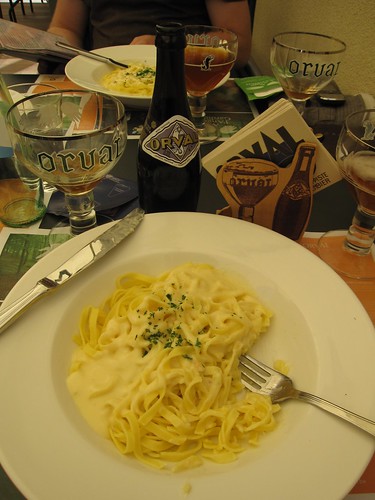
Tagliatelles à la crème d'Orval

The restaurant has a good food menu too, usually with ingredients from the abbey - such as the delicious tagliatelle dish I had which came with melted Orval cheese on top. It went really well with the beer.


I highly recommend a visit to the beautiful and tranquil Orval, the only downside is that you really need a car to get there - it is too remote for public transport to have discovered the place. Which is part of the charm anyway :)

Photos from the visit to Orval can by found at Flickr.


Friday, March 23, 2012

Visit to Cantillon

World famous lambic brewery Cantillon in Brussels, Belgium, is also famous for being a keeper of traditions. The brewery acts as a living museum, with equipment from the early 20th century still in daily use, allowing visitors to experience the history of lambic brewing and gueuze blending.

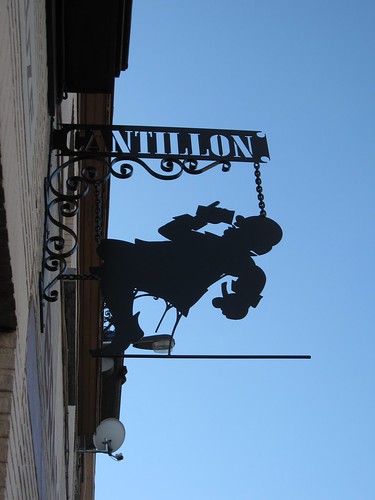
The iconic Cantillon sign outside the brewery. 

Early history - the founding

Located in Rue Gheude 56 in the Anderlecht district of southwest Brussels, just a couple of blocks from the Gare du Midi train station, Cantillon was founded at its present address in 1900 by one Paul Cantillon.

Paul was the son of a Lembeek brewer and had purchased an old warehouse, dating back to 1874, to start blending gueuze which was all the rage in Brussels in those days - most cafés would blend their own gueuze from lambics bought from lambic breweries in Pajottenland - just outside the city.

Initially, there were no plans of brewing lambic at Cantillon. It was Paul's sons, Marcel and Robert, who took this next step. They set about purchasing some second hand equipment and manufacturing a copper mash tun, and in November 1937 the first lambic wort flowed into the coolship at Cantillon - a new lambic brewery was born, and inside the city of Brussels.

In 1962, the twenty year old teacher Jean-Pierre Van Roy met a lovely young girl, Claude Cantillon, without realizing she was the daughter of Marcel Cantillon, then owner and head brewer of Cantillon. Claude and Jean-Pierre fell in love and eventually married, in 1967. The same year they received a son and a future brewer, Jean. Two years later, his father-in-law told him "either you take over or I close the brewery". Jean-Pierre duly did, learrning the art of brewing lambic from his father-in-law.

A copper brewing kettle from 1937 still in use at Cantillon.

Recent history - sticking to traditions

When Jean-Pierre took over the brewery in 1969, he decided to stick with the Cantillon name. For several decades, Jean-Pierre battled an uphill struggle to keep the lambic tradition alive in Belgium, at a time when most other lambic brewers either closed or started producing sweet, fruit beers.

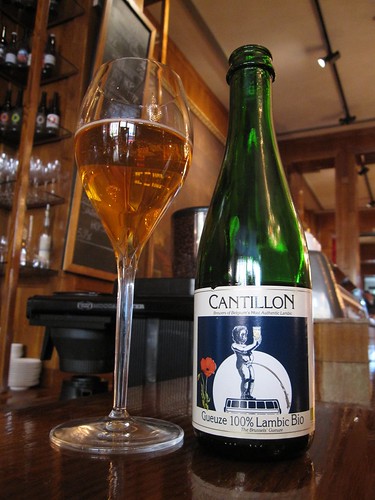
The classic Cantillon Gueuze 100% Lambic Bio.
Only in the last 10-15 years, after the US market discovered his amazing traditional gueuze, tart and sour, has he been repaid for his labor. Cantillon is now recognized, across the world, as a keeper of Belgian lambic traditions.

In September 2009, Jean-Pierre brewed his last batch of lambic, leaving the brewing and gueuze blending to the great-grandson of the brewery's founder: His own son, Jean Van Roy. Jean has learned the art of lambic brewing and gueuze blending by his father's side, over the last twenty years, even introducing some of his own ideas - such as the famed Zwanze series - before taking over as the new head brewer of Cantillon.

Jean Van Roy has shown a greater will to experiment than his father, creating a number of new sour ales and even introducing Roman-style ceramic amphoras for maturing lambic instead of the traditional oak. As of 2012, the Cantillon brewery seems to be in very good and capable hands with the fourth generation of the Cantillon-Van Roy family in charge.

Public Brewing Session

Twice a year, one Saturday in March and one Saturday in November, Cantillon hosts a Public Brewing Session, where visitors can come in and watch the entire process of brewing a traditional lambic. On November 12, 2011, I attended one such brewing session and here follows a few photos and a brief account of that experience.

Brewing a lambic is a time consuming enterprise, because of the unusually long boiling times of 3-6 hours, so the brewing day starts early. At cantillon at 7 am. So get up early if you want to witness it all. Here's a typical brewing schedule:

Hot water and ground malt going into the
mash tun at Cantillon. Notice the leakage!
07-09: Mash-in
Witness the ground malt getting mixed with hot water and poured into the mash tun to extract the fermentable wort. Pay attention to all the cranky mechanics used to close and open ancient valves, and look for sudden leaks that are handled by placing a bucket on the floor.

09-12: Transfer to brew kettle
Witness the filtration and hopping of the wort as it gets ready for transfer to the brew kettle.

12-15: Boil-in
The hopped wort is boiled in two large copper brew kettles for at least three hours, reducing the liquid from 10,000 litres to 7,500 in order to raise the gravity of the wort, break up starches and reduce the bitterness of the hops.

15:30 Coolship
After the long boiling, the wort is pumped to the coolship upstairs, just underneath the ceiling, where the wort is allowed to cool overnight and become germinated with the wild yeast - Brettanomyces bruxellensis - living in the walls of the old brewery. The next day, the cooled wort will be transferred into big oak barrels, formerly used for aging red wines in Bordeaux or Rioja, for primary fermentation, which may take a couple of months, and then aging for up to three years.

The coolship at Cantillon is located right under the ceiling.

The Cantillon Public Brewing Sessions are very popular events in Brussels so the small brewery will quickly feel swamped by people, so it's smart to be there when the brewery opens at 6:30 am and take the very first tour, before the line of people with cameras gets too long. If you do that, you can sit down at the brasserie section and enjoy some of their lambics and gueuze while watching new visitors line up for the later tours.

Cantillon is also open for visits outside the Public Brewing Sessions, both the brasserie and the brewery / museum (self-guided tours). On Mondays to Fridays they're open from 9 am to 5 pm and on Saturdays from 10 am to 5 pm.

A bottle of Cuvée Saint-Gilloise and gueuze cheese at Cantillon.


Photo sets from my visits to Cantillon can be found at Flickr: May and November 2011.