Thursday, April 12, 2012

Ægir Bryggeri - beer for gods

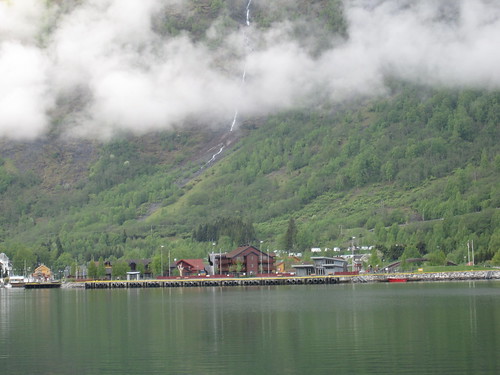
Beautifully located between steep mountains at the innermost part of the Aurlandsfjord, a southern arm of the famous Sognefjord on the west coast of Norway, the small community of Flåm has attracted tourists for centuries and still is a popular stop for cruise ships going up the Sognefjord. Flåm is also the end station of the 20 km long Flåmsbana railway line, known as the most beautiful train ride in Norway, going between Flåm at sea level and the Myrdal Station on the Bergen Line at 866 m above sea level.

Flåmsbrygga where large cruise ships arrive in summer.

Besides its breathtaking natural attractions, Flåm also offers a world class brewery - Ægir Bryggeri - which this post will be about.

The small start

Back in 2004, American design consultant Evan Lewis and his Norwegian wife, Aud Melås, decided to move from California back to her native Flåm in Norway. It was part of a dream for both, she wanted to run a hotel and restaurant business while Evan, who had been a homebrewer since the age of 17, dreamed of turning his hobby into a profession.
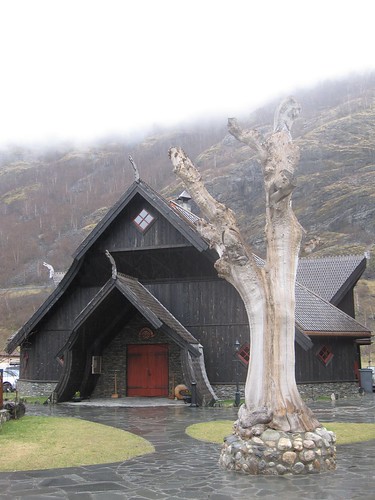
Ægir brewery and pub in Flåm.
After a couple of years of constructions, the Flåmsbrygga hotel and restaurant opened up, followed in the summer 2007 by the brewpub, housed in a beautiful, Norse dragon-style, wooden building next to the hotel.

Named after the brewer of the gods in Norse mythology, Ægir Bryggeri was a small 10 hl brewpub with a capacity of 1,400 hl beer per year. A simple bottling facility was installed too, to allow Ægir to distribute their beer outside Flåm. In those days craft beer was still in its infancy in Norway, even the best beer bars only sold craft beer on bottle, not on draft, so a bottling line was essential for wider distribution.

The impressive growth

Thanks to some very good, high quality base beers, such as the crisp Bøyla Blonde Ale, the tasty Sumbel Porter and the American style India Pale Ale, and the great atmosphere of the brewpub, Ægir experienced a phenomenal growth and almost instant recognition in Norwegian beer circles - it has been voted the Best Brewpub in Norway every year since 2008 by the 100 thousand members of Norøl and Norbrygg!

Because of the rapid growth, Evan hired brewer Dave Gardonio from Toronto, Canada, to help out with the daily operations at Ægir. By the end of 2009, Ægir sold 60% of their beer outside Flåm and there was no way they could keep up with the growing demand at their essentially brewpub-sized brewery. They would either have to refuse more orders or come up with a plan for how to meet the growing demand.

In Early 2010, Evan decided to "outsource" his most popular bottled beers, to have them brewed on contract at another brewery, to save the Ægir brewing capacity for making draft beers and for experimenting with new beers. He chose to have his bottled beers brewed at De Proefbrouwerij, a world famous contract brewery in Lochristi, Belgium, that already had craft brewing legends such as Mikkeller and BrewDog as clients.

View of the central fireplace at the Ægir pub in Flåm.

On my previous visit to Ægir, in May 2010, they had just received the first bottles of India Pale Ale from De Proef and Evan admitted it was difficult to exactly reproduce the aroma and flavor of the Flåm brewed original. But after some tweeking and feedback to De Proef, green light was given and bottled Ægir beers started to arrive from Belgium.

And the exceptional growth continued, both the bottled beers and now also kegged beers took off like never before in Norway. New beer bars, selling craft beer on draft, appeared in all the bigger cities. A few restaurants even did the unheard thing of pairing dishes with beer on their food menus! In the span of 2010, Ægir beer sales grew by a staggering 115%!

Ægir Natt Imperial Porter - a personal favorite.

Thanks to contracting out the brewing of Rallar Amber Ale, Sumbel Porter, India Pale Ale and other Ægir fixtures, Ægir had time to play around with new recipes too, introducing new beers from their brewpub - such as the Roggenbier (draft only) and the tasty Natt Imperial Porter - a personal favorite. They also barrel aged the latter, creating the very popular Lynchburg Natt.

A new brewery takes shap

With their continued growth, it became obvious to Evan that they not only should but could, thanks to the financial strength of a popular brand, bring their bottled beer production back to Flåm. Plan for a 510 m² warehouse in Flåm was redrawn and expanded to a 1,200 m² building, to house both the planned warehouse, a brand new brewery, a small distillery and a new bottling line.
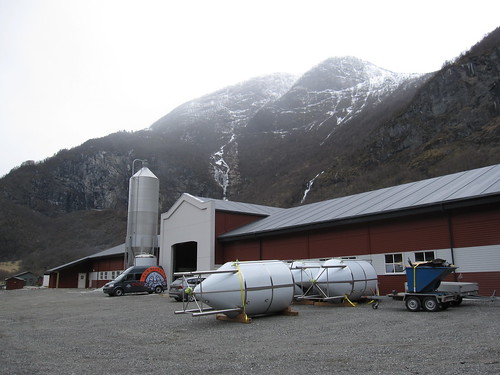
The new 1,200 m² Ægir Bryggeri complex in Flåm.
A plot of land on the banks of the Flåmselvi river, on the south side of the E16 highway through Flåm, was selected for the new brewery complex and construction work started in 2011. By the time of my recent visit, in April 2012, the large building was finished and the warehouse and a 180-litre distillery was already in use.

The new brewery will consist of a 35 hl four-vessel brewhouse from Newlands Systems Inc in Canada, with six 70 hl fermenters and two similar sized conditioning tanks, giving Ægir an initial brewing capacity of 8,000 hl per year - about six times higher than the brewpub. And they have enough space to expand the brewing capacity up to 35,000 hl/yr!

Outlooks for 2012

Most of the tanks and the bottling line have arrived in Flåm, but still awaits final assembly at the new brewery. Right now it looks like the brewery installation will take place in May 2012, so we may see the first Ægir beers roll out of the new brewery in time for their 5 year anniversary. Taking the production of their bottled beers back to Flåm, after two years of contract brewing in Belgium, would be a great way to celebrate five years in the brewing business.

In the meantime, the old brewpub is brewing at full steam to fill up orders from Vinmonopolet and other beer thirsty clients. Vinmonopolet, the Norwegian government owned chain of liquor stores, wanted a Norwegian brewed Abbey Dubbel style of beer and Ægir rose to the task, taking inspiration from their very popular Ægir Julebrygg (green label), and created Ægir Skumring Dubbel - a 7% sweet, spicy and fruity dubbel. Ægir will also get their Scotch Ale listed at Vinmonopolet later this year, so that's even more great news.

Ægir Skumring Dubbel - a tasty new beer.

In addition to brewing beer, Ægir is also experimenting with their own distillery. Expect more types of akvavit to be bottled and ready for Christmas (an important akvavit season in Norway) this year.

As mentioned above, this summer Ægir Bryggeri will celebrate their 5 year anniversary. Expect news of a big party to be published soon. If you're in Norway at the end of June you may wish to consider a trip to Flåm :)

Getting there

Visiting Ægir and Flåm may seem like a daunting task, it does look fairly remote when you look at a map of Norway. But it's truly worth it, the trip to Flåm will take you through some of the most scenic parts of Norway, with long fjords, waterfalls and steep mountain sides hiding deep valleys. 
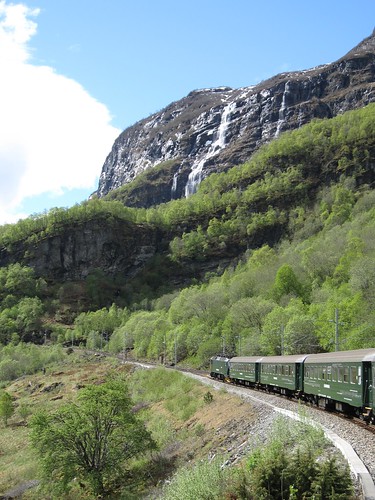
View from the train on Flåmsbana.
As briefly mentioned, at the start of this post, there are several modes of transport that can get you to Flåm. Many visitors will come by the sea, on big cruise ships, and in that case you're all set. If you're in Bergen during the summer season you could also take the Fjord1 ferries, they connect many communities on the west coast and also stops at Flåmsbrygga.

If the sea is not your thing you still have two choices - either to come by rail or by road.

There are daily trains going between Oslo and Bergen, following the Bergen Line across the mountains and stopping at the Myrland Station. There you will have to get off and take the Flåmsbana train which departs hourly in the summer season and takes you down to Flåm in less than an hour.

If you decide on driving, it's a two and a half hour or 166 km long trip along the E16 highway from Bergen. From Oslo it's between 330 and 350 km, depending on the specific route you take, the longer (E16) is actually the shortest in time - taking about four and a half hours to drive.

The best time to visit is in May-June, before the onset of tourist season and the large cruise ships, or in the early fall when the tourists have left. Then Flåm returns to a tranquil place and the brewpub becomes less crowded.

Photo sets from Ægir and Flåm can be found at Flickr: May 2010 and April 2012.

Sunday, April 1, 2012

Abbaye Notre-Dame d'Orval

For beer lovers, the small country of Belgium provides an almost infinite source of variation on what constitutes a beer - from sour, wild yeast based ales, fruit beers, spiced beer and farmhouse ales to the various abbey styles (dubbel, tripel, quadrupel). And, not to forget, the famous Trappist beers, still being brewed by monks of the Order of Cistercians of the Strict Observance - better known as Trappists.

The Authentic Trappist Product logo.

Trappist beer

Trappist beer is not really a beer style, even though you will often find them listed under the same heading at beer pubs around the world. A Trappist beer can be blond or dark, it can be sweet or dry, it can be strong or it can be low in alcohol. The only thing that unites the Trappist beers is how they are made: They have to be brewed at a Trappist monastery and by the monks (though there is some leeway, the monks can hire secular workers to handle some of the brewing operations).

In 1997, eight Trappist monasteries founded the International Trappist Association to prevent non-Trappist companies from abusing the Trappist name. Their Authentic Trappist Product logo can only be carried by products that have been made at genuine Trappist monasteries - be it cheese, jam or beer.

Today there are seven Trappist monasteries brewing beer, one located in the Netherlands - the Onze Lieve Vrouw van Koningshoeven known for their La Trappe series - and six in Belgium: Abbaye Notre-Dame de Scourmont (Chimay), Sint-Benedictusabdij de Achelse Kluis (Achel), Abdij Sint-Sixtus (Westvleteren), Abdij van Onze-Lieve-Vrouw van het Heilig Hart (Westmalle), Abbey of Notre-Dame de Saint-Rémy (Rochefort) and Abbaye Notre-Dame d'Orval (Orval). I've noted the name of their beers in parentheses. There is also a Trappist monastery in France, L'abbaye du Mont des Cats, but their Biere Trappiste is brewed by the Trappist monks in Scourmont and so does not qualiify as an authentic Trappist beer.

This post is about one of the six Belgian Trappist breweries: Abbaye Notre-Dame d'Orval.

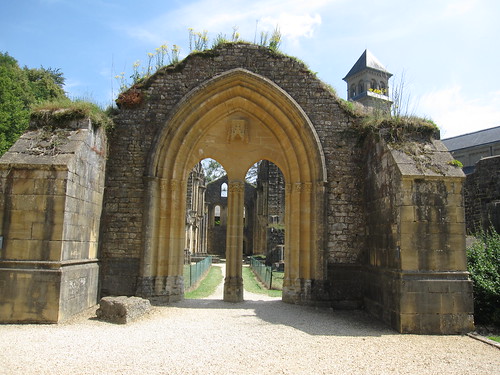
Ruins of the old Orval Abbey, destroyed in 1793.

Abbaye Notre-Dame d'Orval

Abbaye Notre-Dame d'Orval or Orval Abbey was founded in 1132 by a group of Cistercian monks from the Trois-Fontaines Abbey in Champagne, who settled in the remote Gaume region in the far south east of Belgium, just a kilometer north of France, in what is now known as the Belgian province of Luxembourg.

Trout with a golden ring.
Orval means "golden valley" and a popular myth says it originated with Countess Mathilde of Tuscany (1046-1115). One day, while she was out hunting in the woods of the Count de Chiny, she stopped in a valley to drink from a fountain there. By accident her wedding ring fell into the water. She went to a nearby chapel and began to pray. A trout then appeared on the surface of the water, carrying in its mouth the precious ring. Mathilde cried out: "This is truly a golden valley!"

Despite wars and fires the abbey functioned for more then six hundred years, until 1793 when the French Revolution arrived at their gate. In revenge for having sheltered Austrian troops, the French revolutionary troops burned down the abbey and dispersed the monks. Just like they soon would do with the monasteries in Bavaria.

For a hundred years all that remained were the ruins, but in 1887 the land and ruins were acquired by the Harenne family. In 1926, they made a donation of it to the Cistercian order, allowing them to return and rebuild the Orval Abbey. Between 1926 and 1948, the new monastery was constructed, and in 1935 Orval regained the rank of abbey.

Orval Trappist Beer

In 1931, the monastery hired the German brewmaster Martin Pappenheimer (1883-1942) to create a recipe for a beer they could brew. Together with the two Belgian brewers, Honoré Van Zande and John Vanhuele, who were employed to brew at the monastery, he came up with a unique recipe.

Orval Trappist Beer.
Inspired by English brewing, Orval is a top fermented beer that is dry-hopped for 2-3 weeks (large "tea" bags full of hop cones get soaked in the beer as it slowly goes through secondary fermentation). Commonly done in English brewing, dry-hopping was and, to some extent, still is a novelty in Belgium. Finally, to give the beer a real Belgian twist, a local wild yeast of the Brettanomyces strain gets added to the beer, giving it that funky, tart expression as it ages in the bottle.

To this day, Orval only brews this one beer of 6.2% ABV, though they also make a weaker 3.5% ABV version, called Petite Orval, for use by the monks at the monastery.

Orval beer is sold in a specially designed bottle and served in a specially designed Orval glass. And if you look closely at the logo on a bottle you will notice the jumping trout with the golden ring in its mouth, mentioned above in the Countess Mathilde myth. Supposedly, the well that fed the fountain where Mathilde lost her ring is the same well that is used as water supply when brewing the Orval.

A l'Ange Gardien

In July 2011, the monastery opened up a restaurant and tasting room, called A l'Ange Gardien, just outside the walls of the abbey. A l'Ange Gardien, which is French for "guardian angel", serves beer and cheese made at Orval Abbey, allowing visitors to enjoy the Trappist treats almost onsite.

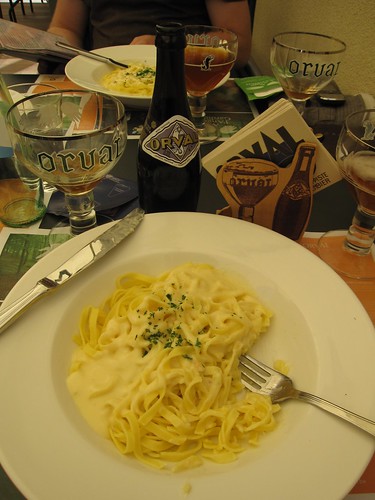
Tagliatelles à la crème d'Orval

The restaurant has a good food menu too, usually with ingredients from the abbey - such as the delicious tagliatelle dish I had which came with melted Orval cheese on top. It went really well with the beer.


I highly recommend a visit to the beautiful and tranquil Orval, the only downside is that you really need a car to get there - it is too remote for public transport to have discovered the place. Which is part of the charm anyway :)

Photos from the visit to Orval can by found at Flickr.


Wednesday, March 28, 2012

Visit to BrewDog Aberdeen

Aberdeen, Scotland, is probably best known as the oil capital of Britain and a former fishing harbor on the North Sea coast. More recently it has also gained a reputation for beer, more specifically as the home base for the infamous punk brewery BrewDog.

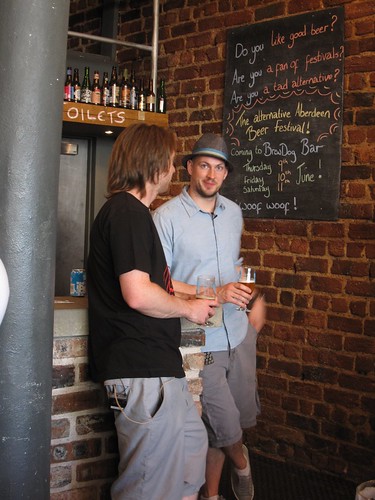
Martin Dickie and James Watt.
BrewDog Aberdeen, May 2011.

Starting up a punk brewery

Back when he was still captain on a fishing boat, James Watt would dream of hoppy and full bodied beers. Like his friend, Martin Dickie, he was tired of the "insipid, mass produced chemical products churned out by big companies". In the end they got so fed up with what they could buy locally that they bought a brewing kit and started brewing American inspired pale ales in James' garage. They slowly honed their brewing skills.

In 2006 Martin and James went to London to seek out the opinion of Michael "The Beer Hunter" Jackson, one of the most influential persons in the beer world at the time. He tasted their IPA, looked searchingly at them and uttered the profound words "It's time to quit your day jobs". The two duly did, spending the rest of the year securing loans to build a brewery in their hometown Fraserburgh in the far north of Aberdeenshire.

In April 2007, named BrewDog after after James’s dog Bracken, the brewery was ready for operation. But, as they've admitted since, that's when the real problems began.

Punk's not dead or how to survive in brewing

Trying to make a break in the UK beer market turned out to be easier said than done for Martin and James, their BrewDog beers were all made after the American craft beer mold - hoppy, flavorful and high in ABV. The average British beer drinker is not known for his willingness to try new flavors and even less for trying a beer much above 3.5% ABV. Thus, BrewDog immediately faced an uphill struggle in getting their beers sold.

Another problem was that many pubs Martin and James contacted were already tied to large breweries and those that weren't didn't think BrewDog beers would sell enough to warrant a spot in their bar, partly because of the 30% higher price.

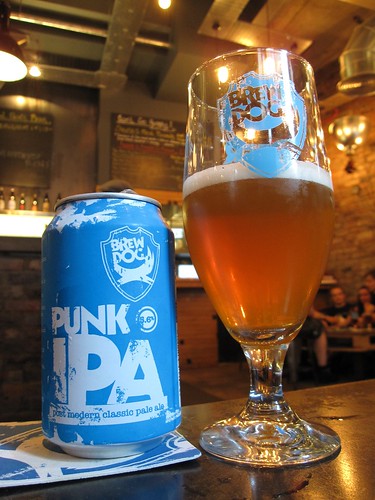
Punk IPA - the original BrewDog success.
Sales were slow and after eight months the firm was only selling around ten cases a month, which didn’t cover the costs of making the beer. They started to fall behind on the loan and things did not look good, until they got a surprising call.

Shortly after starting BrewDog, they had entered Punk IPA in a tasting competition for Tesco - the British multinational grocery retailer. Six months later it turned out they had won, and Tesco called them asking about selling BrewDog beers in 400 stores across Britain!

Brewdog made the Tesco order and soon got another big order from Systembolaget in Sweden who started selling Punk IPA in the spring of 2008 (which was how I got my first taste of it). By the end of 2008, they had sold beer for £800,000.

Today, Punk IPA remains their flagship beer, sold on bottle, can and keg all over Europe. And it has been followed by dozens of other beers in all styles and manners, from the darkest imperial stouts to the hoppiest india pale ales. BrewDog has also launched the experimental Abstrakt series where new and often strange recipes are tried out, sometimes very successful other times just plain weird. But what has caused most media attention have been their strong beers.

The new media kings

BrewDog have never played by the books and have a love / hate relationship with the media, which can be traced back to the July 2009 release of their "intergalactic fantastic oak aged beer" Tokyo* of 18.2% ABV.

BrewDog Tokyo* - hardly a teens drink.

British journalists were outraged, calling BrewDog irresponsible and asking what was the point of such a high ABV? They claimed teenagers would drink this beer just to get clobbered every weekend. Little did the journalists reflect over the price of a BrewDog Tokyo*, which would deter most teenagers from considering this a good way to get drunk. Secondly, the massive flavors of this beer would have been more than a mouthfeel for British teens used to drinking pale, tasteless bitters or lagers. But, no, the media would not listen to that kind of arguments.

BrewDog never let the media reactions stop them. Instead they hit back, creating a ridiculously hoppy beer of just 1% ABV - Nanny State - which packed more punch than all Bitters in Britain combined, but with hardly any alcohol. Today, an even lower alcohol version of Nanny State is sold as a non-alcoholic beer at many pubs across Europe.

The story doesn't end here though, oh no, BrewDog was just warming up to their own personal media war that would see them go head to head with a German brewery and finally animal activists around the world.

Tactical Nuclear Penguin - the arms race

After all the media attention, BrewDog was contacted by Kleinbrauerei Schorschbräu, a small brewery from Gunzenhausen in Bavaria, specializing in high ABV beers known as eisbocks. Eisbocks are made by freeze distilling bock beers, removing the frozen water from the chilled beer causes them to get a more intense flavor and a higher alcohol.

BrewDog was not interested in paying for German secrets, instead they read up on freeze distilling and went for the throat, launching the strongest beer in the world, Tactical Nuclear Penguin - a 32% ABV freeze distilled imperial stout, in November 2009.

BrewDog Tactical Nuclear Penguin - 32% abv.
The Germans responded with a stronger eisbock of their own. This again prompted another attack from BrewDog, this time a freeze-distilled imperial IPA - the 41% ABV Sink The Bismark, accompanied by a hillarious video showing Martin and James dressed up as Hans and Wolfgang, two Germans trying to sabotage BrewDog.

This part of the story ends in July 2010 with The End of History, a crazy freeze-distilled beer of 55% ABV and only made in a small quanity of 11 bottles! Each bottle was enclosed in a piece of road kill and sold for £500-700 at their webshop. Despite having been killed on the roads, animal activists fumed by the lack of respect BrewDog showed for the carcasses while beer writers fumed over the high abv, claiming that what BrewDog had made had nothing to do with beer.

Despite the negative press, guess who was laughing all the way to the bank? Yes, Martin and James! From being a small, obscure brewery on the outskirts of Europe, they had made BrewDog a household name even outside beer geek circles. Orders poured in from all over the world, even a few daredevil pubs in Britain started ordering a keg or two. Today, their beers are sold in 28 countries around the globe.

Punk is certainly not dead!

The BrewDog bars

Because of the lack of response from British pubs and beer drinkers, Martin and James conceived the plan that they should do like former English breweries - start their own chain of pubs, partly to be able to sell their own beer from draft but just as importantly to educate the beer drinkers in the new ways of craft beer.

BrewDog Aberdeen - the first BrewDog pub.

Thus, in October 2010 the very first BrewDog bar opened up at 17 Gallowgate in their home city, Aberdeen, followed half a year later by BrewDog Edinburgh. As of this moment they have five bars, all in the UK:
  1. BrewDog Aberdeen (opened: 19 October 2010)
  2. BrewDog Edinburgh (opened: 24 March 2011)
  3. BrewDog Glasgow (opened: 23 July 2011)
  4. BrewDog Camden (opened: 10 December 2011)
  5. BrewDog Nottingham (opened: 25 February 2012)
In addition, they expect to open up bars in Newcastle (contract signed), Leeds and Manchester later this year and there's even talk of finding a city in Scandinavia - most likely in Stockholm or Copenhagen - for the first BrewDog bar outside the UK.

The bar at BrewDog Aberdeen.
The BrewDog bars have a common design, so whether you visit BrewDog Camden or BrewDog Glasgow you should get the same feel and roughly the same types of beer.

The bar in Aberdeen is stacked with board games, chess and other forms of games that people can play at their tables, while enjoying good craft beer and a tasty pizzy or a cheese & sausage platter from the kitchen. The staff behind the bar seemed very knowledgeable about craft beer in general and the BrewDog beers in particular, so whether you come as a rookie or a seasoned beer veteran there's always helpful advices on what to try.

During my visit in May 2011, BrewDog Aberdeen had 7 BrewDog beers on tap, including Tokyo*, Alice Porter and Hardcore IPA, and four guest beers, from Stone Brewing Co and Evil Twin. All was properly poured and tasted fresh and good. There is also a good bottle selection to choose from once you've exhausted the draft beer menu, so you can easily spend several days here and just try new beers.

Like most bars in the UK (and elsewhere), BrewDog Aberdeen can get fairly packed at night, especially on Fridays and Saturdays, but it's a really great place for a beer or five in the early afternoon, since they open at noon on weekdays.

Photo sets from the BrewDog pubs can be found at Flickr: Aberdeen (and Edinburgh).

Friday, March 23, 2012

Visit to Cantillon

World famous lambic brewery Cantillon in Brussels, Belgium, is also famous for being a keeper of traditions. The brewery acts as a living museum, with equipment from the early 20th century still in daily use, allowing visitors to experience the history of lambic brewing and gueuze blending.

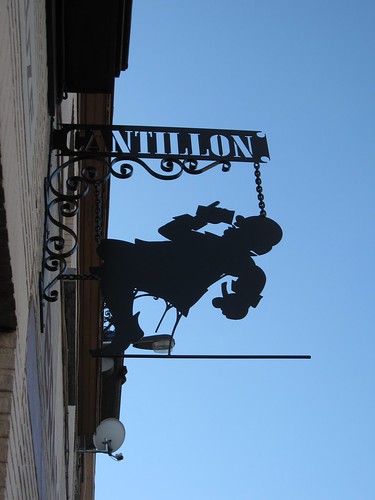
The iconic Cantillon sign outside the brewery. 

Early history - the founding

Located in Rue Gheude 56 in the Anderlecht district of southwest Brussels, just a couple of blocks from the Gare du Midi train station, Cantillon was founded at its present address in 1900 by one Paul Cantillon.

Paul was the son of a Lembeek brewer and had purchased an old warehouse, dating back to 1874, to start blending gueuze which was all the rage in Brussels in those days - most cafés would blend their own gueuze from lambics bought from lambic breweries in Pajottenland - just outside the city.

Initially, there were no plans of brewing lambic at Cantillon. It was Paul's sons, Marcel and Robert, who took this next step. They set about purchasing some second hand equipment and manufacturing a copper mash tun, and in November 1937 the first lambic wort flowed into the coolship at Cantillon - a new lambic brewery was born, and inside the city of Brussels.

In 1962, the twenty year old teacher Jean-Pierre Van Roy met a lovely young girl, Claude Cantillon, without realizing she was the daughter of Marcel Cantillon, then owner and head brewer of Cantillon. Claude and Jean-Pierre fell in love and eventually married, in 1967. The same year they received a son and a future brewer, Jean. Two years later, his father-in-law told him "either you take over or I close the brewery". Jean-Pierre duly did, learrning the art of brewing lambic from his father-in-law.

A copper brewing kettle from 1937 still in use at Cantillon.

Recent history - sticking to traditions

When Jean-Pierre took over the brewery in 1969, he decided to stick with the Cantillon name. For several decades, Jean-Pierre battled an uphill struggle to keep the lambic tradition alive in Belgium, at a time when most other lambic brewers either closed or started producing sweet, fruit beers.

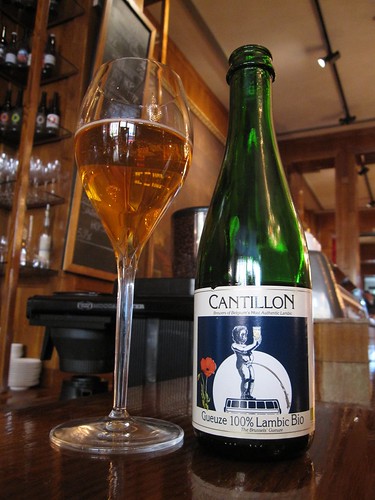
The classic Cantillon Gueuze 100% Lambic Bio.
Only in the last 10-15 years, after the US market discovered his amazing traditional gueuze, tart and sour, has he been repaid for his labor. Cantillon is now recognized, across the world, as a keeper of Belgian lambic traditions.

In September 2009, Jean-Pierre brewed his last batch of lambic, leaving the brewing and gueuze blending to the great-grandson of the brewery's founder: His own son, Jean Van Roy. Jean has learned the art of lambic brewing and gueuze blending by his father's side, over the last twenty years, even introducing some of his own ideas - such as the famed Zwanze series - before taking over as the new head brewer of Cantillon.

Jean Van Roy has shown a greater will to experiment than his father, creating a number of new sour ales and even introducing Roman-style ceramic amphoras for maturing lambic instead of the traditional oak. As of 2012, the Cantillon brewery seems to be in very good and capable hands with the fourth generation of the Cantillon-Van Roy family in charge.

Public Brewing Session

Twice a year, one Saturday in March and one Saturday in November, Cantillon hosts a Public Brewing Session, where visitors can come in and watch the entire process of brewing a traditional lambic. On November 12, 2011, I attended one such brewing session and here follows a few photos and a brief account of that experience.

Brewing a lambic is a time consuming enterprise, because of the unusually long boiling times of 3-6 hours, so the brewing day starts early. At cantillon at 7 am. So get up early if you want to witness it all. Here's a typical brewing schedule:

Hot water and ground malt going into the
mash tun at Cantillon. Notice the leakage!
07-09: Mash-in
Witness the ground malt getting mixed with hot water and poured into the mash tun to extract the fermentable wort. Pay attention to all the cranky mechanics used to close and open ancient valves, and look for sudden leaks that are handled by placing a bucket on the floor.

09-12: Transfer to brew kettle
Witness the filtration and hopping of the wort as it gets ready for transfer to the brew kettle.

12-15: Boil-in
The hopped wort is boiled in two large copper brew kettles for at least three hours, reducing the liquid from 10,000 litres to 7,500 in order to raise the gravity of the wort, break up starches and reduce the bitterness of the hops.

15:30 Coolship
After the long boiling, the wort is pumped to the coolship upstairs, just underneath the ceiling, where the wort is allowed to cool overnight and become germinated with the wild yeast - Brettanomyces bruxellensis - living in the walls of the old brewery. The next day, the cooled wort will be transferred into big oak barrels, formerly used for aging red wines in Bordeaux or Rioja, for primary fermentation, which may take a couple of months, and then aging for up to three years.

The coolship at Cantillon is located right under the ceiling.

The Cantillon Public Brewing Sessions are very popular events in Brussels so the small brewery will quickly feel swamped by people, so it's smart to be there when the brewery opens at 6:30 am and take the very first tour, before the line of people with cameras gets too long. If you do that, you can sit down at the brasserie section and enjoy some of their lambics and gueuze while watching new visitors line up for the later tours.

Cantillon is also open for visits outside the Public Brewing Sessions, both the brasserie and the brewery / museum (self-guided tours). On Mondays to Fridays they're open from 9 am to 5 pm and on Saturdays from 10 am to 5 pm.

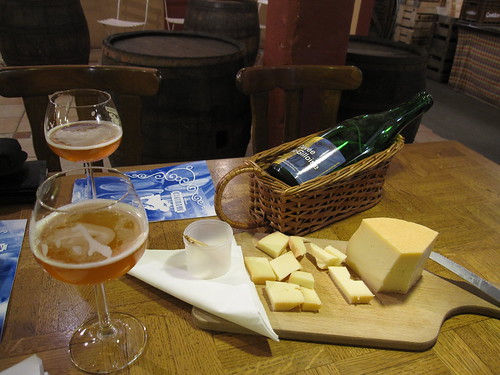
A bottle of Cuvée Saint-Gilloise and gueuze cheese at Cantillon.


Photo sets from my visits to Cantillon can be found at Flickr: May and November 2011.

Thursday, March 22, 2012

Haand 2012

As reported earlier, HaandBryggeriet will host Norway's first major craft beer festival - Haand Craft Beer Festival 2012 - with breweries from all over Europe attending. This post brings some new and updated information about this beer festival.


The first Haand Craft Beer Festival will be arranged on May 4 and 5, 2012, at the new HaandBryggeriet brewery, which opened up in Sundland, Drammen, in December 2011. The festival starts at 4 pm on Friday and at noon on Saturday, closing at 10 pm on both days.

Tickets are now available through billettservice.no for NOK 300,- plus tax, limited to only 400 tickets on Friday and 600 on Saturday. So be quick and order before they run out!

Which breweries will attend?

Sadly, De struise Brouwers and Birrificio di Montegioco will not be able to come, so the list of attending breweries now looks like this:

- Picobrouwerij Alvinne (Belgium)    
- Aass (Norway)                      
- Brouwerij De Molen (Netherlands)  
- Bierbrouwerij Emelisse (Netherlands)
- HaandBryggeriet (Norway)
- Kinn Bryggeri (Norway)            
- LoverBeer (Italy)                  
- Nynäshamn Ångbryggeri (Sweden)    
- Närke Kulturbryggeri (Sweden)      
- Nøgne Ø - Det kompromissløse bryggeri (Norway)                  
- Brasserie Artisanale de Rulles (Belgium)

How about food?

To go with all the great beer, HaandBryggeriet has arranged for some pretty impressive pub grub:

- Sausage platter, with sausages made from deer, duck and wild boar.
- Home made rye bread with Akvavit marinated salmond in a mustard sauce.
- French fries in aioli.
- Cured deer meat in wraps, with a cream cheese from Den Blinde Ku.
- Cheese platter with three types of cheese from Eiker Gård, figs and spicy crackers.
- Home made chocolate truffles.

Should be something to fit most beer styles :)

How to get to the festival?

Sundland is an area in Drammen located east of the Drammenselva river, about 1.5 km east of the railway station as the following Google Maps satellite view shows.

Google Maps satellite view of  the Sundland area in Drammen.
"A" marks Strømsø Torg , "H" building H in Sundland Industripark.

If you come by car (which you shouldn't, unless driven there) it's possible to park by the entrance to Sundland Industripark at Skogliveien 4.

If you come by train, like most sane people will do, get off at Drammen railway station and either get a taxi at Strømsø torg or walk. If walking is an option: Follow Konnerudgata from Strømsø Torg for about 900 m to 2.Strøm Terrasse where you take right and follow that road for 300 m until you reach Skogliveien on the right hand side, which is the turn off to Sundland industrial park. HaandBryggeriet is located in building H, at the back of the industrial park.

Friday, March 16, 2012

De Molen Borefts Beer Festival


The Netherlands may not have the same ring to it as Belgium, when it comes to beer and beer festivals. While Belgium has long and famous brewing traditions, with its trappist beers, sour ales, fruit beers, strong ales, saisons and wits, the Netherlands have had to rely on La Trappe as their main source of pride. Until recently. And while Belgium has a number of famous beer festivals, such as Zythos and the Weekend of Spontaneous Fermentation, those in the Netherlands have been few and far between. Until recently.

Bouwerij de Molen uses real casks for their cask beers.
However, the times they are a-changing. The last few years have seen a number of new breweries appear in the Netherlands, of which Brouwerij de Molen is the most successful example. In just six short years, Menno Olivier has taken his small craft brewery, located in an old windmill in the town of Bodegraven, to world reknown (#12 on RateBeer's Best Brewers In The World 2012). The massive success and demand for his beers forced De Molen to construct a larger brewery, which opened up in the summer of 2011.

In 2009, Menno Olivier and his De Molen helpers did a very brave thing and invited craft breweries and beer geeks to a beer festival at their own brewery, then located in the aformentioned windmill: Borefts was born!

The first Borefts festival became such a success that they decided to make it an annual autumn festival. And with each passing year, Borefts has become a little bigger and a little better known, attracting serious beer fans from all over Europe and even from America. Still small, by American standards, 2011 saw the Borefts festival expand to the new brewery - which allowed guests to walk back and forth the hundred meters between the windmill and the new brewery, to check out different beers and breweries.

Unlike many festivals I've been to, Borefts has a very relaxed, almost tranquil, atmosphere, there's hardly a queue to be seen, you get your fill of beer in seconds, and people remain relaxed and seated. There's no non-beer related show and circus, and the brewers are either found behind their own taps or, just as often, at other stands, sampling beer from fellow craft brewers.

Närke Kaggen! Stormaktsporter on draft @ Borefts 2010.
The quality of the breweries is high. Some of the very best European craft breweries show up year after year, such as Thornbridge, Marble and The Kernel from England, Mikkeller, Midtfyns and Amager Bryghus from Denmark, De Struise Brouwers and Alvinne from Belgium, Revelation Cat from Italy, Emelisse from the Netherlands, Närke from Sweden (who had their famous Kaggen! Stormaktsporter on draft at the 2010 festival) and Nøgne Ø and HaandBryggeriet from Norway. And, naturally, De Molen themselves usually have a large number of unique, barrel aged beers - usually several imperial stouts - available on both keg and cask.

2012 will be the 4th year the Borefts festival will be held. So far just a few breweries have signed up for the 2-day festival on September 28 and 29: Alvinne, Mikkeller, Evil Twin, HaandBryggeriet, Emelisse, Thornbridge and The Kernel are old-timers at Borefts, while Buxton from England and Mommeriete from the Netherlands will make their debut this year. Expect more brewery names to be published over the next six months.

I can hardly wait to go back to Bodegraven and Borefts.

The old windmill of Brouwerij de Molen.

Photos from the two previous Borefts festivals can be found at Flick: 2010 and 2011.

Tuesday, March 13, 2012

Het Anker in Mechelen

If you're visiting Antwerp, the second largest city in Belgium, and have some extra time on your hands it is worthwhile to take a quick daytrip to the city of Mechelen about 25 km to the south. Getting there is both fast and easy, as trains leave frequently from Antwerp Centraal and takes only 21 minutes to Mechelen.

There are several good reasons for going to Mechelen, aside from getting out of the most polluted city in Belgium. One is to visit an important historic center for art in Flanders, known from the Northern Renaissance when composers, painters, printmakers and illuminators were attracted to this area by rich patrons. Another could be to visit the impressive Sint-Romboutskathedraal near Grote Markt, an example of the Brabantian Gothic architectural style. Finally, and most dear to my heart, Mechelen is home to the old Het Anker, one of a handful of independent Belgian Family Brewers and world famous for its Gouden Carolus beers.
Het Anker Family Brewery in Mechelen.

Het Anker is first and foremost a brewery, its roots stretching back to the 15th century, but in the late 1990s a brasserie and an Inn, with 22 guest rooms, were added to the brewery. The brasserie allows vistors to enjoy some hearty Flemish dishes while sampling the brews from Het Anker.

There is also a small but well stocked brewery shop on the premises, selling t-shirts, glasses, chocolate made with Het Anker beer and, of course, all of their bottled beers - including the rare Cuvée Van De Keizer which is made only once a year (more about that later).

Anyhow, the history of the current family brewery goes back to 1872 when one Louis Van Breedam purchased the Beguinage brewery in Mechelen and built one of the first modern steam-operated breweries of his time. In 1904 the brewery got its current name, NV Het Anker, which means "The anchor", after the historic brewer from Mechelen, Jan in de Anker. In 1912, Louis' son Victor had a maltery constructed at the brewery, to allow them better control with the malt they used.

Het Anker survived both World Wars but the third generation Van Breedam, Charles, worried that the brewery was too small to survive in the long run. He installed a new, state of the art brewery and closed the malting facility. Charles wanted to focus on making beer, and in the early 1950's he launched Keizersbier inspired by the historic Mechelsen Bruynen - said to have been the favorite beer of emperor Charles V, who was brought up in Mechelen in the first decades of the 16th century.

Gouden Carolus Classic on draft at Het Anker.
In 1961, Keizersbier was renamed to Gouden Carolus, after the golden coins of Charles Quint (V). Thanks to a distribution agreement with the Lamot brewery, Golden Carolus became a massive success in Belgium and in many foreign beer markets. Because of this financial success, the brewery decided to quit producing lager!

Charles, the man behind the Gouden Carolus adventure, did not live to see the huge success, by then his son, Michel, was in charge of Het Anker.

Michel had inherited a brewery on the way up, and success usually spawns more success. In 1968 Het Anker acquired the authorization for brewing and selling the Abbey beers of Floreffe, a former abbey in the Namur province of Wallonia. This was a great deal for Het Anker and they kept the brewing licence until 1982 (today these beers are brewed by Brasserie Lefebvre).

However, in the late 1980s Het Anker went into a serious decline. They had lost the Floreffe income and their own beer sales were dropping, so when Charles Leclef, fifth generation Van Breedam-Leclef, took over the brewery in 1990 he was faced with some serious headaches. After a few attempts at partnerships, with Brouwerij Riva (now part of Moortgat) and John Martin (now Scottish & Newcastle), Charles gave up this idea and decided to remain independent, brewing their beers only at Het Anker.

In order to get Het Anker back on track, Charles started a thorough reconstruction of all the buildings, modernizing the production process, installing new fermentors and lagering tanks. He also expanded the Het Anker beer range: Gouden Carolus Tripel, Gouden Carolus Ambrio, Gouden Carolus Hopsinjoor, Gouden Carolus Noël and Gouden Carolus Cuvée van de Keizer. The Cuvée is a special beer only brewed once a year, on February 24th - the birthday of Charles V (born in 1500). It's a sweet and potent strong ale of 11% abv, sold in large 75 cl bottles and is great for cellaring.

In 1997, Charles opened the brasserie and a year later the Inn, completing a stunning revitalization of Het Anker and bringing the family brewery into the 21st century.

Brasserie Het Anker in Mechelen.

In 2010, Charles purchased a 17th century gin distillery in Blaasveld. After having two pot stills installed, the production of Gouden Carolus single malt whisky could start - giving Het Anker another leg to stand on. It's future now looks much brighter than just twenty years ago.

So, if you have the time, do make that trip to Mechelen and visit Het Anker - a thriving family brewery - to taste some of their delicious beers from draft while enjoying a hearty dish at the brasserie.

Photos from the visit to Het Anker can be found at Flickr.